
What Healthcare Auditors Expect in 2026 (And Why Most Clinics Aren’t Ready)
Introduction: The Audit Landscape Is Changing — Fast
Healthcare audits in 2026 will not look the same as they did five years ago.
Regulatory bodies are shifting their focus from surface-level compliance to operational proof, leadership accountability, and measurable implementation. Documentation alone is no longer enough. Auditors want evidence of integration, sustainability, and executive oversight.
For many clinics, this shift represents a serious risk.
At Extensive Medical Consultant, LLC (EMC), Dr. Scarlett Lusk, PhD, MPH, RHIA, CCHP, with 27 years of U.S. Public Health Service leadership, has observed a clear pattern: most clinics are not failing because they lack policies. They are failing because their systems do not consistently support implementation.
Understanding what healthcare auditors expect in 2026 is the first step toward achieving true audit readiness.
The 2026 Audit Reality: What Has Changed
Healthcare accreditation bodies, including the Joint Commission, NCCHC, ACA, AAAHC, and ODO, are intensifying scrutiny in four major areas:
1. Demonstrated Implementation, Not Just Written Policies
Auditors now expect:
- Real-time workflow consistency
- Staff interviews confirming procedural understanding
- Cross-department alignment
- Evidence of ongoing training
A binder of policies will not pass an audit if frontline staff cannot articulate or demonstrate execution.
In 2026, auditors are evaluating culture, not just paperwork.
2. Data Integrity and Measurable Outcomes
Data transparency is no longer optional.
Auditors are reviewing:
- Quality improvement metrics
- Incident tracking trends
- Infection prevention data
- Medication management patterns
- Claims and billing compliance indicators
Organizations must show not only that they collect data, but that leadership actively reviews and responds to it.
3. Leadership Accountability
One of the most significant changes in audit expectations is the emphasis on executive involvement.
Surveyors increasingly ask:
- How does leadership monitor compliance?
- Who is accountable for corrective action?
- How are risks escalated and resolved?
- What governance structures ensure oversight?
If leadership cannot clearly explain monitoring mechanisms, it signals structural weakness.
Dr. Scarlett Lusk emphasizes that proactive healthcare management begins at the executive level. Without structured oversight, compliance becomes reactive rather than strategic.
4. System Sustainability
Temporary compliance fixes are easily detected.
Auditors in 2026 are looking for:
- Ongoing performance improvement cycles
- Documented corrective action follow-ups
- Standardized workflows
- Audit trails showing consistency over time
Short-term “audit preparation” is no longer effective. Sustainable systems are now the standard.
The Critical Gap: Documentation vs. Implementation
One of the most common vulnerabilities EMC identifies during a clinic system review is the documentation-implementation gap.
Many clinics have:
- Well-written policies
- Completed annual training records
- Structured procedure manuals
Yet operational inconsistencies remain.
This gap often reveals:
- Unclear delegation of responsibility
- Poor workflow design
- Communication breakdown between departments
- Insufficient monitoring systems
Auditors recognize this disconnect immediately.
Dr. Lusk’s background in healthcare systems research (PhD), public health oversight (MPH), health information administration (RHIA), and correctional healthcare compliance (CCHP) allows her to diagnose root causes beyond surface-level documentation.
True audit readiness requires operational alignment, not just paperwork completion.
Why Most Clinics Aren’t Ready for 2026
Despite growing regulatory expectations, many clinics remain vulnerable due to:
- Reactive compliance culture
- Leadership bandwidth constraints
- Fragmented reporting systems
- Inconsistent quality improvement processes
- Lack of structured accountability
Operational stability in healthcare cannot be achieved through last-minute audit preparation.
Audit readiness must be engineered into the system.
EMC’s Audit-Readiness Approach
At Extensive Medical Consultant, LLC, audit readiness is not a checklist exercise. It is a structural redesign process.
Under Dr. Scarlett Lusk’s leadership, EMC applies a comprehensive, systems-based framework that includes:
1. Full Operational System Review
- Workflow mapping
- Role clarity evaluation
- Communication pathway analysis
2. Compliance Risk Assessment
- Gap analysis against current standards
- Documentation review
- Policy-implementation alignment
3. Leadership Accountability Framework
- Oversight structure design
- Executive reporting models
- Performance review protocols
4. Data-Driven Quality Monitoring
- KPI alignment
- Incident trend evaluation
- Continuous improvement structure
EMC’s approach transforms clinics from reactive audit anxiety to proactive compliance confidence.
Audit preparation becomes continuous rather than cyclical.
The Future of Audit Readiness: Proactive, Data-Driven, Leadership-Led
In 2026, healthcare auditors expect:
- Cultural compliance integration
- Measurable operational stability
- Executive accountability
- Sustainable system performance
Organizations that treat compliance as a leadership strategy, not an administrative burden, will outperform those relying on reactive correction.
Dr. Scarlett Lusk and Extensive Medical Consultant, LLC, specialize in helping clinics move from vulnerability to structural strength.
Audit readiness is no longer about passing inspections.
It is about building resilient healthcare systems.
Conclusion: Are You Ready for 2026?
The regulatory landscape is evolving.
If your clinic relies on documentation without operational integration…
If audit preparation feels stressful and last-minute…
If leadership oversight lacks structure…
It may be time for a strategic system review.
Contact Dr. Scarlett Lusk and Extensive Medical Consultant, LLC, to schedule a comprehensive audit-readiness assessment and ensure your organization is prepared, not pressured, in 2026.

The 2026 NCCHC Mental Health Standards are now in effect. Discover what changed, what your facility must implement, and how EMC supports correctional healthcare leaders through the transition.

Discover the hidden operational gaps — "silent zones" — that drive compliance failures in ambulatory and correctional healthcare. Expert insight from Dr. Scarlett Lusk, EMC.

Poor clinical documentation creates legal vulnerability even when care was correct. Learn how EMC builds systemic documentation frameworks that protect your organization.
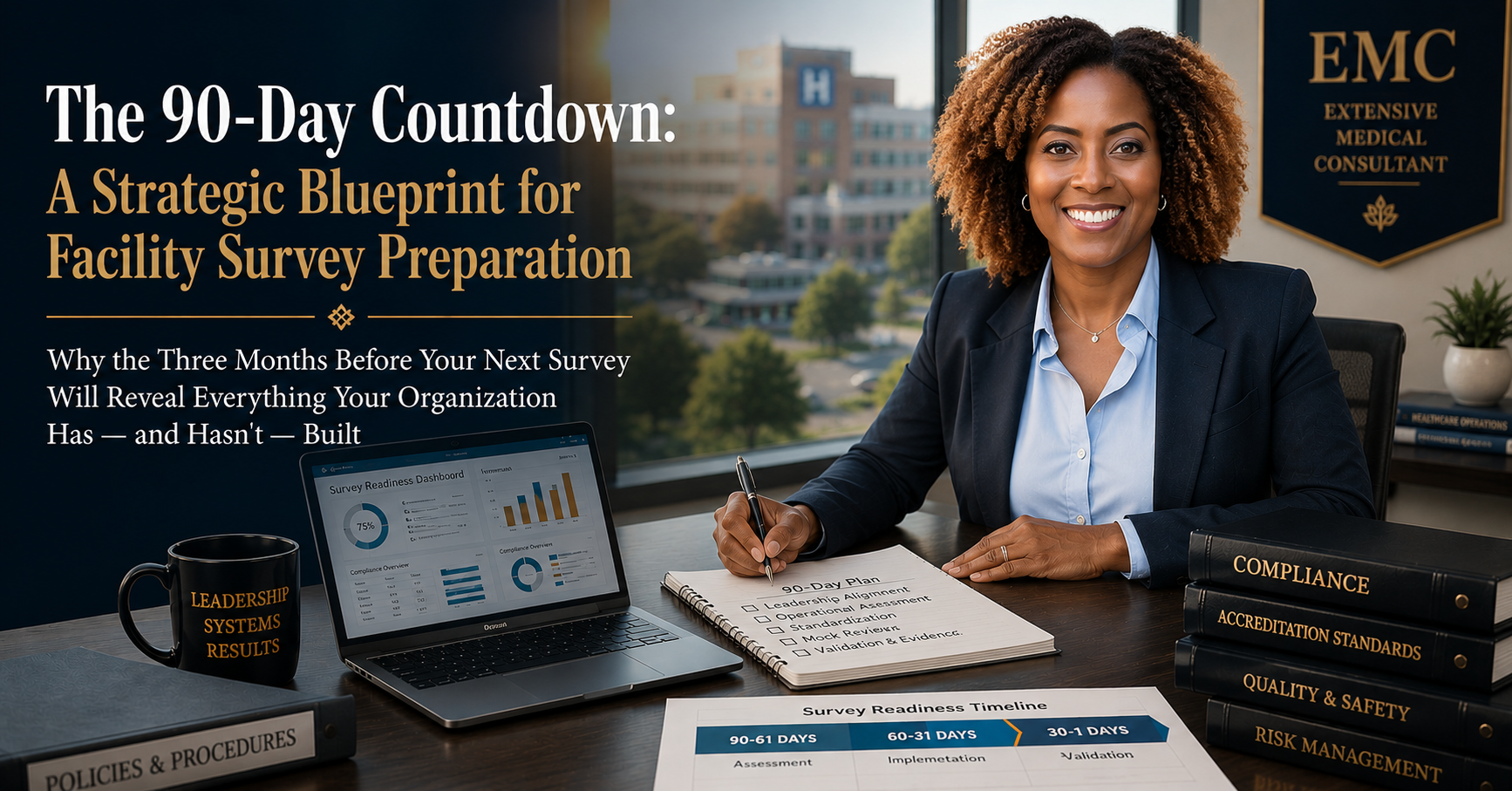
A 90-day executive blueprint for accreditation survey readiness. Learn how healthcare leaders build sustainable systems, not last-minute checklists.

Dr. Scarlett Lusk shares 6 leadership lessons from 27 years in the U.S. Public Health Service — and how military-grade discipline transforms civilian healthcare operations.
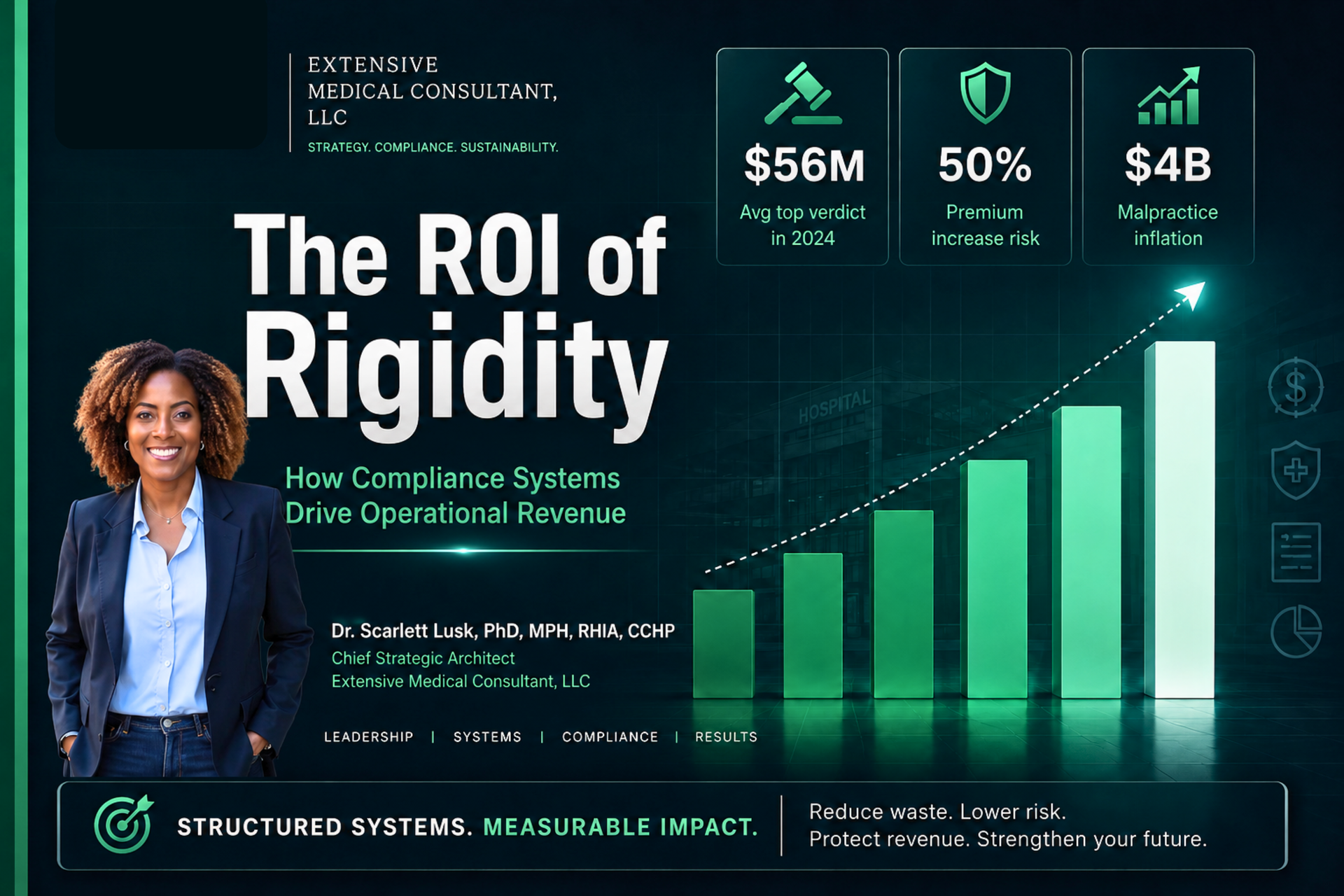
Learn how structured healthcare compliance systems reduce waste, lower litigation risk, and compress insurance premiums — generating measurable financial returns for CFOs and CEOs. Expert insight from Dr. Scarlett Lusk, Extensive Medical Consultant, LLC.

Discover how healthcare organizations can move beyond reactive accreditation preparation and build sustainable compliance systems for NCCHC, ACA, and AAAHC readiness with EMC and Dr. Scarlett Lusk.
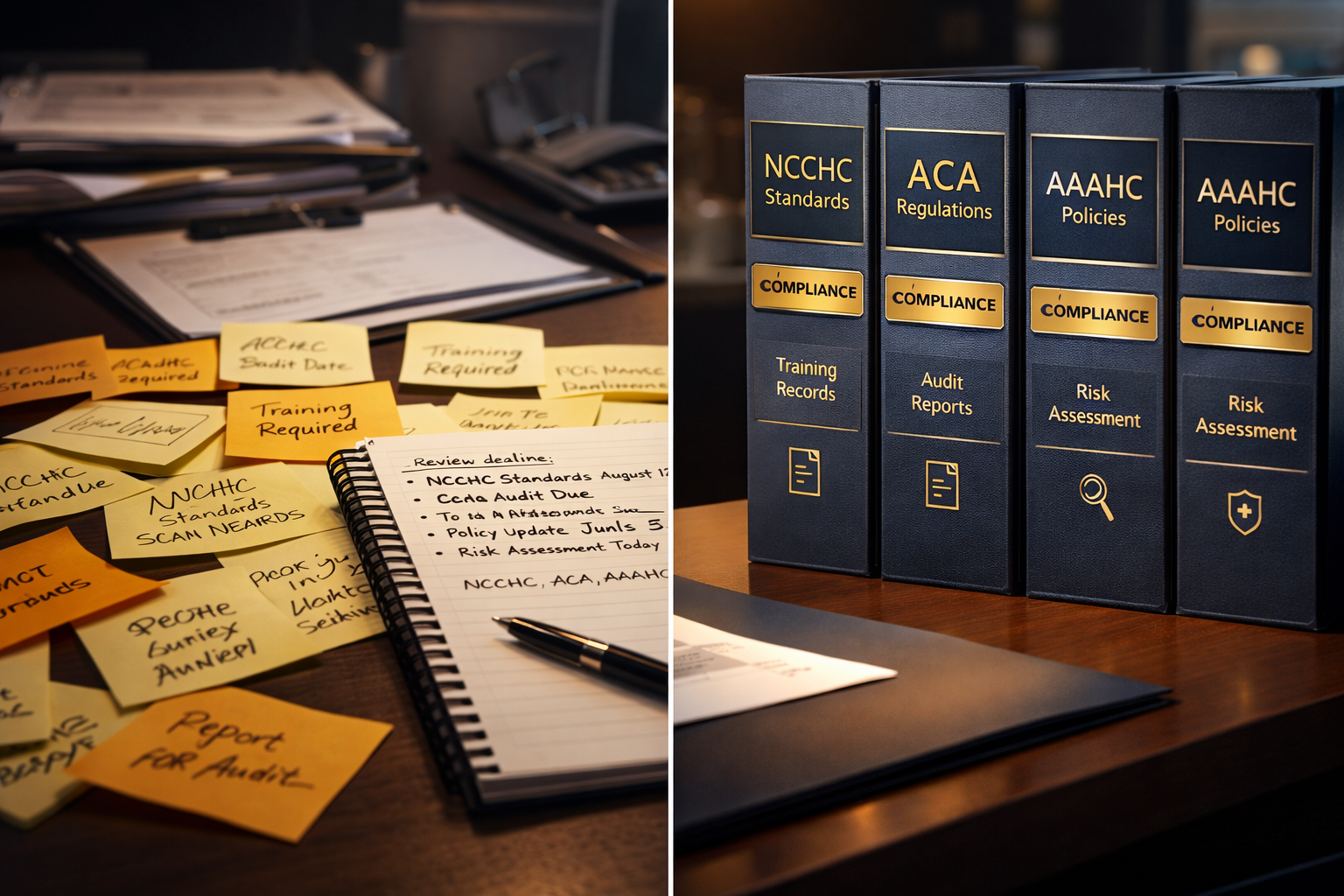
Tribal knowledge in healthcare is your most dangerous compliance vulnerability. Discover how person-dependent systems create accreditation risk and how EMC builds the documentation frameworks that eliminate it.

Healthcare leadership burnout is a systems problem, not a personal one. Discover how EMC helps healthcare executives reduce operational pressure through compliance systems, workflow optimization, and leadership frameworks.

Failing accreditation costs more than a citation. Discover the true financial, reputational, and operational consequences — and how EMC helps you prevent them.
The 2026 NCCHC Mental Health Standards are now in effect. Discover what changed, what your facility must implement, and how EMC supports correctional healthcare leaders through the transition.
Discover the hidden operational gaps — "silent zones" — that drive compliance failures in ambulatory and correctional healthcare. Expert insight from Dr. Scarlett Lusk, EMC.
Poor clinical documentation creates legal vulnerability even when care was correct. Learn how EMC builds systemic documentation frameworks that protect your organization.
A 90-day executive blueprint for accreditation survey readiness. Learn how healthcare leaders build sustainable systems, not last-minute checklists.
Dr. Scarlett Lusk shares 6 leadership lessons from 27 years in the U.S. Public Health Service — and how military-grade discipline transforms civilian healthcare operations.
Learn how structured healthcare compliance systems reduce waste, lower litigation risk, and compress insurance premiums — generating measurable financial returns for CFOs and CEOs. Expert insight from Dr. Scarlett Lusk, Extensive Medical Consultant, LLC.
Discover how healthcare organizations can move beyond reactive accreditation preparation and build sustainable compliance systems for NCCHC, ACA, and AAAHC readiness with EMC and Dr. Scarlett Lusk.
Tribal knowledge in healthcare is your most dangerous compliance vulnerability. Discover how person-dependent systems create accreditation risk and how EMC builds the documentation frameworks that eliminate it.
Healthcare leadership burnout is a systems problem, not a personal one. Discover how EMC helps healthcare executives reduce operational pressure through compliance systems, workflow optimization, and leadership frameworks.
Failing accreditation costs more than a citation. Discover the true financial, reputational, and operational consequences — and how EMC helps you prevent them.
