What the 2026 NCCHC Mental Health Standards Mean for Correctional Healthcare Leaders

The clock started on April 1. Is Your Facility Ready?


The National Commission on Correctional Health Care quietly released one of its most significant regulatory updates in a decade. The 2026 Standards for Mental Health Services in Correctional Facilities, published in September 2025 and effective for accreditation beginning April 1, 2026, represent a fundamental shift in what correctional mental health programs are expected to deliver, document, and demonstrate.


This is not an incremental update. Compared to the 2015 edition it replaces, the 2026 Mental Health Standards introduce structural changes in clinical accountability, interdisciplinary collaboration, workforce preparedness, restrictive housing oversight, and documentation requirements that reach across every layer of a correctional mental health program. For facilities still operating under 2015 frameworks or under informal adaptations of standards that were already a decade old, the gap between current practice and 2026 expectations is likely larger than leadership realizes.


Dr. Scarlett Lusk, founder of Extensive Medical Consultant and a former commissioned officer with twenty-seven years in the U.S. Public Health Service, including direct operational leadership in correctional healthcare environments, has been watching this transition closely. Her assessment is direct: the facilities that will struggle most are not the ones that ignored the update; they are the ones that read it but have not yet examined what it demands at the operational level.


This article is that examination.


Why This Update Is Different From Previous Revisions


The 2015 NCCHC Mental Health Standards were a solid framework for their time. But the decade between 2015 and 2026 changed the operational landscape of correctional mental health in ways that the older edition was not designed to address: rising rates of serious mental illness in incarcerated populations, increased scrutiny of suicide prevention and crisis response, growing litigation around restrictive housing and mental health monitoring, and a broader professional consensus around person-centered, recovery-oriented care.


The 2026 edition responds to all of these simultaneously. According to NCCHC itself, the revision reflects "a fundamental change toward equity, clinical accountability, and modern best practices in correctional mental health." Amy Panagopoulos, NCCHC's Vice President of Accreditation, described it as mental health care in correctional facilities entering "a new era."


That language is not marketing language. It is an accurate description of the scope of what changed and what facilities are now expected to implement.


What the 2026 Standards Actually Changed: The Operational Reality


1. Structural Realignment With the 2026 Jail and Prison Health Standards


The most foundational organizational change in the 2026 Mental Health Standards is the realignment of the entire manual structure to parallel the 2026 Jail and Prison Health Standards. This means the format, section organization, and standard numbering now correspond directly to the broader health services framework, a change that sounds administrative but carries genuine operational consequences.


For facilities that manage both general health and mental health under NCCHC accreditation, this realignment creates an opportunity for integrated governance and policy architecture. For facilities whose mental health and general health programs have historically been siloed with separate leadership, separate documentation systems, and separate accreditation preparation processes, the structural alignment now creates an expectation of coordination that was previously implicit and is now explicit.


What this demands operationally: Leadership review of how mental health and general health governance structures interact, communicate, and share accountability. Organizations with fragmented clinical-operational structures will need to examine whether their current design can meet the collaborative expectations embedded in the new framework.


2. Language Reform and What It Signals Beyond Terminology


The 2026 Standards eliminate language the field has long recognized as stigmatizing. The phrase "inmate with mental illness" is replaced throughout with person-first alternatives such as "individual receiving mental health care." This is not purely cosmetic. Language embedded in policies, documentation templates, staff training materials, and intake forms shapes clinical culture, and culture shapes practice.


What this demands operationally: A comprehensive review of all policy language, documentation templates, training materials, orientation content, and assessment tools to identify and update terminology. This is an audit function, not a word-processing task. The facilities that treat this as a find-and-replace exercise will pass a documentation review and fail a staff interview.


3. Mandatory Mental Health Orientation and Ongoing Workforce Education (C-09)


The 2026 Standards introduce C-09, a new standard requiring mandatory mental health orientation for staff and ongoing education specifically designed to prepare them for the unique stresses and challenges of correctional mental health environments. This is distinct from general correctional health training; it is a targeted workforce preparedness requirement focused on mental health competency.


What this demands operationally: A structured, documented orientation curriculum for mental health staff, a continuing education calendar that meets the standard's ongoing education expectations, and evidence, not just attendance records, that staff understand the operational and clinical environment they are working in. Surveyors under the 2026 framework will ask staff about their orientation experience and ongoing education. A stack of sign-in sheets will not satisfy this standard.


4. Restrictive Housing Mental Health Oversight (G-02)


Standard G-02, Restrictive Housing, introduces stringent new requirements for mental health rounds in restrictive housing units. This is one of the most operationally intensive changes in the entire 2026 edition and one of the highest areas of legal and accreditation risk for facilities currently managing restrictive housing under informal or inconsistently applied mental health monitoring protocols.


The requirements for mental health rounds in restrictive housing are not simply about frequency. They address the quality, documentation, independence, and clinical integrity of the monitoring process. For facilities where mental health rounds in restrictive housing have historically been brief, inadequately documented, or conflated with custody security checks, the 2026 G-02 requirements will require substantive operational change, not just policy revision.


What this demands operationally: Review of current restrictive housing mental health monitoring protocols against 2026 G-02 requirements, examination of documentation practices for mental health rounds, and an honest assessment of whether clinical staff conducting rounds have the operational independence and time to meet the standard's expectations under current staffing and scheduling models.


5. Interdisciplinary Treatment Teams for Serious Mental Illness


The 2026 Standards introduce explicit guidance establishing interdisciplinary treatment teams for patients with serious mental illness. This formalizes what best practice has long recommended, but what many correctional facilities have implemented inconsistently, if at all. An interdisciplinary treatment team in a correctional environment requires coordination across mental health, medical, custody, and often case management functions. Each of these functions operates under a different command structure, different priorities, and different documentation systems.


What this demands operationally: Defined team composition, documented meeting frequency, clear decision-making accountability, and evidence of collaborative case management planning across disciplines. For facilities where "interdisciplinary" has meant occasional case consultations between clinical staff, the 2026 standard's formalized expectation will require significant structural change.


6. Collaborative Case Management Planning


The 2026 edition places new and specific emphasis on collaborative case management planning between custody, medical, and mental health staff. This recognizes what experienced correctional healthcare leaders already know: that the friction between clinical and security operations is not just a management challenge; it is a patient safety risk and a compliance liability.


Collaborative case management under the 2026 Standards is not a recommendation. It is a documented requirement. Evidence of that collaboration, shared planning, documented communication across departments, and measurable outcomes against case management goals will be expected during accreditation review.


What this demands operationally: Protocols governing how custody and clinical staff communicate about patients with serious mental illness, documentation structures that capture that communication, and accountability mechanisms that ensure collaboration happens consistently across shifts, not just when a supervisor is present.


7. New Survey Documentation Requirements


Across the full 2026 update, both the health services standards and the mental health standards, NCCHC has introduced a new section called "Supporting Survey Documentation" within each standard. Each standard now includes a detailed list of recommended documentation that facilities should have available for accreditation survey review.


This is a structural change in how NCCHC evaluates evidence. The 2026 edition makes the documentary expectations explicit in a way the 2015 edition did not, meaning facilities can no longer rely on generally "having things in order." Surveyors will arrive with a specific documentary framework against which they will evaluate each standard.


What this demands operationally: A comprehensive audit of existing documentation systems against the new Supporting Survey Documentation requirements, identification of gaps in current evidence collection, and an organized, accessible documentation architecture that can produce the required evidence on demand, not assembled during the week before a survey.


The Risk for Facilities Still Operating Under 2015 Frameworks


The transition from the 2015 to the 2026 Mental Health Standards is not a light administrative update. It is a 228-slide change overview that NCCHC itself has published to help facilities navigate the transition. The size of that transition document tells its own story.


Facilities that have not yet conducted a structured gap analysis against the 2026 standards are carrying compliance risk that they may not be able to quantify. That risk is not theoretical. The 2026 standards are now the accreditation and reaccreditation reference for all NCCHC Mental Health accreditation surveys, which means any facility whose next survey window opens after April 1, 2026, will be evaluated against the 2026 framework.


The specific risk categories for unprepared facilities include:


  • Accreditation findings in standards where the 2026 edition introduced requirements that the facility has not yet implemented, G-02 (restrictive housing) and C-09 (workforce education)
  • Documentation deficiencies against the new Supporting Survey Documentation expectations, where evidence that would have satisfied the 2015 framework no longer meets the 2026 standard
  • Interdisciplinary coordination failures that become visible during surveyor interviews when staff from different departments describe case management, restrictive housing monitoring, and crisis response protocols inconsistently
  • Legal exposure in facilities where restrictive housing mental health oversight does not meet the heightened 2026 G-02 requirements, given the existing litigation landscape around solitary confinement and mental health monitoring


The EMC Approach: Implementation, Not Just Interpretation


Understanding what the 2026 NCCHC Mental Health Standards say is the first step. Understanding what they demand at the operational level inside a correctional environment, across disciplines, under staffing and scheduling constraints, and with the clinical-security friction that every correctional health leader navigates daily is a fundamentally different exercise.


Dr. Scarlett Lusk and the Extensive Medical Consultant team approach the 2026 standards transition not as policy interpretation but as operational implementation architecture. Having led correctional healthcare operations under federal oversight in environments where the gap between documented standards and operational practice is scrutinized continuously, not just at survey time, the EMC team brings a perspective that policy summaries cannot replicate.

An EMC engagement for facilities navigating the 2026 Mental Health Standards transition includes:


A structured gap analysis mapping current facility practice against 2026 requirements across each of the key operational domains: interdisciplinary coordination, restrictive housing monitoring, workforce education, documentation architecture, and collaborative case management.


Operational redesign support for the processes and protocols that require substantive change rather than policy revision alone, specifically the areas where the 2026 standards demand behavioral change across staff and disciplines, not simply updated language in a binder.


Documentation architecture review against the new Supporting Survey Documentation requirements, ensuring that evidence is being collected, organized, and maintained in a format that will satisfy 2026 surveyor expectations, not the 2015 framework most facilities have spent years building toward.


Leadership and staff education built around the 2026 requirements and the operational context of correctional environments is designed so that clinical staff can answer surveyor questions about why they do what they do, not simply that they do it.


The Window Is Open, But It Will Not Stay Open


The 2026 NCCHC Mental Health Standards are effective now. Facilities approaching their next accreditation or reaccreditation window under NCCHC Mental Health standards will be evaluated against the 2026 framework. The question is not whether the transition needs to happen. The question is whether it happens on the facility's terms with structured preparation, honest gap assessment, and operational redesign or whether it happens on a surveyor's timeline.


The facilities that have already begun their 2026 transition are building operational advantage. The facilities that have not are accumulating compliance risk that will be harder and more expensive to address the closer the survey window gets.


Ready to Assess Your 2026 NCCHC Mental Health Standards Readiness?


If your facility is operating under NCCHC Mental Health accreditation or pursuing it, and your team has not yet conducted a structured review of your alignment with the 2026 standards, that assessment is where the conversation with EMC begins.


Extensive Medical Consultant offers confidential 2026 NCCHC Mental Health Standards gap assessments and implementation support for correctional healthcare programs of every type and size.


Schedule a confidential consultation with Dr. Scarlett Lusk and the EMC team today.



Black shapes with a white diagonal stripe on a white background.

Have a question?

We’re here to help. Send us a message or give us a call today

346-564-1335
hidden compliance risks ambulatory correctional healthcare
By Scarlett Lusk • August 19, 2026
Discover the hidden operational gaps — "silent zones" — that drive compliance failures in ambulatory and correctional healthcare. Expert insight from Dr. Scarlett Lusk, EMC.
By Scarlett Lusk • August 9, 2026
Poor clinical documentation creates legal vulnerability even when care was correct. Learn how EMC builds systemic documentation frameworks that protect your organization.
By Scarlett Lusk • June 30, 2026
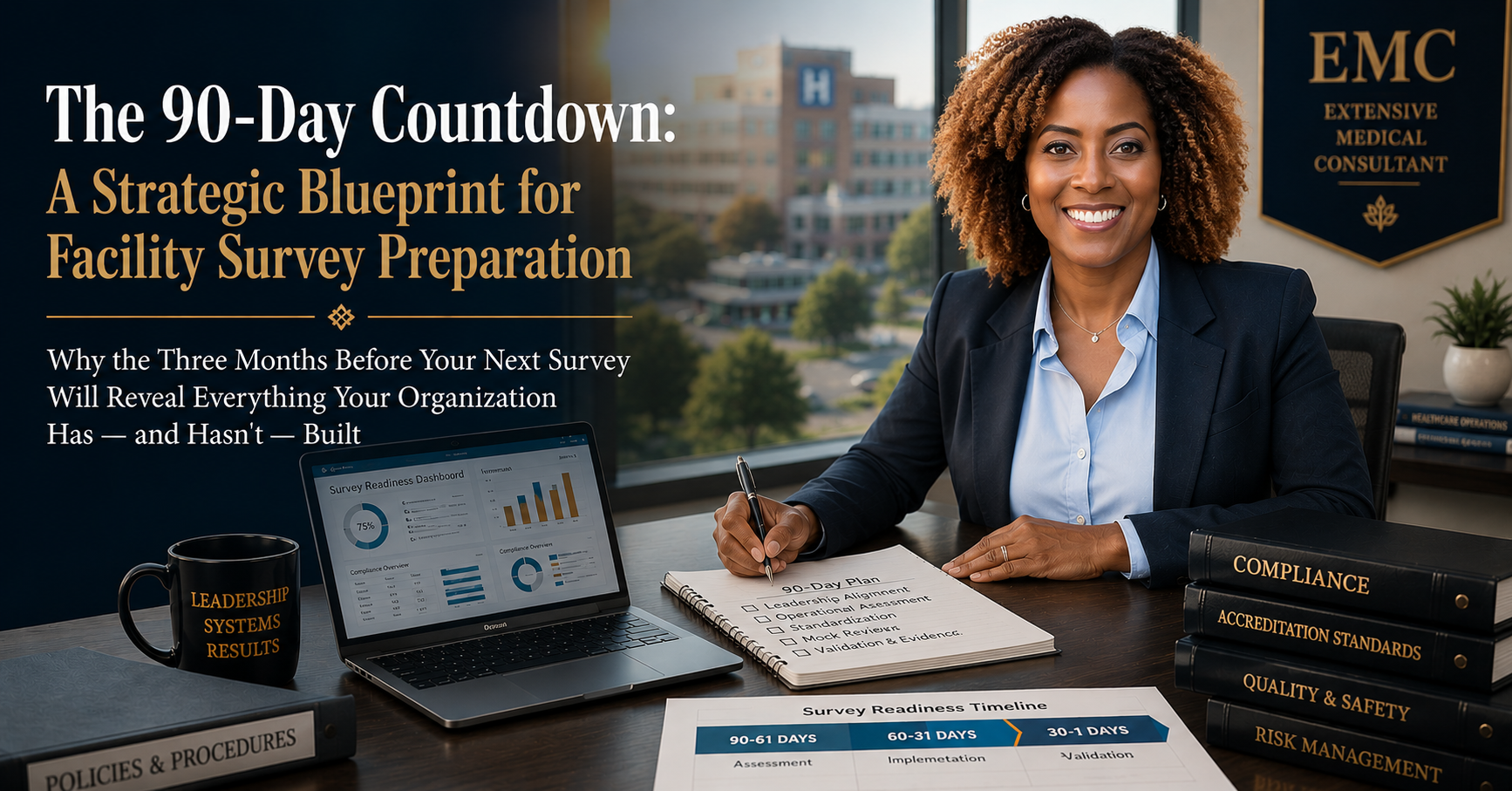
A 90-day executive blueprint for accreditation survey readiness. Learn how healthcare leaders build sustainable systems, not last-minute checklists.
Leadership Under Pressure: Lessons from 27 Years in the U.S. Public Health Service
By Scarlett Lusk • May 29, 2026
Dr. Scarlett Lusk shares 6 leadership lessons from 27 years in the U.S. Public Health Service — and how military-grade discipline transforms civilian healthcare operations.
Healthcare compliance consultant reviewing financial performance dashboard — EMC, Houston TX
By Scarlett Lusk • May 18, 2026
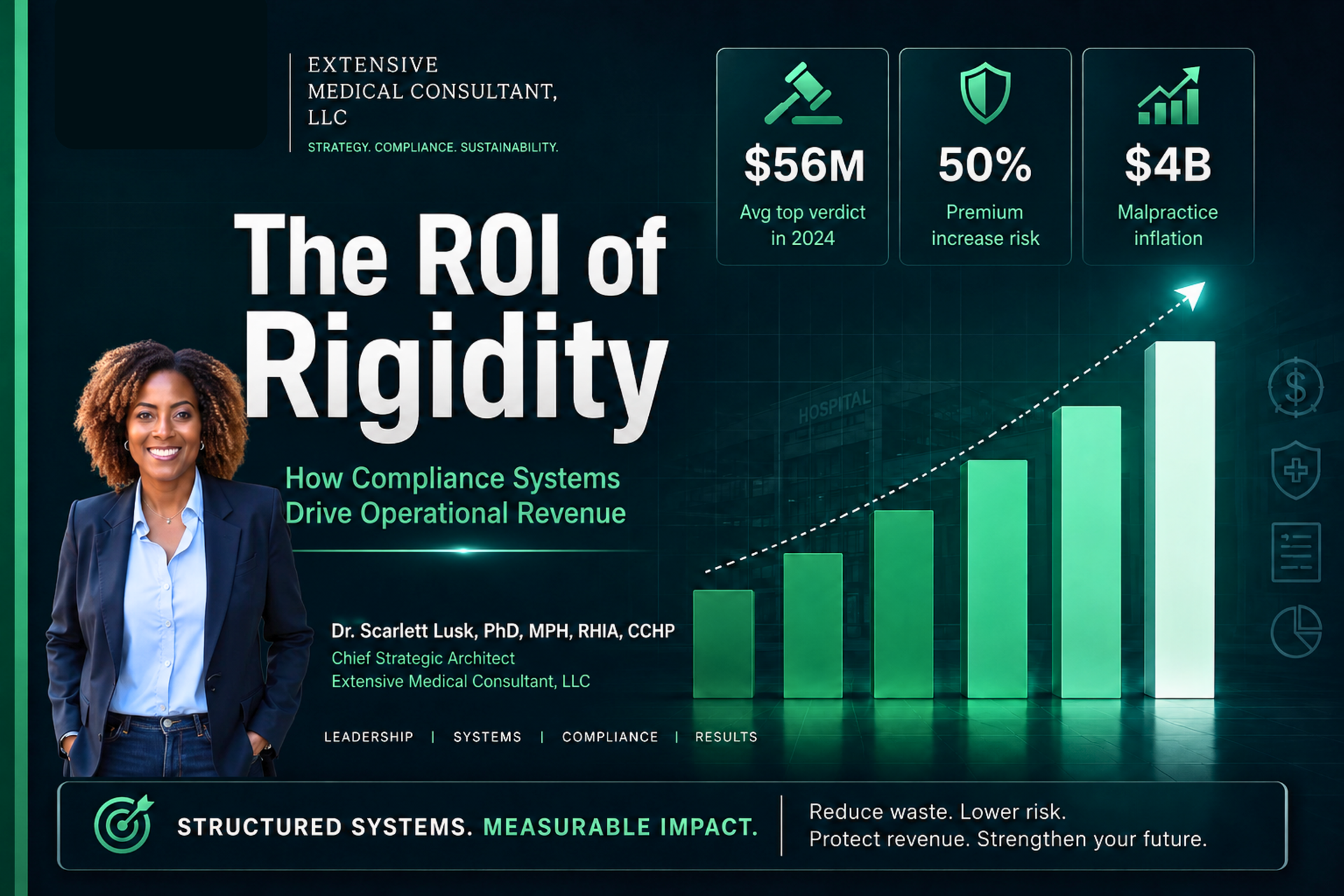
Learn how structured healthcare compliance systems reduce waste, lower litigation risk, and compress insurance premiums — generating measurable financial returns for CFOs and CEOs. Expert insight from Dr. Scarlett Lusk, Extensive Medical Consultant, LLC.
Beyond the Checklist: Continuous Accreditation Readiness for NCCHC, ACA & AAAHC | EMC
By Scarlett Lusk • May 13, 2026
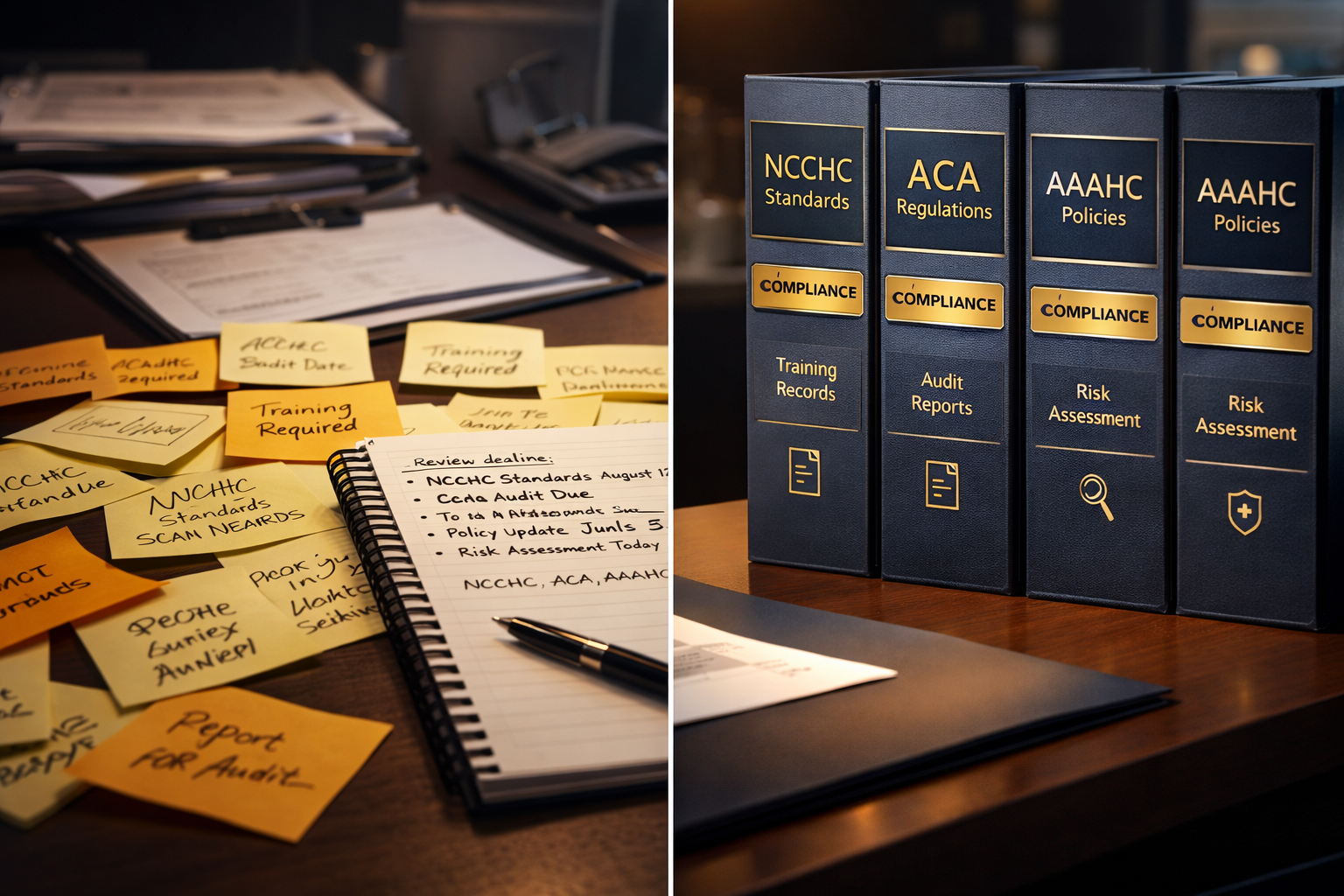
Discover how healthcare organizations can move beyond reactive accreditation preparation and build sustainable compliance systems for NCCHC, ACA, and AAAHC readiness with EMC and Dr. Scarlett Lusk.
The
By Scarlett Lusk • April 21, 2026
Tribal knowledge in healthcare is your most dangerous compliance vulnerability. Discover how person-dependent systems create accreditation risk and how EMC builds the documentation frameworks that eliminate it.
By Scarlett Lusk • April 11, 2026
Healthcare leadership burnout is a systems problem, not a personal one. Discover how EMC helps healthcare executives reduce operational pressure through compliance systems, workflow optimization, and leadership frameworks.
Healthcare accreditation consulting by Dr. Scarlett Lusk — compliance and audit readiness expert.
March 23, 2026
Failing accreditation costs more than a citation. Discover the true financial, reputational, and operational consequences — and how EMC helps you prevent them.
By Scarlett Lusk • March 13, 2026
Modern healthcare organizations operate in an increasingly complex environment. Regulatory requirements evolve, accreditation standards tighten, and operational demands continue to grow. While internal teams work tirelessly to maintain quality care and efficient operations, many clinics eventually encounter challenges that require a fresh perspective. This is where external consulting expertise becomes valuable. Healthcare consultants are not replacements for internal leadership; they are strategic partners who help organizations strengthen systems, identify risks, and navigate complex compliance landscapes. Through structured guidance and objective analysis, consulting support can help clinics move from reactive problem-solving to proactive operational stability. Under the leadership of Dr. Scarlett Lusk, Extensive Medical Consultant works with healthcare organizations to provide that clarity, structure, and expertise. Why Internal Teams Often Miss Critical Blind Spots Healthcare professionals and administrators are deeply committed to their organizations. However, being closely involved in daily operations can sometimes make it difficult to recognize systemic issues. Internal teams often focus on immediate operational demands: Patient care coordination Staffing challenges Documentation management Regulatory compliance requirements Over time, these responsibilities can create operational “blind spots.” Processes that once worked well may become outdated, inefficient, or misaligned with current compliance expectations. Because internal teams are immersed in daily workflows, they may not always see the structural gaps forming beneath the surface. External consultants provide something essential: objective distance. They can analyze operations without the constraints of internal routines, allowing them to identify hidden inefficiencies, compliance vulnerabilities, and workflow breakdowns that might otherwise go unnoticed. The Value of Objective Leadership Support Healthcare leadership carries significant responsibility. Administrators and clinical leaders must balance patient care, regulatory compliance, operational efficiency, and staff wellbeing—all at the same time. In such high-pressure environments, objective leadership support becomes extremely valuable. External consultants serve as strategic advisors who help leaders: Evaluate operational structures Strengthen compliance frameworks Prepare for accreditation reviews Implement sustainable workflow improvements This type of guidance allows healthcare leaders to make informed decisions based on data, regulatory insight, and industry best practices. Rather than reacting to problems after they occur, organizations can build systems designed to prevent them. When Clinics Should Consider Bringing in Consultants Many clinics assume consulting support is only necessary during a crisis. In reality, the most effective consulting relationships begin before problems escalate. Healthcare organizations often benefit from external expertise during key moments of growth or transition, including: 1. Preparing for Accreditation or Regulatory Surveys Accreditation readiness requires careful preparation. Consultants help ensure policies, documentation, and operational workflows meet regulatory expectations before surveyors arrive. 2. Rapid Organizational Growth As clinics expand, operational structures must evolve. Growth often exposes inefficiencies or compliance gaps that were not visible at smaller scales. 3. Operational Workflow Challenges When teams experience recurring inefficiencies, communication breakdowns, or documentation issues, consulting support can help redesign workflows for greater clarity and efficiency. 4. Leadership Transitions New leadership often benefits from an external operational assessment to understand existing systems and identify areas for improvement. By bringing in consultants at these moments, clinics can proactively address structural issues rather than waiting for them to surface during audits or inspections. EMC’s Tailored Consulting Approach At Extensive Medical Consultant, consulting is not based on one-size-fits-all solutions. Every healthcare organization has unique operational structures, leadership styles, and regulatory challenges. That is why EMC focuses on tailored consulting strategies designed around each client’s specific needs. Guided by the extensive leadership experience of Dr. Scarlett Lusk, EMC provides consulting services that help healthcare organizations strengthen operational foundations while maintaining focus on patient care. The consulting approach emphasizes four key areas: Accreditation Preparation Healthcare organizations receive structured guidance to prepare for accreditation surveys with confidence. Compliance System Development EMC helps clinics design compliance systems that align with regulatory standards and support long-term operational stability. Workflow Optimization Operational workflows are evaluated and redesigned to improve efficiency, communication, and documentation processes. Leadership Support Healthcare executives receive strategic guidance to help them make informed decisions about organizational growth, risk management, and operational improvement. Through this structured and collaborative approach, EMC helps healthcare organizations move beyond temporary fixes and build sustainable systems that support long-term success. Building Stronger Healthcare Systems The healthcare environment will continue to evolve. Regulatory expectations will change, patient demands will grow, and operational complexity will increase. Organizations that thrive in this environment are those that prioritize strong systems, clear structures, and proactive leadership strategies. External consulting support plays an important role in helping healthcare leaders achieve these goals. By identifying blind spots, strengthening compliance frameworks, and optimizing workflows, consultants provide the strategic insight organizations need to operate confidently. With experienced leadership and a commitment to operational excellence, Extensive Medical Consultant continues to support healthcare organizations in building the systems that make sustainable success possible. Need guidance navigating accreditation, compliance, or operational challenges? Connect with Extensive Medical Consultant today to learn how expert consulting support can help strengthen your healthcare organization’s future.
More Posts
hidden compliance risks ambulatory correctional healthcare
By Scarlett Lusk • August 19, 2026
Discover the hidden operational gaps — "silent zones" — that drive compliance failures in ambulatory and correctional healthcare. Expert insight from Dr. Scarlett Lusk, EMC.
By Scarlett Lusk • August 9, 2026
Poor clinical documentation creates legal vulnerability even when care was correct. Learn how EMC builds systemic documentation frameworks that protect your organization.
By Scarlett Lusk • June 30, 2026
A 90-day executive blueprint for accreditation survey readiness. Learn how healthcare leaders build sustainable systems, not last-minute checklists.
Leadership Under Pressure: Lessons from 27 Years in the U.S. Public Health Service
By Scarlett Lusk • May 29, 2026
Dr. Scarlett Lusk shares 6 leadership lessons from 27 years in the U.S. Public Health Service — and how military-grade discipline transforms civilian healthcare operations.
Healthcare compliance consultant reviewing financial performance dashboard — EMC, Houston TX
By Scarlett Lusk • May 18, 2026
Learn how structured healthcare compliance systems reduce waste, lower litigation risk, and compress insurance premiums — generating measurable financial returns for CFOs and CEOs. Expert insight from Dr. Scarlett Lusk, Extensive Medical Consultant, LLC.
Beyond the Checklist: Continuous Accreditation Readiness for NCCHC, ACA & AAAHC | EMC
By Scarlett Lusk • May 13, 2026
Discover how healthcare organizations can move beyond reactive accreditation preparation and build sustainable compliance systems for NCCHC, ACA, and AAAHC readiness with EMC and Dr. Scarlett Lusk.
The
By Scarlett Lusk • April 21, 2026
Tribal knowledge in healthcare is your most dangerous compliance vulnerability. Discover how person-dependent systems create accreditation risk and how EMC builds the documentation frameworks that eliminate it.
By Scarlett Lusk • April 11, 2026
Healthcare leadership burnout is a systems problem, not a personal one. Discover how EMC helps healthcare executives reduce operational pressure through compliance systems, workflow optimization, and leadership frameworks.
Healthcare accreditation consulting by Dr. Scarlett Lusk — compliance and audit readiness expert.
March 23, 2026
Failing accreditation costs more than a citation. Discover the true financial, reputational, and operational consequences — and how EMC helps you prevent them.
By Scarlett Lusk • March 13, 2026
Modern healthcare organizations operate in an increasingly complex environment. Regulatory requirements evolve, accreditation standards tighten, and operational demands continue to grow. While internal teams work tirelessly to maintain quality care and efficient operations, many clinics eventually encounter challenges that require a fresh perspective. This is where external consulting expertise becomes valuable. Healthcare consultants are not replacements for internal leadership; they are strategic partners who help organizations strengthen systems, identify risks, and navigate complex compliance landscapes. Through structured guidance and objective analysis, consulting support can help clinics move from reactive problem-solving to proactive operational stability. Under the leadership of Dr. Scarlett Lusk, Extensive Medical Consultant works with healthcare organizations to provide that clarity, structure, and expertise. Why Internal Teams Often Miss Critical Blind Spots Healthcare professionals and administrators are deeply committed to their organizations. However, being closely involved in daily operations can sometimes make it difficult to recognize systemic issues. Internal teams often focus on immediate operational demands: Patient care coordination Staffing challenges Documentation management Regulatory compliance requirements Over time, these responsibilities can create operational “blind spots.” Processes that once worked well may become outdated, inefficient, or misaligned with current compliance expectations. Because internal teams are immersed in daily workflows, they may not always see the structural gaps forming beneath the surface. External consultants provide something essential: objective distance. They can analyze operations without the constraints of internal routines, allowing them to identify hidden inefficiencies, compliance vulnerabilities, and workflow breakdowns that might otherwise go unnoticed. The Value of Objective Leadership Support Healthcare leadership carries significant responsibility. Administrators and clinical leaders must balance patient care, regulatory compliance, operational efficiency, and staff wellbeing—all at the same time. In such high-pressure environments, objective leadership support becomes extremely valuable. External consultants serve as strategic advisors who help leaders: Evaluate operational structures Strengthen compliance frameworks Prepare for accreditation reviews Implement sustainable workflow improvements This type of guidance allows healthcare leaders to make informed decisions based on data, regulatory insight, and industry best practices. Rather than reacting to problems after they occur, organizations can build systems designed to prevent them. When Clinics Should Consider Bringing in Consultants Many clinics assume consulting support is only necessary during a crisis. In reality, the most effective consulting relationships begin before problems escalate. Healthcare organizations often benefit from external expertise during key moments of growth or transition, including: 1. Preparing for Accreditation or Regulatory Surveys Accreditation readiness requires careful preparation. Consultants help ensure policies, documentation, and operational workflows meet regulatory expectations before surveyors arrive. 2. Rapid Organizational Growth As clinics expand, operational structures must evolve. Growth often exposes inefficiencies or compliance gaps that were not visible at smaller scales. 3. Operational Workflow Challenges When teams experience recurring inefficiencies, communication breakdowns, or documentation issues, consulting support can help redesign workflows for greater clarity and efficiency. 4. Leadership Transitions New leadership often benefits from an external operational assessment to understand existing systems and identify areas for improvement. By bringing in consultants at these moments, clinics can proactively address structural issues rather than waiting for them to surface during audits or inspections. EMC’s Tailored Consulting Approach At Extensive Medical Consultant, consulting is not based on one-size-fits-all solutions. Every healthcare organization has unique operational structures, leadership styles, and regulatory challenges. That is why EMC focuses on tailored consulting strategies designed around each client’s specific needs. Guided by the extensive leadership experience of Dr. Scarlett Lusk, EMC provides consulting services that help healthcare organizations strengthen operational foundations while maintaining focus on patient care. The consulting approach emphasizes four key areas: Accreditation Preparation Healthcare organizations receive structured guidance to prepare for accreditation surveys with confidence. Compliance System Development EMC helps clinics design compliance systems that align with regulatory standards and support long-term operational stability. Workflow Optimization Operational workflows are evaluated and redesigned to improve efficiency, communication, and documentation processes. Leadership Support Healthcare executives receive strategic guidance to help them make informed decisions about organizational growth, risk management, and operational improvement. Through this structured and collaborative approach, EMC helps healthcare organizations move beyond temporary fixes and build sustainable systems that support long-term success. Building Stronger Healthcare Systems The healthcare environment will continue to evolve. Regulatory expectations will change, patient demands will grow, and operational complexity will increase. Organizations that thrive in this environment are those that prioritize strong systems, clear structures, and proactive leadership strategies. External consulting support plays an important role in helping healthcare leaders achieve these goals. By identifying blind spots, strengthening compliance frameworks, and optimizing workflows, consultants provide the strategic insight organizations need to operate confidently. With experienced leadership and a commitment to operational excellence, Extensive Medical Consultant continues to support healthcare organizations in building the systems that make sustainable success possible. Need guidance navigating accreditation, compliance, or operational challenges? Connect with Extensive Medical Consultant today to learn how expert consulting support can help strengthen your healthcare organization’s future.