The Silent Zones: Identifying Hidden Risk in Ambulatory and Correctional Care
The Policy Says One Thing. The Floor Does Another.
Every healthcare organization that has ever received a serious regulatory finding shares a particular experience: the moment leadership realizes that what was written in policy and what was actually happening in clinical operations had quietly, gradually diverged. Not because anyone decided to abandon a standard, but because no one was watching the space between the shifts, the handoffs, and the departments where the real operational decisions get made.
I call these spaces the Silent Zones.
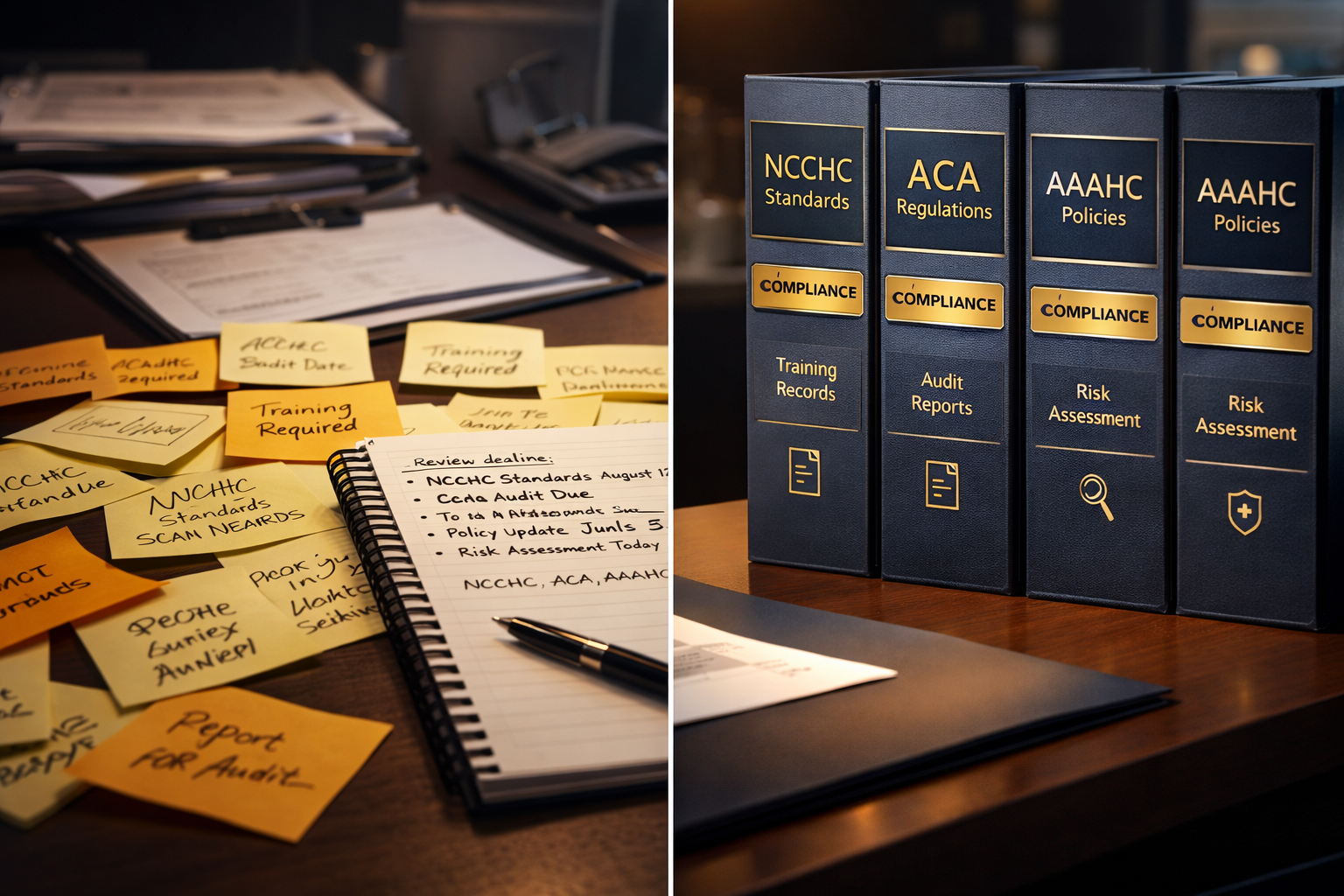
They are not catastrophic failures. They rarely begin that way. A Silent Zone is the place where an otherwise compliant organization drifts, slowly and invisibly, away from the governance expectations its policies claim to uphold. It is the intake triage completed two hours past the required window because security didn’t call clinical until the count was cleared. It is the point‑of‑care charting shortcut that every nurse on the afternoon shift uses because the electronic template takes four minutes longer than the paper workaround. It is the credentialing verification that passed initial onboarding but was never re‑checked when the provider’s privilege profile changed six months later.
None of these gaps appear in a binder review. None of them surface during a self‑reported compliance assessment. They emerge in operational observation, in the kind of structured, behavior‑level scrutiny that most healthcare organizations never apply to themselves until a surveyor, a plaintiff attorney, or a regulatory investigator applies it for them.
This article is about two clinical environments where Silent Zones are particularly dangerous, particularly common, and particularly misunderstood: ambulatory care and correctional healthcare. And it is about the difference between organizations that find these gaps on their own terms and organizations that have them found.
Section 1: The Blind Spots in Ambulatory Care
Ambulatory settings operate under a paradox that their leadership teams often describe in almost identical language: high‑performing teams, strong patient satisfaction metrics, and survey histories that look, on paper, exactly like organizations that have their operations in order.
What paper cannot capture is throughput pressure.
In a busy ambulatory surgery or outpatient clinic environment, the volume of patients moving through the facility in a single operational day creates conditions where clinically excellent people make small, expedient decisions that individually seem inconsequential and collectively constitute practice drift. The afternoon team, four procedures behind schedule, skips the standardized pre‑procedure verification read‑back because they know the patient and they are running forty minutes late. The infection control checklist gets initialed during the equipment setup rather than verified during it. The provider credentialing log reflects active privileges for a physician whose scope of practice was informally adjusted during a peer conversation three months ago, a conversation that was never entered into the governance record.
Where AAAHC Accreditation Gaps Most Frequently Emerge
Organizations preparing for or maintaining accreditation through the Accreditation Association for Ambulatory Health Care typically demonstrate strong performance in the areas that are easiest to document in advance: written policies, organizational charts, credentialing files, and quality improvement meeting minutes. The gaps that surface during rigorous operational assessment are almost never in those domains.
They appear in three places with disproportionate frequency:
- Point‑of‑care documentation under throughput stress. When patient volume exceeds staffing capacity, even temporarily, real‑time charting gives way to retrospective documentation. What gets entered after the fact is accurate in substance but stripped of the timestamps, sequential detail, and clinical decision rationale that constitute a defensible record. The record reflects what happened. It does not reflect when, in what sequence, or why each decision was made. In a legal or regulatory proceeding, that distinction is rarely survivable.
- Credentialing and privileging currency. Initial credentialing processes in ambulatory organizations tend to be thorough. The ongoing maintenance of provider privilege files, particularly when providers work across multiple sites, add new procedures, or transition roles, is where currency gaps accumulate. An organization whose credentialing policies require biennial re‑verification but whose actual operational practice relies on the credentialing coordinator’s calendar is an organization carrying undisclosed risk in its provider files.
- Infection prevention in compressed procedural cycles. Under high throughput, the intervals between procedural room turnover get compressed. Environmental services timing, equipment processing cycles, and surface contact times are the first places where real practice diverges from posted protocol, not because staff are careless, but because the staffing model was not designed to meet the procedural volume at full compliance fidelity simultaneously. This gap almost never shows up in the infection control log. It shows up in observation.
Executive Takeaway: The most consequential compliance gaps in ambulatory settings are behavioral, not documentary. They live in what staff actually do under pressure, not what the policy describes when no one is watching the clock.
Section 2: The High‑Stakes Realities of Correctional Healthcare
Correctional healthcare operates in an environment that amplifies every operational challenge that exists in community settings, and then adds several that exist nowhere else.
The dual authority structure is foundational to understanding how Silent Zones form in correctional environments. Clinical operations exist inside a security institution with its own command structure, its own operational priorities, and its own definition of what constitutes an emergency. When those two systems, clinical and security, operate without clearly documented, mutually understood protocols, the friction between them creates compliance gaps that standard healthcare audits are not designed to find.
Where NCCHC Standards Are Most Frequently Tested
The National Commission on Correctional Health Care establishes clinical standards that reflect the complexity of delivering constitutionally adequate healthcare inside a controlled, restricted environment. Organizations maintaining or pursuing NCCHC accreditation typically invest significant effort in policy development. The operational vulnerabilities that create genuine accreditation and legal exposure emerge at the intersection of clinical standards and correctional operational reality.
- Intake triage timing. The NCCHC requirement for timely health screening at intake is one of the most consistently observed standards in accreditation documentation and one of the most consistently compromised standards in actual operational practice. Intake processing controlled by security, including cell block availability, administrative processing queues, and count times, creates intervals between arrival and clinical contact that routinely exceed documented policy. When those intervals are not tracked, documented, and reported through a clinical accountability structure, the organization cannot demonstrate compliance it may genuinely be attempting to maintain.
- Emergency response documentation. In a correctional environment, the documentation of a medical emergency, from recognition to response to outcome, frequently involves multiple parties from both security and clinical teams. When that documentation is assembled retrospectively from separate reports, the timeline discrepancies between the security incident report and the clinical response record create exactly the kind of contradictory evidentiary record that drives adverse legal findings. The gap is almost never intentional. It is structural.
- Medication administration integrity. Medication administration in a correctional setting involves clinical accuracy requirements and security observation requirements that create legitimate competing pressures at the point of administration. Directly observed therapy logs, refusal documentation, and medication disposal records are areas where the operational burden of compliance in a correctional environment frequently outpaces the staffing capacity assigned to manage it. Incomplete records in this domain carry both accreditation and constitutional liability implications.
- Inter‑departmental friction as a compliance variable. The relationship between security and clinical leadership is one of the most predictive factors in the compliance health of a correctional healthcare program. Organizations where clinical and security leadership have established clear, mutually agreed‑upon operational protocols demonstrate measurably better compliance fidelity than organizations where the two departments manage their intersection informally. Informal management of that intersection is itself a Silent Zone, one that produces inconsistent outcomes and generates no documentation of the inconsistency.
Executive Takeaway: In correctional healthcare, the most significant compliance risks are structural, not individual. They live in the gaps between clinical standards and security operations, and they cannot be addressed through clinical training alone.
Section 3: Why Generic Audits Consistently Miss the Real Exposure
The standard compliance audit, whether conducted internally or by a generalist consulting firm, produces a report based on what is reviewable: policies, procedures, meeting minutes, training records, and credentialing files. These documents can be excellent. An organization can produce an excellent document review audit and still carry significant operational risk, because the audit answered the wrong question.
Document audits answer: does the policy exist?
Operational assessments answer: does the practice match the policy, under the actual conditions in which the practice occurs?
These are not the same question. The gap between them is where Silent Zones live, and it is a gap that generic audits are not structured to close. A checklist applied to a policy binder cannot observe the afternoon shift under throughput pressure. It cannot follow the path of an emergency response from recognition to documentation. It cannot identify the credentialing file that was accurate at onboarding and has not been meaningfully reviewed since.
Organizations that rely exclusively on document audits are not under‑investing in compliance. They are investing in the wrong visibility. And the consequence of that misalignment, in accreditation proceedings, in litigation, and in regulatory investigations, is borne entirely by the leadership team that signed the compliance attestation.
Section 4: The EMC Methodology — Seeing What Generic Consultants Miss
The work that Extensive Medical Consultant conducts with healthcare organizations is not audit work in the conventional sense. It is operational assessment, a structured examination of the space between governance expectations and operational behavior, designed to surface what document review cannot reach.
Dr. Scarlett Lusk’s twenty‑seven years of commissioned service in the U.S. Public Health Service included direct operational leadership in correctional healthcare, ambulatory clinical programs, and federal health systems that operate under the most demanding and rigorously enforced regulatory expectations in the country. The EMC team, which includes former federal healthcare leaders with backgrounds spanning the FDA, Indian Health Service, the U.S. Navy, and ICE Health Services Corps, brings a perspective that is built on having operated inside these environments, not simply having studied them.
What an EMC Operational Assessment Examines
The EMC methodology approaches Silent Zone identification through behavioral observation alongside documentary review, examining what staff actually do across shifts, under operational pressure, and at the departmental intersections where practice drift is most likely to form undetected.
In ambulatory environments, this means examining clinical operations during actual high‑volume procedural periods rather than scheduling assessment visits during lighter operational days. In correctional environments, this means observing the clinical‑security interface at the points of highest operational friction, including intake processing, medication administration rounds, and emergency response activation, rather than reviewing the protocols that govern those interactions in theory.
The output is not a compliance checklist. It is an operational gap analysis that tells leadership, with specificity, where their documented governance expectations and their actual operational behavior have diverged, and what the regulatory, legal, and patient safety consequences of that divergence are if left unaddressed.
This is the work that transforms a compliance program from an annual preparation sprint into a continuous operational strategy. And it is the work that allows healthcare organizations to surface their Silent Zones on their own terms, before a surveyor, an investigator, or a plaintiff’s attorney surfaces them first.
The Most Expensive Gap Is the One You Don’t Know Exists
Regulatory surveys do not find violations in policy manuals. They find violations in operational behavior. The organizations that walk into accreditation reviews, whether under AAAHC, NCCHC, ACA, or Joint Commission standards, with genuine confidence are not the organizations with the most polished binders. They are the organizations that have already looked honestly at what their staff actually do, at 2 in the afternoon on a fully booked procedure day or at 6 in the morning during the first medication pass of the day, and made certain that what they observed matched what their governance documents require.
That honest look is not comfortable. It rarely is. But it is the only look that matters.
Schedule a Confidential Readiness Evaluation With EMC
If your organization operates in ambulatory or correctional care, or both, and your last compliance assessment was primarily a document review, you may already have Silent Zones you are not aware of. The question is not whether those gaps exist. The question is whether you find them before your next accreditation survey does.
Extensive Medical Consultant conducts confidential operational readiness evaluations for healthcare organizations across both environments. Our assessments are designed to give leadership a clear, specific, actionable picture of where operational behavior and governance expectations have diverged, and exactly what is required to close those gaps before they become findings.
Contact Dr. Scarlett Lusk and the EMC team to schedule your confidential evaluation today.