The 90-Day Countdown: A Strategic Blueprint for Facility Survey Preparation
Why the Three Months Before Your Next Survey Will Reveal Everything Your Organization Has — and Hasn't — Built
There is a particular kind of quiet that settles over a healthcare executive's office roughly ninety days before a known survey window opens. It isn't panic yet. It's the awareness that a clock has started, and that everything the organization has done or failed to do over the preceding three years is about to be examined by someone with no emotional investment in the outcome.
Most healthcare leaders underestimate this window, not from carelessness but because daily operational urgency consistently crowds out the strategic discipline survey readiness requires. By the time ninety days remain, many organizations are already behind, even if no one has said so out loud.
Dr. Scarlett Lusk, founder of Extensive Medical Consultant and a former commissioned officer with twenty-seven years of service in the U.S. Public Health Service, has watched this pattern repeat across federal, correctional, and ambulatory care environments. The organizations that walk into survey week with confidence are rarely the ones that scramble hardest at the end. They are the ones who understood, well before the ninety-day mark, that a survey is not an event to survive. It is a mirror, one that reflects, with total indifference, how the organization actually operates when no one is performing for an audience.
This is not a checklist. What follows is the executive-level blueprint healthcare leaders need to walk into the ninety-day window with clarity instead of dread and walk out having built something that outlasts the certificate on the wall.
Why Preparation Begins Long Before Day 90
A foundational truth every experienced executive eventually learns: a survey does not create your organization's compliance posture. It reveals it.
Surveyors are not arriving to test whether staff can perform well for a few days. They are observing what your organization does on an ordinary Tuesday, extrapolated across departments and shifts. The Joint Commission's Survey Process Guide, introduced under its Accreditation 360 initiative effective January 1, 2026, was explicitly designed around this principle: evaluating how organizations function continuously, not how well they can stage a single inspection.
Executive Insight: Organizations that treat the ninety-day window as a sprint typically produce improvement that experienced surveyors can distinguish from authentic operational maturity. Organizations that treat it as a structured validation period walk away with something a sprint can never produce: evidence that the standard is sustainable.
The Strategic 90-Day Blueprint
Days 90–61: Leadership Alignment and Operational Assessment. This phase answers one question honestly: where does the organization actually stand, independent of what anyone hopes is true? It is diagnostic, not corrective. Executive leadership must be visibly engaged, not delegating assessment entirely to a quality director. The work includes a comprehensive operational assessment across clinical, administrative, and life safety domains; a documentation review focused on consistency rather than volume; and risk identification prioritized by patient safety impact. The most common mistake is assessing documentation without observing actual practice. Paper compliance and operational compliance are not the same thing, and that gap is exactly what surveyors are trained to find.
Days 60–31: Standardization, Education, and Mock Review. With a clear picture established, the middle thirty days close the gaps that matter most. Leadership's role shifts from oversight to active sponsorship, particularly when standardizing a process requires one department to adopt another's workflow. This phase includes process standardization, policy validation, staff education built around the why behind requirements, and mock reviews using tracer methodology, following a patient or process across departments exactly as a surveyor would. Organizations frequently treat education as a one-time event; surveyors interviewing staff weeks later can often tell the difference between information understood and information memorized.
Executive Insight: "A mock review conducted with the same seriousness as the real survey is the single highest-value activity in the entire window. It's the only point where leadership sees exactly what a surveyor will see while there is still time to act on it."
Days 30–1: Validation, Evidence, and Communication. The final thirty days are not for new initiatives; they validate what was built. Leadership rounding across all shifts, including nights and weekends, does more to reduce organizational anxiety than any memo. This phase includes final validation of corrective actions, evidence collection and organization, a full survey simulation, and clear internal communication. The most damaging mistake is documentation panic, a late scramble to generate evidence that should have existed naturally. Experienced surveyors are highly attuned to evidence that appears manufactured rather than organic.
By day thirty, the organization should be confirming and communicating, not building. If significant corrective work is still underway this close to survey week, that's a signal that earlier phases were compressed, and it deserves direct executive attention.
Why Traditional Survey Preparation Often Fails
Much available guidance focuses on compliance mechanics and misses what determines whether readiness is durable: leadership behavior under pressure.
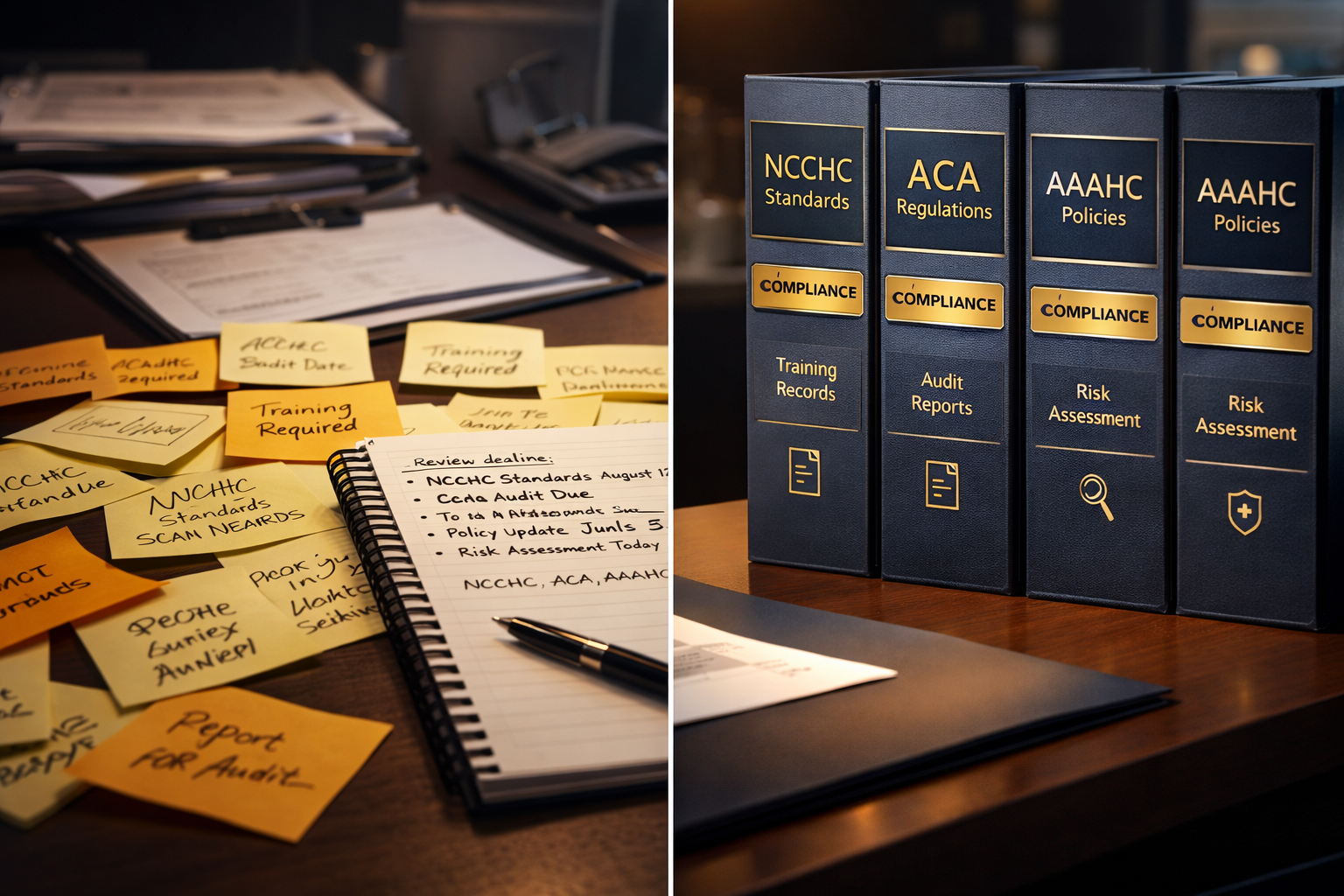
Recurring failure patterns are consistent across facility types: checklist mentality, producing organizations that look prepared on paper but feel unprepared in practice; temporary compliance, where survey-week-only changes create a damaging cycle repeating every cycle; documentation panic, a reliable predictor of a difficult outcome; leadership bottlenecks, where readiness depends on one or two individuals; staff fatigue, from preparation that intensifies only in the final weeks; and lack of accountability, where no leader owns readiness continuously.
The EMC Difference: Building Systems, Not Survey Projects
Extensive Medical Consultant approaches survey preparation from a different starting position. Rather than treating each survey as an isolated project, EMC works with organizations to build the operational infrastructure that makes readiness a byproduct of daily operations, not a separate initiative competing for attention.
An organization with genuine operational infrastructure doesn't experience the ninety-day window as a crisis countdown. It experiences it as validation. Dr. Lusk and the EMC team, including former federal healthcare leaders with backgrounds spanning the U.S. Navy, the FDA, Indian Health Service, and ICE Health Services Corps, bring a perspective shaped by operating inside the structured, accountable systems federal healthcare requires by design.
EMC does not disclose its complete proprietary methodology, but nearly every first conversation begins with the same question Dr. Lusk asks directly: if your most experienced compliance leader left tomorrow, what would your organization still be able to demonstrate to a surveyor without them in the room? The answer reveals, almost immediately, whether an organization has built a system or has simply been relying on a person.
The Five Pillars of Sustainable Survey Readiness™
EMC organizes its approach around five interconnected pillars: Leadership Ownership readiness visibly owned by executive leadership, not delegated to a compliance function; Operational Transparency an honest, continuously updated picture of organizational reality; Standardized Infrastructure consistent processes across departments and locations; Continuous Validation mock reviews functioning as an ongoing rhythm, not a pre-survey scramble; and Cultural Resilience staff who understand not just what is required, but why.
Executive Action Checklist
Identify who owns survey readiness as a continuous responsibility, empowered to make cross-departmental decisions. Schedule an honest, leadership-visible operational assessment now, regardless of how far away your next survey is. Review documentation consistency across every shift and location. Build a recurring mock review rhythm into normal operations. Establish leadership rounding that includes night and weekend staff.
Frequently Asked Questions
How far in advance should preparation begin? While activities intensify in the ninety days before a known survey, sustainable readiness depends on systems maintained continuously throughout the full accreditation cycle.
How often are healthcare facilities surveyed? Frequency varies by accreditation body. The Joint Commission generally conducts unannounced surveys between thirty and thirty-six months after a previous full survey.
Does working with a consultant guarantee survey success? No reputable partner can promise a guaranteed outcome, and EMC does not. What experienced guidance offers is a disciplined process for closing genuine gaps and building infrastructure that benefits the organization well beyond any single survey.
Executive Conclusion
The ninety days before a survey will always reveal something true about an organization. The only real question is how much of that truth leadership chooses to discover on its own terms, well in advance, rather than at the moment a surveyor asks the question first.
The organizations that walk into survey week with genuine calm are not the ones that worked hardest in the final six weeks. They are the ones who understood, long before the countdown began, that readiness is not something you perform. It is something you build.
Ready to Build Sustainable Survey Readiness?
If your organization's next survey window is approaching or you recognize the patterns described here, the conversation worth having isn't about a single survey. It's about the infrastructure that determines how every future survey will feel.