Leadership Under Pressure: Lessons from 27 Years in the U.S. Public Health Service

"Civilian healthcare leadership is not easier than federal service. It is different. The pressure is the same. The stakes are the same. What is missing in most organizations  is the discipline that federal service demands from day one." Dr. Scarlett Lusk


The Day Everything Changed


There is a moment that every commissioned officer in the U.S. Public Health Service carries with them — the moment they understand that leadership is not a role you step into. It is a standard you are held to, every single day, regardless of how you feel, how ready you are, or how cooperative the circumstances around you happen to be.


For Dr. Scarlett Lusk, that moment did not arrive as a dramatic emergency or a defining crisis. It arrived quietly, in the weight of the uniform itself, in the understanding that when you are commissioned as an officer in the United States Public Health Service, you are no longer simply a healthcare professional. You are a system within a larger system. Your decisions carry consequences that extend far beyond the room you are standing in. Your leadership is not optional, not negotiable, and never truly off the clock.


Twenty-seven years later, that understanding forms the bedrock of everything Extensive Medical Consultant, LLC does for the healthcare organizations it serves.


This article is about what those twenty-seven years actually teach, not the abstractions of leadership theory, but the hard, practical, operationally verified lessons that only come from leading in environments where the cost of failure is real, the scrutiny is unrelenting, and the systems you depend on must hold regardless of who shows up to lead them on any given morning.


Why the U.S. Public Health Service Is Unlike Anything in Civilian Healthcare


Before these lessons can be fully appreciated, the context in which they were earned deserves to be understood.


The U.S. Public Health Service Commissioned Corps is one of eight uniformed services of the United States. With approximately 6,000 active duty officers and a core mission to protect, promote, and advance the health and safety of the nation, the Corps deploys officers across federal agencies, including the FDA, Indian Health Service, Bureau of Prisons, ICE Health Services Corps, and the Centers for Disease Control and Prevention, among others.


The Corps operates under a clear command structure, with core values of Leadership, Service, Integrity, and Excellence formally embedded into every aspect of officer development, promotion, and evaluation. Officers hold naval ranks, and they earn each promotion through demonstrated performance, not tenure. There is no coasting in the Commissioned Corps. There is no ambiguity about accountability. And there is no leadership without evidence.


What this means in practice is that USPHS officers develop a quality of leadership discipline that most civilian healthcare administrators, however talented, have simply never been required to cultivate. Not because civilian healthcare lacks urgency. But the institutional scaffolding that enforces excellence in federal service rarely exists in civilian organizations.


Dr. Lusk navigated that environment for twenty-seven years, leading healthcare operations, managing compliance infrastructure, directing quality assurance programs, and building the organizational systems that continue to serve the populations she was deployed to protect. What she brought out of that service and into EMC is not a set of theories. It is a lived operational playbook, tested under conditions that most healthcare consulting firms have never come close to.


Lesson One: Pressure Reveals Structure — Not Character


The most common myth about leadership under pressure is that what pressure reveals is character. That is when the crisis comes; you discover who people truly are.

Twenty-seven years of federal service taught Dr. Lusk a different truth: pressure does not reveal character. It reveals structure.


When a USPHS officer is deployed to a public health emergency, a disease outbreak, a natural disaster, or a federal facility under regulatory siege, what determines the quality of the response is not the personal courage of the individuals in the room. It is the systems that those individuals were trained to activate, the protocols they were prepared to execute, and the organizational architecture that had been built in advance to hold the operation together when conditions became unpredictable.


The most decorated deployments in the history of the Commissioned Corps were not won by extraordinary individuals working heroically in isolation. They were executed by ordinary officers who knew their roles precisely, who had protocols for every foreseeable contingency, and who operated within command structures clear enough that even new personnel could step in and perform.


The application to civilian healthcare is direct and unmistakable.


When a healthcare facility fails a Joint Commission survey, the failure is rarely caused by incompetent staff. It is caused by a structural failure, documentation inconsistencies, protocol gaps, and accountability vacuums that existed long before the surveyor walked through the door. When a facility loses institutional knowledge after a key leader departs, the loss is not primarily a personnel failure. It is an architectural failure. The knowledge was never built into the system; it lived in a person. And when that person left, the system was exposed.


What federal service instills and what Dr. Lusk carries into every EMC engagement is the discipline to build structure before the pressure arrives. Not because crises are predictable, but because the only organizations that respond well to unpredictable crises are those whose systems are strong enough to hold when everything else is in motion.


Lesson Two: Accountability Is an Act of Respect


In civilian healthcare organizations, accountability is often treated as a disciplinary instrument, something applied to people who underperform, delivered through uncomfortable conversations, and associated with the negative end of the employment relationship.


In federal service, accountability is something fundamentally different. It is an act of respect.

When a USPHS commanding officer holds their team to a standard, they are not expressing disappointment. They are expressing confidence in the belief that the people on their team are capable of performing at the level required, and the respect that comes from refusing to lower that standard on their behalf. The officer who accepts mediocrity from their team is not being kind. They are being negligent. They are communicating, through their actions, that they do not believe their team can meet the standard, and that is a far deeper form of disrespect than any difficult performance conversation.


This reframe is one of the most transformative things EMC brings to healthcare leadership development. The healthcare administrators who work with Dr. Lusk often arrive carrying a version of accountability that feels punitive — something to be deployed carefully, reluctantly, and only when avoidance is no longer possible. They leave with a version of accountability that feels generative, a leadership act that builds culture, elevates performance, and communicates to every member of a team that they are trusted to be excellent.


The practical operational implications of this shift are substantial. In organizations where accountability is punitive, staff learn to minimize visibility of problems rather than surface them. Documentation quality suffers because people fear what documented errors will be used for. Compliance gaps are hidden rather than corrected. The entire organizational immune system, the capacity to identify and address problems before they become crises, is suppressed.


In organizations where accountability is structural and respectful, the opposite happens. Staff surface problems early because they trust the system's response. Documentation quality improves because people understand its purpose. Compliance is a cultural norm rather than an imposed requirement. And the organization develops a genuine capacity for self-correction that is worth more, operationally and financially, than any amount of reactive crisis management.


Lesson Three: Clarity at the Top Creates Calm at the Bottom


One of the most consistent findings across twenty-seven years of federal healthcare leadership is this: the majority of operational dysfunction in healthcare organizations originates not in the work itself but in ambiguity about who is responsible for what.


In the U.S. Public Health Service, command structure is non-negotiable. There is no ambiguity about who holds authority over a given domain, who is responsible for a given decision, or who is accountable for a given outcome. This clarity does not constrain the people within the system; it liberates them. When every member of a team knows precisely what they are responsible for and what decisions fall within their authority, they can move with confidence and speed. They do not need to pause for permission on every decision. They do not need to navigate organizational politics to determine who needs to sign off on what. They act within their clearly defined remit, and they trust that others are acting within theirs.


Civilian healthcare organizations struggle with this more than almost any other dimension of operations. The reasons are understandable. Civilian organizations evolve organically, adding roles and responsibilities as needs emerge, often without the deliberate structural design that would clarify accountability at each step. The result is a pervasive ambiguity that healthcare staff almost universally experience but rarely name accurately: a sense that the organization does not quite know what it wants from them, that authority and accountability are distributed unevenly and unpredictably, and that the path to getting things done runs through people rather than systems.


Dr. Lusk's answer to this, built from decades of operating in environments where ambiguity was a risk no one could afford, is what EMC calls organizational clarity architecture. It is the deliberate, documented design of who owns what, who decides what, and how decisions move through an organization. It is not a bureaucratic exercise. It is a precision leadership tool that, when applied correctly, reduces the friction that consumes enormous organizational energy and replaces it with the kind of coordinated movement that characterizes genuinely high-performing healthcare teams.


Lesson Four: Mission Before Comfort And Why That Is a Kindness


Perhaps the most jarring translation from federal service to civilian healthcare is this: in the Commissioned Corps, the mission comes before personal comfort. Not occasionally, not when circumstances demand it, but as a standing organizational value.


This sounds harsh until you understand what it actually produces.


When an organization is genuinely mission-focused, when every leader and every staff member understands that their personal preferences are subordinate to the goals the organization exists to accomplish, something remarkable happens. The organizational energy that is typically consumed by internal politics, personal agendas, and status management is redirected toward actual work. The decisions that drag on for weeks in personality-driven organizations get made in hours in mission-driven ones. The turf battles that fragment healthcare operations dissolve when everyone agrees on what the turf exists to accomplish.


More practically: a mission-before-comfort culture is the single most effective antidote to the compliance fragmentation that Dr. Lusk encounters most frequently in her consulting work. When compliance is understood as a mission requirement rather than a personal inconvenience, it stops being something that individuals decide to honor or ignore based on their own priorities. It becomes part of the organizational immune system embedded in culture, reinforced in behavior, and resilient in the face of turnover, stress, and survey pressure that every healthcare facility must navigate.


Building this culture in a civilian organization is not a matter of imposing military discipline. It is a matter of connecting every role from the clinical team to the administrative staff to the compliance function to the larger purpose the organization exists to serve. When that connection is clear and consistently reinforced, mission-before-comfort stops being a sacrifice and starts being the natural expression of organizational identity.


Lesson Five: The Leader You Are in the Quiet Determines the Leader You Are in the Crisis


There is a temptation in healthcare leadership development to focus almost entirely on crisis performance — on how leaders behave under pressure, during surveys, during emergencies, during the moments that are visible and consequential.


Federal service teaches a different lesson. The leader you are in a crisis is determined almost entirely by the leader you are in the quiet.


The daily disciplines matter. The routine accountability conversations matter. The standard you hold in the ordinary week, when no surveyor is watching, and no crisis is building, is the standard your organization will perform to when the extraordinary week arrives. You cannot manufacture discipline in the moment of need. You can only deploy the discipline you have already built.


This is why EMC's approach to healthcare leadership development is not organized around crisis response training. It is organized around daily leadership practice, the habits, rhythms, and standards that, when consistently maintained, create organizations capable of extraordinary performance precisely because they perform excellently on ordinary days.


Dr. Lusk has seen the difference in federal service repeatedly. The officers who performed best under the most demanding conditions were rarely the most dramatic or charismatic leaders. They were the most consistent ones. They were the leaders who held the standard when it was inconvenient, who documented when documentation felt unnecessary, who ran the protocol when improvisation would have been faster, and who maintained their leadership posture on the ordinary Thursday that preceded the extraordinary Friday.


That consistency, quiet, unglamorous, and enormously powerful, is the most transferable lesson of twenty-seven years in federal service. And it is the quality that EMC works hardest to build in every healthcare organization it serves.


Lesson Six: Your Team Is a Reflection of Your System — Not Your Intentions


Every healthcare leader believes they want a high-performing team. The belief is universal. The outcomes are not.


The gap between intention and outcome is almost always explained by the same thing: the leader's intentions are excellent, but the system surrounding the team does not reflect those intentions. The accountability structures are unclear. The protocols are inconsistent. The feedback loops are absent. The documentation standards are unenforced. And so the team, however talented individually, performs at the level the system supports, which is rarely the level the leader imagined.


In the Commissioned Corps, officers learn early that their teams are reflections of the systems they build, not the aspirations they hold. A commanding officer cannot wish their unit into high performance. They must architect it through training systems, accountability frameworks, clear standards, and the consistent behavior that demonstrates, day after day, what the organization actually values.


This lesson has direct application to every healthcare executive and administrator who has ever been frustrated by the gap between the team they want and the team they have. That gap is rarely a talent problem. It is a system problem. And system problems have system solutions, precisely the kind that EMC builds.


What 27 Years Built — And What It Means for Your Organization


Dr. Scarlett Lusk entered the U.S. Public Health Service as a commissioned officer with a mission to protect, promote, and advance the health and safety of the nation. She spent twenty-seven years doing exactly that across federal agencies, correctional healthcare environments, public health deployments, and administrative operations that required her to lead through conditions that most civilian healthcare leaders will never encounter.


What she emerged with is not a theoretical framework. It is an operational philosophy tested across two and a half decades, refined through the kind of high-stakes accountability that federal service uniquely imposes, and translated through EMC into practical tools, frameworks, and systems that civilian healthcare organizations can actually implement.


The team Dr. Lusk has assembled at Extensive Medical Consultant, LLC shares that foundation. CDR Kimberley Jones, who pioneered the first tri-service Virtual Behavioral Health program. CDR Zenja Woodley, whose three decades spanned the U.S. Navy and the FDA. CDR Trimeka Smith, whose federal healthcare experience stretches from the Indian Health Services to the ICE Health Services Corps. LaQuinta Haley-Gilliam, whose fifteen years of healthcare administration and operations bring the civilian lens that completes the picture.


Together, they bring something to healthcare leadership consulting that is genuinely rare: the perspective of people who have not just studied high-performance healthcare operations from the outside, but who have lived inside them, been held accountable to them, and spent careers building the systems that made them work.


The Leadership Conversation Healthcare Needs to Have


The healthcare industry in 2026 is not suffering from a shortage of leadership content. There are frameworks, models, books, workshops, and certifications available to every healthcare administrator who wants them.


What the industry is suffering from is a shortage of leadership that actually holds under pressure, the kind of leadership that does not depend on a charismatic individual to sustain it, that does not fragment when people leave, and that does not require heroic effort to maintain because it is built into the organizational architecture rather than carried on someone's shoulders.


That is the leadership that twenty-seven years of federal service teaches. And it is the leadership that Extensive Medical Consultant, LLC exists to build.


If your organization is ready for that conversation, we are ready to have it.


Schedule a consultation with Dr. Scarlett Lusk and the EMC team



Black shapes with a white diagonal stripe on a white background.

Have a question?

We’re here to help. Send us a message or give us a call today

346-564-1335
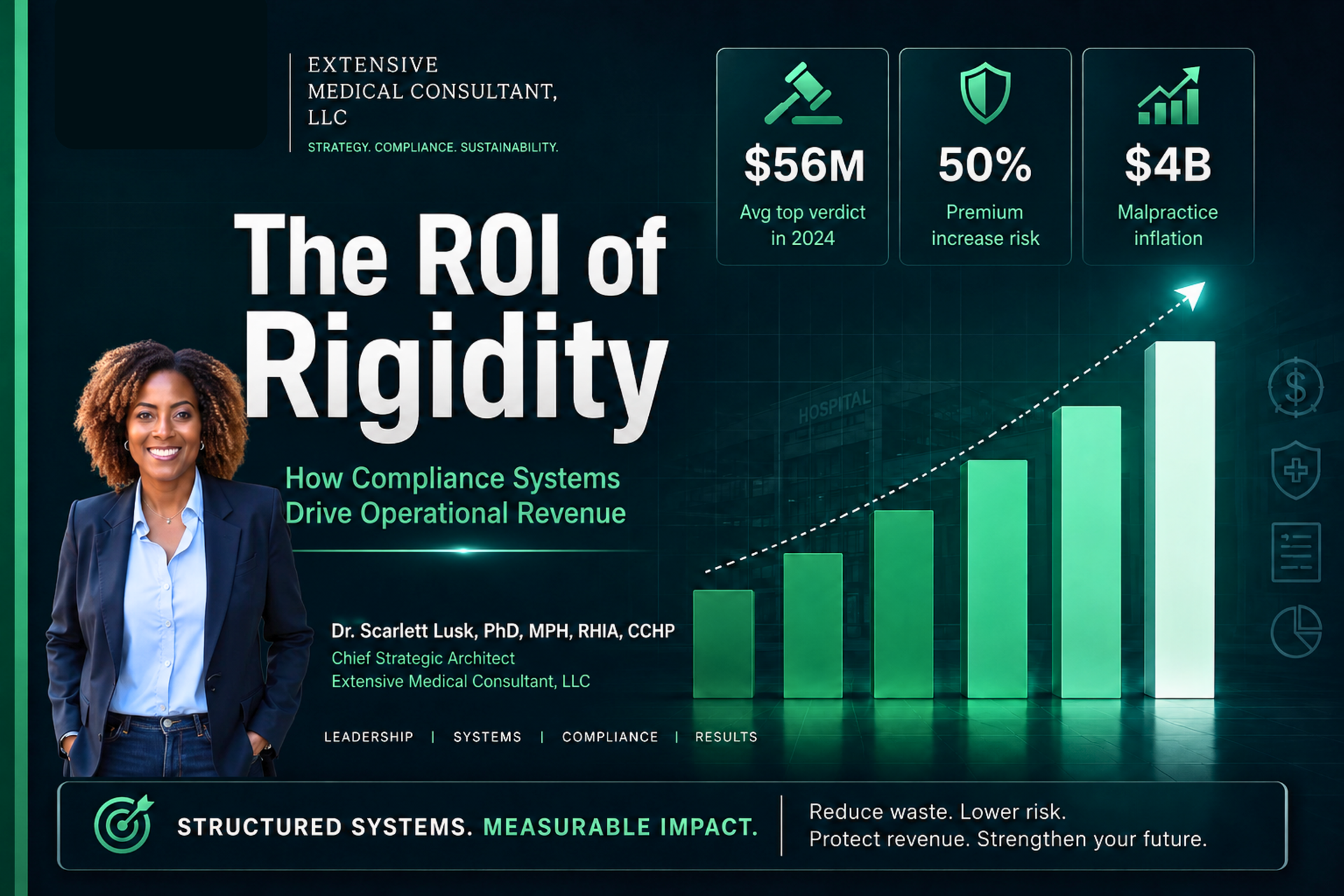
Healthcare compliance consultant reviewing financial performance dashboard — EMC, Houston TX
By Scarlett Lusk May 18, 2026
Learn how structured healthcare compliance systems reduce waste, lower litigation risk, and compress insurance premiums — generating measurable financial returns for CFOs and CEOs. Expert insight from Dr. Scarlett Lusk, Extensive Medical Consultant, LLC.
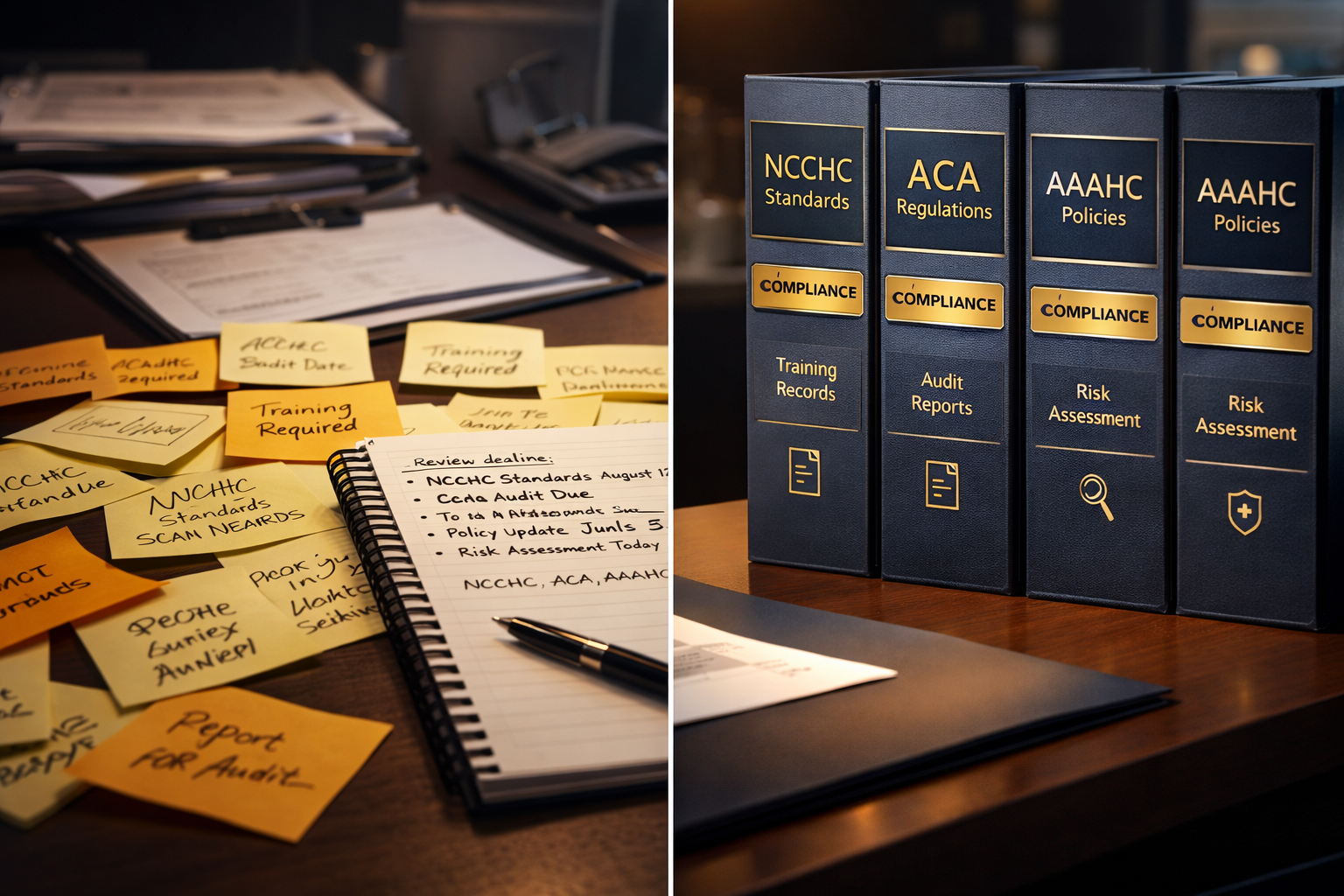
Beyond the Checklist: Continuous Accreditation Readiness for NCCHC, ACA & AAAHC | EMC
By Scarlett Lusk May 13, 2026
Discover how healthcare organizations can move beyond reactive accreditation preparation and build sustainable compliance systems for NCCHC, ACA, and AAAHC readiness with EMC and Dr. Scarlett Lusk.
The
By Scarlett Lusk April 21, 2026
Tribal knowledge in healthcare is your most dangerous compliance vulnerability. Discover how person-dependent systems create accreditation risk and how EMC builds the documentation frameworks that eliminate it.
By Scarlett Lusk April 11, 2026
Healthcare leadership burnout is a systems problem, not a personal one. Discover how EMC helps healthcare executives reduce operational pressure through compliance systems, workflow optimization, and leadership frameworks.
Healthcare accreditation consulting by Dr. Scarlett Lusk — compliance and audit readiness expert.
March 23, 2026
Failing accreditation costs more than a citation. Discover the true financial, reputational, and operational consequences — and how EMC helps you prevent them.
By Scarlett Lusk March 13, 2026
Modern healthcare organizations operate in an increasingly complex environment. Regulatory requirements evolve, accreditation standards tighten, and operational demands continue to grow. While internal teams work tirelessly to maintain quality care and efficient operations, many clinics eventually encounter challenges that require a fresh perspective. This is where external consulting expertise becomes valuable. Healthcare consultants are not replacements for internal leadership; they are strategic partners who help organizations strengthen systems, identify risks, and navigate complex compliance landscapes. Through structured guidance and objective analysis, consulting support can help clinics move from reactive problem-solving to proactive operational stability. Under the leadership of Dr. Scarlett Lusk, Extensive Medical Consultant works with healthcare organizations to provide that clarity, structure, and expertise. Why Internal Teams Often Miss Critical Blind Spots Healthcare professionals and administrators are deeply committed to their organizations. However, being closely involved in daily operations can sometimes make it difficult to recognize systemic issues. Internal teams often focus on immediate operational demands: Patient care coordination Staffing challenges Documentation management Regulatory compliance requirements Over time, these responsibilities can create operational “blind spots.” Processes that once worked well may become outdated, inefficient, or misaligned with current compliance expectations. Because internal teams are immersed in daily workflows, they may not always see the structural gaps forming beneath the surface. External consultants provide something essential: objective distance. They can analyze operations without the constraints of internal routines, allowing them to identify hidden inefficiencies, compliance vulnerabilities, and workflow breakdowns that might otherwise go unnoticed. The Value of Objective Leadership Support Healthcare leadership carries significant responsibility. Administrators and clinical leaders must balance patient care, regulatory compliance, operational efficiency, and staff wellbeing—all at the same time. In such high-pressure environments, objective leadership support becomes extremely valuable. External consultants serve as strategic advisors who help leaders: Evaluate operational structures Strengthen compliance frameworks Prepare for accreditation reviews Implement sustainable workflow improvements This type of guidance allows healthcare leaders to make informed decisions based on data, regulatory insight, and industry best practices. Rather than reacting to problems after they occur, organizations can build systems designed to prevent them. When Clinics Should Consider Bringing in Consultants Many clinics assume consulting support is only necessary during a crisis. In reality, the most effective consulting relationships begin before problems escalate. Healthcare organizations often benefit from external expertise during key moments of growth or transition, including: 1. Preparing for Accreditation or Regulatory Surveys Accreditation readiness requires careful preparation. Consultants help ensure policies, documentation, and operational workflows meet regulatory expectations before surveyors arrive. 2. Rapid Organizational Growth As clinics expand, operational structures must evolve. Growth often exposes inefficiencies or compliance gaps that were not visible at smaller scales. 3. Operational Workflow Challenges When teams experience recurring inefficiencies, communication breakdowns, or documentation issues, consulting support can help redesign workflows for greater clarity and efficiency. 4. Leadership Transitions New leadership often benefits from an external operational assessment to understand existing systems and identify areas for improvement. By bringing in consultants at these moments, clinics can proactively address structural issues rather than waiting for them to surface during audits or inspections. EMC’s Tailored Consulting Approach At Extensive Medical Consultant, consulting is not based on one-size-fits-all solutions. Every healthcare organization has unique operational structures, leadership styles, and regulatory challenges. That is why EMC focuses on tailored consulting strategies designed around each client’s specific needs. Guided by the extensive leadership experience of Dr. Scarlett Lusk, EMC provides consulting services that help healthcare organizations strengthen operational foundations while maintaining focus on patient care. The consulting approach emphasizes four key areas: Accreditation Preparation Healthcare organizations receive structured guidance to prepare for accreditation surveys with confidence. Compliance System Development EMC helps clinics design compliance systems that align with regulatory standards and support long-term operational stability. Workflow Optimization Operational workflows are evaluated and redesigned to improve efficiency, communication, and documentation processes. Leadership Support Healthcare executives receive strategic guidance to help them make informed decisions about organizational growth, risk management, and operational improvement. Through this structured and collaborative approach, EMC helps healthcare organizations move beyond temporary fixes and build sustainable systems that support long-term success. Building Stronger Healthcare Systems The healthcare environment will continue to evolve. Regulatory expectations will change, patient demands will grow, and operational complexity will increase. Organizations that thrive in this environment are those that prioritize strong systems, clear structures, and proactive leadership strategies. External consulting support plays an important role in helping healthcare leaders achieve these goals. By identifying blind spots, strengthening compliance frameworks, and optimizing workflows, consultants provide the strategic insight organizations need to operate confidently. With experienced leadership and a commitment to operational excellence, Extensive Medical Consultant continues to support healthcare organizations in building the systems that make sustainable success possible. Need guidance navigating accreditation, compliance, or operational challenges? Connect with Extensive Medical Consultant today to learn how expert consulting support can help strengthen your healthcare organization’s future.
By Scarlett Lusk March 2, 2026
Introduction: Leadership Alone Is Not Enough Healthcare leadership has never been more demanding. Regulatory pressure, workforce shortages, compliance complexity, patient safety expectations, and financial constraints create a constant state of operational tension. Many organizations respond by asking leaders to “do more.” More oversight. More engagement. More availability. But here is the strategic truth: Leadership effort without a leadership structure leads to exhaustion, not excellence. Strong healthcare leadership does not begin with personality, resilience, or even experience. It begins with systems. Dr. Scarlett Lusk, healthcare leadership strategist and founder of Extensive Medical Consultant, LLC, has consistently emphasized that sustainable executive performance is built on infrastructure, not intensity. Her work focuses on transforming overwhelmed leadership environments into structured, high-performing healthcare systems. Because in modern healthcare, effort may sustain you temporarily, but structure sustains you long-term. Leadership Effort vs. Leadership Structure One of the most misunderstood dynamics in healthcare organizations is the difference between leadership effort and leadership structure. Dr. Scarlett Lusk frequently identifies this distinction as the turning point between reactive management and strategic leadership. Leadership Effort Leadership effort is personal. It includes: Long hours Constant decision-making Hands-on crisis resolution Emotional labor Direct involvement in operational issues Effort can temporarily compensate for weak systems. However, it is not scalable, and it does not protect leaders from burnout or compliance risk. When organizations rely heavily on leadership effort, executives become the safety net for every gap in the system. That model is unsustainable. Leadership Structure Leadership structure is organizational. It includes: Defined workflows Clear accountability channels Compliance monitoring systems Communication frameworks Standard operating procedures Structure distributes responsibility. Structure creates predictability. Structure reduces dependency on individual heroics. Dr. Scarlett Lusk’s leadership framework focuses on strengthening these structural pillars so healthcare executives can shift from constant firefighting to strategic oversight. When healthcare systems rely primarily on structure, leaders regain clarity, authority, and sustainability. This distinction is critical in modern healthcare management. How Strong Systems Protect Healthcare Leaders Healthcare systems are not merely operational tools. They are protective architecture. Dr. Scarlett Lusk teaches that well-designed systems serve as executive safeguards, reducing exposure, stabilizing performance, and preventing overload. 1. Systems Reduce Decision Fatigue Without standardized processes, leaders make repetitive operational decisions every day. Over time, this constant cognitive load weakens clarity and slows strategic thinking. Defined systems streamline routine processes, allowing leaders to focus on growth, compliance, integrity, and long-term strategy. Protection begins with predictability. 2. Systems Strengthen Compliance and Risk Management Compliance failures are rarely caused by ignorance. They are often caused by inconsistency. Structured compliance systems: Track documentation Standardize reporting Clarify responsibility Reduce regulatory exposure Dr. Scarlett Lusk integrates compliance architecture directly into operational design, ensuring that protection is built into the system, not added after problems arise. This approach safeguards both the organization and its leadership. 3. Systems Improve Organizational Stability In healthcare, unpredictability increases stress at every level. Strong systems create operational rhythm. When workflows are clearly defined: Teams perform with confidence Communication improves Escalations decrease Leaders regain oversight clarity This stability impacts patient safety, financial performance, and staff retention. According to Dr. Scarlett Lusk, stability is not accidental; it is engineered. Preventing Crisis-Driven Healthcare Management Crisis-driven management is one of the most damaging leadership patterns in healthcare organizations. It often looks like: Constant urgency Reactive compliance responses Emergency staffing solutions Leadership burnout Short-term decision cycles While crisis management may feel productive, over time, it erodes culture, morale, and executive sustainability. Strong healthcare systems prevent crises before they escalate. By implementing: Early-warning compliance monitoring Operational dashboards Defined accountability layers Escalation protocols Organizations shift from reaction to prevention. This is where true strategic leadership emerges, and this is the transformation model Dr. Scarlett Lusk applies when working with healthcare organizations seeking long-term operational strength. Why This Approach Works in Healthcare Organizations Healthcare operates at the intersection of: Clinical care Regulatory governance Financial stewardship Human service delivery Because of this complexity: Informal management fails. Reactive leadership collapses under pressure. Effort-only leadership burns out. Structured healthcare systems align people, policies, and performance into a coordinated framework. Dr. Scarlett Lusk’s leadership model prioritizes: ✔ Organizational clarity ✔ Executive protection ✔ Operational predictability ✔ Sustainable compliance ✔ Long-term growth strategy This positions her not merely as a consultant, but as a healthcare leadership authority focused on systemic transformation. The Strategic Shift: From Overload to Oversight When healthcare leaders transition from effort-based leadership to structure-based leadership, the results are measurable. Before Systems: High stress Frequent compliance risk Reactive culture Leadership exhaustion After Systems: Strategic clarity Defined accountability Reduced operational volatility Sustainable executive performance This shift does not reduce leadership responsibility. It strengthens it. Under structured systems, leaders move from operational overload to strategic oversight, the position true leadership requires. Conclusion: Systems Are the Foundation of Strong Healthcare Leadership Healthcare leadership is not tested during calm seasons; it is tested during complexity. And complexity cannot be managed through effort alone. Strong healthcare leadership starts with strong systems because: Systems protect leaders from overload Systems reduce compliance exposure Systems prevent crisis-driven management Systems allow strategic vision to replace operational chaos In modern healthcare organizations, structure is not optional. It is foundational. Leaders deserve systems that support their responsibility, not systems that rely on their sacrifice. If your leadership team feels overwhelmed, reactive, or stretched beyond capacity, the issue may not be effort; it may be infrastructure. Dr. Scarlett Lusk works directly with healthcare organizations to design operational systems that protect leadership, strengthen compliance, and build sustainable performance. Do not wait for the next crisis to expose structural gaps. Schedule your strategic consultation today and begin building the systems that support strong healthcare leadership. Real leadership strength is not about carrying more. It is about designing better.
By Scarlett Lusk February 17, 2026
Introduction: The Audit Landscape Is Changing — Fast Healthcare audits in 2026 will not look the same as they did five years ago. Regulatory bodies are shifting their focus from surface-level compliance to operational proof, leadership accountability, and measurable implementation. Documentation alone is no longer enough. Auditors want evidence of integration, sustainability, and executive oversight. For many clinics, this shift represents a serious risk. At Extensive Medical Consultant, LLC (EMC), Dr. Scarlett Lusk, PhD, MPH, RHIA, CCHP, with 27 years of U.S. Public Health Service leadership, has observed a clear pattern: most clinics are not failing because they lack policies. They are failing because their systems do not consistently support implementation. Understanding what healthcare auditors expect in 2026 is the first step toward achieving true audit readiness. The 2026 Audit Reality: What Has Changed Healthcare accreditation bodies, including the Joint Commission, NCCHC, ACA, AAAHC, and ODO, are intensifying scrutiny in four major areas: 1. Demonstrated Implementation, Not Just Written Policies Auditors now expect: Real-time workflow consistency Staff interviews confirming procedural understanding Cross-department alignment Evidence of ongoing training A binder of policies will not pass an audit if frontline staff cannot articulate or demonstrate execution. In 2026, auditors are evaluating culture, not just paperwork. 2. Data Integrity and Measurable Outcomes Data transparency is no longer optional. Auditors are reviewing: Quality improvement metrics Incident tracking trends Infection prevention data Medication management patterns Claims and billing compliance indicators Organizations must show not only that they collect data, but that leadership actively reviews and responds to it. 3. Leadership Accountability One of the most significant changes in audit expectations is the emphasis on executive involvement. Surveyors increasingly ask: How does leadership monitor compliance? Who is accountable for corrective action? How are risks escalated and resolved? What governance structures ensure oversight? If leadership cannot clearly explain monitoring mechanisms, it signals structural weakness. Dr. Scarlett Lusk emphasizes that proactive healthcare management begins at the executive level. Without structured oversight, compliance becomes reactive rather than strategic. 4. System Sustainability Temporary compliance fixes are easily detected. Auditors in 2026 are looking for: Ongoing performance improvement cycles Documented corrective action follow-ups Standardized workflows Audit trails showing consistency over time Short-term “audit preparation” is no longer effective. Sustainable systems are now the standard. The Critical Gap: Documentation vs. Implementation One of the most common vulnerabilities EMC identifies during a clinic system review is the documentation-implementation gap. Many clinics have: Well-written policies Completed annual training records Structured procedure manuals Yet operational inconsistencies remain. This gap often reveals: Unclear delegation of responsibility Poor workflow design Communication breakdown between departments Insufficient monitoring systems Auditors recognize this disconnect immediately. Dr. Lusk’s background in healthcare systems research (PhD), public health oversight (MPH), health information administration (RHIA), and correctional healthcare compliance (CCHP) allows her to diagnose root causes beyond surface-level documentation. True audit readiness requires operational alignment, not just paperwork completion. Why Most Clinics Aren’t Ready for 2026 Despite growing regulatory expectations, many clinics remain vulnerable due to: Reactive compliance culture Leadership bandwidth constraints Fragmented reporting systems Inconsistent quality improvement processes Lack of structured accountability Operational stability in healthcare cannot be achieved through last-minute audit preparation. Audit readiness must be engineered into the system. EMC’s Audit-Readiness Approach At Extensive Medical Consultant, LLC, audit readiness is not a checklist exercise. It is a structural redesign process. Under Dr. Scarlett Lusk’s leadership, EMC applies a comprehensive, systems-based framework that includes: 1. Full Operational System Review Workflow mapping Role clarity evaluation Communication pathway analysis 2. Compliance Risk Assessment Gap analysis against current standards Documentation review Policy-implementation alignment 3. Leadership Accountability Framework Oversight structure design Executive reporting models Performance review protocols 4. Data-Driven Quality Monitoring KPI alignment Incident trend evaluation Continuous improvement structure EMC’s approach transforms clinics from reactive audit anxiety to proactive compliance confidence. Audit preparation becomes continuous rather than cyclical. The Future of Audit Readiness: Proactive, Data-Driven, Leadership-Led In 2026, healthcare auditors expect: Cultural compliance integration Measurable operational stability Executive accountability Sustainable system performance Organizations that treat compliance as a leadership strategy, not an administrative burden, will outperform those relying on reactive correction. Dr. Scarlett Lusk and Extensive Medical Consultant, LLC, specialize in helping clinics move from vulnerability to structural strength. Audit readiness is no longer about passing inspections. It is about building resilient healthcare systems. Conclusion: Are You Ready for 2026? The regulatory landscape is evolving. If your clinic relies on documentation without operational integration… If audit preparation feels stressful and last-minute… If leadership oversight lacks structure… It may be time for a strategic system review. Contact Dr. Scarlett Lusk and Extensive Medical Consultant, LLC, to schedule a comprehensive audit-readiness assessment and ensure your organization is prepared, not pressured, in 2026.
By Scarlett Lusk February 6, 2026
Overwhelmed by clinic chaos? Learn how a strategic clinic system review by Dr. Scarlett Lusk strengthens leadership and ensures operational stability.
By Scarlett Lusk January 17, 2026
Healthcare accreditation is often treated as a finish line. It is seen as a milestone to cross, celebrate, and then move on from until the next survey cycle appears. For healthcare leaders, administrators, and compliance professionals operating under standards set by the Joint Commission, NCCHC, ACA, ODO, and AAAHC, this mindset is not only outdated but also risky. Accreditation was never intended to function as a periodic checklist. It reflects how an organization operates every single day. In today’s regulatory environment, where expectations are higher and scrutiny is constant, continuous readiness is no longer optional. It is the foundation of sustainable, high-quality healthcare delivery. At Extensive Medical Consultant (EMC), led by Dr. Scarlett Lusk, PhD, MPH, RHIA, CCHP, accreditation is treated as an operational discipline. This approach strengthens governance, protects patients, and supports long-term organizational resilience. Accreditation Is More Than a Milestone Accreditation bodies do not exist to pass or fail organizations. Their role is to ensure that healthcare systems consistently meet standards that protect patient safety, ethical practice, and quality outcomes. When accreditation is treated as a once-every-few-years hurdle, organizations unintentionally weaken its true purpose. The reality is straightforward. When systems function effectively every day, accreditation becomes confirmation rather than a crisis. Section 1: Common Accreditation Misconceptions and Their Risks Despite years of regulatory advancement, several misconceptions continue to undermine healthcare organizations. Misconception 1: Accreditation Is a One-Time Checklist Many organizations rush to update policies, conduct last-minute training, and organize documentation just weeks before a survey. While this may create the appearance of readiness, it rarely reflects real practice. The risk includes: Inconsistent staff behavior Policies that exist on paper but are not followed Higher likelihood of findings during unannounced surveys Misconception 2: Passing the Last Survey Means You Are Compliant Accreditation standards evolve continuously. Regulatory interpretations change. What passed during the previous survey may no longer meet current expectations. The risk includes: Continued use of outdated policies Failure to address regulatory updates Exposure to citations, corrective action plans, or loss of accreditation Misconception 3: Accreditation Is the Compliance Department’s Responsibility Accreditation is often isolated within compliance teams while leadership and frontline staff remain disengaged. The risk includes: Staff confusion during surveys Leadership is unable to clearly explain compliance strategies A culture driven by reaction instead of accountability Misconception 4: Surveyors Only Review Documents Documentation is important, but it is not the primary focus of surveys. The risk includes: Excessive focus on paperwork Insufficient investment in operational systems and staff competency Section 2: What Surveyors Actually Look For Understanding surveyor expectations is essential for continuous readiness. Across accrediting bodies, surveyors assess whether policy, practice, and outcomes are aligned. 1. Consistency Between Policy and Practice Surveyors observe operations, interview staff, and review documentation to confirm that policies are actively followed. They evaluate whether: Staff understand policies related to their roles Procedures are applied consistently across shifts and departments Leadership can explain how compliance is monitored 2. Leadership Engagement Surveyors expect leadership to be informed, visible, and accountable. They assess: How leaders oversee compliance Whether governance structures support quality and safety If leadership addresses risk proactively 3. Staff Competency and Training Training records alone are insufficient. Surveyors validate training through staff interaction. They look for: Staff confidence in explaining procedures Evidence of ongoing education Clear understanding of emergency, safety, and ethical protocols 4. Continuous Monitoring and Improvement Accreditation bodies emphasize improvement rather than perfection. Surveyors expect to see: Internal audits and self-assessments Corrective actions driven by data Proof that issues are identified internally before external review Section 3: Year-Round Continuous Readiness Strategies Organizations that maintain readiness do not scramble before surveys. Accreditation is embedded in daily operations. 1. Living Policies Instead of Static Manuals Effective policies are: Reviewed on a scheduled basis Updated when regulations change Integrated into daily workflows Best practice: Assign ownership for each policy area and systematically track revisions. 2. Ongoing Staff Education Training should be continuous, role-specific, and practical. Effective methods include: Short, recurring competency refreshers Scenario-based learning Leadership-led discussions that reinforce expectations 3. Internal Audits and Mock Surveys Routine self-assessments reveal gaps early. Key components include: Internal audits aligned with accreditation standards Leadership participation in mock surveys Clear tracking of corrective actions 4. Data-Driven Monitoring Continuous readiness relies on measurable insight. Organizations should monitor: Incident trends Compliance metrics Quality indicators linked to accreditation standards Data transforms compliance from a reactive task into a strategic advantage. 5. Leadership Accountability When leadership owns accreditation, readiness becomes part of organizational culture. This includes: Regular compliance briefings Clear reporting structures Visible leadership involvement in preparedness efforts Section 4: EMC’s Proactive Accreditation Model At Extensive Medical Consultant, accreditation is treated as an integrated operational system rather than a seasonal project. Under the leadership of Dr. Scarlett Lusk, EMC has developed a proactive model that supports continuous readiness across correctional healthcare, public health systems, ambulatory care, and private clinics. Key Elements of EMC’s Model 1. Systems-Based Assessment EMC evaluates how governance, operations, staffing, and policies function together. 2. Regulatory Alignment Across Standards EMC helps organizations meet overlapping requirements from multiple accrediting bodies through unified systems. 3. Leadership-Centered Readiness Executive teams are equipped to engage confidently with surveyors and sustain compliance. 4. Continuous Support EMC partners with organizations year-round instead of appearing only before surveys. 5. Education and Empowerment Staff and leadership learn not only how to meet standards, but why those standards exist and how they improve care. This approach transforms accreditation from a source of stress into a strategic asset. Conclusion: Readiness Is a Leadership Decision Accreditation is not a single moment in time. It reflects leadership commitment, organizational discipline, and system integrity. Healthcare organizations that embrace continuous readiness: Reduce regulatory risk Improve patient outcomes Strengthen staff confidence Build sustainable operational excellence Organizations that rely on last-minute preparation expose themselves to disruption and reputational harm. The question is no longer when your next survey will occur. The question is whether your systems are ready today . At Extensive Medical Consultant, Dr. Scarlett Lusk and her team help organizations move beyond checklist compliance toward lasting readiness and resilience. If your organization is ready to transition from reactive accreditation to continuous confidence, now is the time to act.
More Posts
Healthcare compliance consultant reviewing financial performance dashboard — EMC, Houston TX
By Scarlett Lusk May 18, 2026
Learn how structured healthcare compliance systems reduce waste, lower litigation risk, and compress insurance premiums — generating measurable financial returns for CFOs and CEOs. Expert insight from Dr. Scarlett Lusk, Extensive Medical Consultant, LLC.
Beyond the Checklist: Continuous Accreditation Readiness for NCCHC, ACA & AAAHC | EMC
By Scarlett Lusk May 13, 2026
Discover how healthcare organizations can move beyond reactive accreditation preparation and build sustainable compliance systems for NCCHC, ACA, and AAAHC readiness with EMC and Dr. Scarlett Lusk.
The
By Scarlett Lusk April 21, 2026
Tribal knowledge in healthcare is your most dangerous compliance vulnerability. Discover how person-dependent systems create accreditation risk and how EMC builds the documentation frameworks that eliminate it.
By Scarlett Lusk April 11, 2026
Healthcare leadership burnout is a systems problem, not a personal one. Discover how EMC helps healthcare executives reduce operational pressure through compliance systems, workflow optimization, and leadership frameworks.
Healthcare accreditation consulting by Dr. Scarlett Lusk — compliance and audit readiness expert.
March 23, 2026
Failing accreditation costs more than a citation. Discover the true financial, reputational, and operational consequences — and how EMC helps you prevent them.
By Scarlett Lusk March 13, 2026
Modern healthcare organizations operate in an increasingly complex environment. Regulatory requirements evolve, accreditation standards tighten, and operational demands continue to grow. While internal teams work tirelessly to maintain quality care and efficient operations, many clinics eventually encounter challenges that require a fresh perspective. This is where external consulting expertise becomes valuable. Healthcare consultants are not replacements for internal leadership; they are strategic partners who help organizations strengthen systems, identify risks, and navigate complex compliance landscapes. Through structured guidance and objective analysis, consulting support can help clinics move from reactive problem-solving to proactive operational stability. Under the leadership of Dr. Scarlett Lusk, Extensive Medical Consultant works with healthcare organizations to provide that clarity, structure, and expertise. Why Internal Teams Often Miss Critical Blind Spots Healthcare professionals and administrators are deeply committed to their organizations. However, being closely involved in daily operations can sometimes make it difficult to recognize systemic issues. Internal teams often focus on immediate operational demands: Patient care coordination Staffing challenges Documentation management Regulatory compliance requirements Over time, these responsibilities can create operational “blind spots.” Processes that once worked well may become outdated, inefficient, or misaligned with current compliance expectations. Because internal teams are immersed in daily workflows, they may not always see the structural gaps forming beneath the surface. External consultants provide something essential: objective distance. They can analyze operations without the constraints of internal routines, allowing them to identify hidden inefficiencies, compliance vulnerabilities, and workflow breakdowns that might otherwise go unnoticed. The Value of Objective Leadership Support Healthcare leadership carries significant responsibility. Administrators and clinical leaders must balance patient care, regulatory compliance, operational efficiency, and staff wellbeing—all at the same time. In such high-pressure environments, objective leadership support becomes extremely valuable. External consultants serve as strategic advisors who help leaders: Evaluate operational structures Strengthen compliance frameworks Prepare for accreditation reviews Implement sustainable workflow improvements This type of guidance allows healthcare leaders to make informed decisions based on data, regulatory insight, and industry best practices. Rather than reacting to problems after they occur, organizations can build systems designed to prevent them. When Clinics Should Consider Bringing in Consultants Many clinics assume consulting support is only necessary during a crisis. In reality, the most effective consulting relationships begin before problems escalate. Healthcare organizations often benefit from external expertise during key moments of growth or transition, including: 1. Preparing for Accreditation or Regulatory Surveys Accreditation readiness requires careful preparation. Consultants help ensure policies, documentation, and operational workflows meet regulatory expectations before surveyors arrive. 2. Rapid Organizational Growth As clinics expand, operational structures must evolve. Growth often exposes inefficiencies or compliance gaps that were not visible at smaller scales. 3. Operational Workflow Challenges When teams experience recurring inefficiencies, communication breakdowns, or documentation issues, consulting support can help redesign workflows for greater clarity and efficiency. 4. Leadership Transitions New leadership often benefits from an external operational assessment to understand existing systems and identify areas for improvement. By bringing in consultants at these moments, clinics can proactively address structural issues rather than waiting for them to surface during audits or inspections. EMC’s Tailored Consulting Approach At Extensive Medical Consultant, consulting is not based on one-size-fits-all solutions. Every healthcare organization has unique operational structures, leadership styles, and regulatory challenges. That is why EMC focuses on tailored consulting strategies designed around each client’s specific needs. Guided by the extensive leadership experience of Dr. Scarlett Lusk, EMC provides consulting services that help healthcare organizations strengthen operational foundations while maintaining focus on patient care. The consulting approach emphasizes four key areas: Accreditation Preparation Healthcare organizations receive structured guidance to prepare for accreditation surveys with confidence. Compliance System Development EMC helps clinics design compliance systems that align with regulatory standards and support long-term operational stability. Workflow Optimization Operational workflows are evaluated and redesigned to improve efficiency, communication, and documentation processes. Leadership Support Healthcare executives receive strategic guidance to help them make informed decisions about organizational growth, risk management, and operational improvement. Through this structured and collaborative approach, EMC helps healthcare organizations move beyond temporary fixes and build sustainable systems that support long-term success. Building Stronger Healthcare Systems The healthcare environment will continue to evolve. Regulatory expectations will change, patient demands will grow, and operational complexity will increase. Organizations that thrive in this environment are those that prioritize strong systems, clear structures, and proactive leadership strategies. External consulting support plays an important role in helping healthcare leaders achieve these goals. By identifying blind spots, strengthening compliance frameworks, and optimizing workflows, consultants provide the strategic insight organizations need to operate confidently. With experienced leadership and a commitment to operational excellence, Extensive Medical Consultant continues to support healthcare organizations in building the systems that make sustainable success possible. Need guidance navigating accreditation, compliance, or operational challenges? Connect with Extensive Medical Consultant today to learn how expert consulting support can help strengthen your healthcare organization’s future.
By Scarlett Lusk March 2, 2026
Introduction: Leadership Alone Is Not Enough Healthcare leadership has never been more demanding. Regulatory pressure, workforce shortages, compliance complexity, patient safety expectations, and financial constraints create a constant state of operational tension. Many organizations respond by asking leaders to “do more.” More oversight. More engagement. More availability. But here is the strategic truth: Leadership effort without a leadership structure leads to exhaustion, not excellence. Strong healthcare leadership does not begin with personality, resilience, or even experience. It begins with systems. Dr. Scarlett Lusk, healthcare leadership strategist and founder of Extensive Medical Consultant, LLC, has consistently emphasized that sustainable executive performance is built on infrastructure, not intensity. Her work focuses on transforming overwhelmed leadership environments into structured, high-performing healthcare systems. Because in modern healthcare, effort may sustain you temporarily, but structure sustains you long-term. Leadership Effort vs. Leadership Structure One of the most misunderstood dynamics in healthcare organizations is the difference between leadership effort and leadership structure. Dr. Scarlett Lusk frequently identifies this distinction as the turning point between reactive management and strategic leadership. Leadership Effort Leadership effort is personal. It includes: Long hours Constant decision-making Hands-on crisis resolution Emotional labor Direct involvement in operational issues Effort can temporarily compensate for weak systems. However, it is not scalable, and it does not protect leaders from burnout or compliance risk. When organizations rely heavily on leadership effort, executives become the safety net for every gap in the system. That model is unsustainable. Leadership Structure Leadership structure is organizational. It includes: Defined workflows Clear accountability channels Compliance monitoring systems Communication frameworks Standard operating procedures Structure distributes responsibility. Structure creates predictability. Structure reduces dependency on individual heroics. Dr. Scarlett Lusk’s leadership framework focuses on strengthening these structural pillars so healthcare executives can shift from constant firefighting to strategic oversight. When healthcare systems rely primarily on structure, leaders regain clarity, authority, and sustainability. This distinction is critical in modern healthcare management. How Strong Systems Protect Healthcare Leaders Healthcare systems are not merely operational tools. They are protective architecture. Dr. Scarlett Lusk teaches that well-designed systems serve as executive safeguards, reducing exposure, stabilizing performance, and preventing overload. 1. Systems Reduce Decision Fatigue Without standardized processes, leaders make repetitive operational decisions every day. Over time, this constant cognitive load weakens clarity and slows strategic thinking. Defined systems streamline routine processes, allowing leaders to focus on growth, compliance, integrity, and long-term strategy. Protection begins with predictability. 2. Systems Strengthen Compliance and Risk Management Compliance failures are rarely caused by ignorance. They are often caused by inconsistency. Structured compliance systems: Track documentation Standardize reporting Clarify responsibility Reduce regulatory exposure Dr. Scarlett Lusk integrates compliance architecture directly into operational design, ensuring that protection is built into the system, not added after problems arise. This approach safeguards both the organization and its leadership. 3. Systems Improve Organizational Stability In healthcare, unpredictability increases stress at every level. Strong systems create operational rhythm. When workflows are clearly defined: Teams perform with confidence Communication improves Escalations decrease Leaders regain oversight clarity This stability impacts patient safety, financial performance, and staff retention. According to Dr. Scarlett Lusk, stability is not accidental; it is engineered. Preventing Crisis-Driven Healthcare Management Crisis-driven management is one of the most damaging leadership patterns in healthcare organizations. It often looks like: Constant urgency Reactive compliance responses Emergency staffing solutions Leadership burnout Short-term decision cycles While crisis management may feel productive, over time, it erodes culture, morale, and executive sustainability. Strong healthcare systems prevent crises before they escalate. By implementing: Early-warning compliance monitoring Operational dashboards Defined accountability layers Escalation protocols Organizations shift from reaction to prevention. This is where true strategic leadership emerges, and this is the transformation model Dr. Scarlett Lusk applies when working with healthcare organizations seeking long-term operational strength. Why This Approach Works in Healthcare Organizations Healthcare operates at the intersection of: Clinical care Regulatory governance Financial stewardship Human service delivery Because of this complexity: Informal management fails. Reactive leadership collapses under pressure. Effort-only leadership burns out. Structured healthcare systems align people, policies, and performance into a coordinated framework. Dr. Scarlett Lusk’s leadership model prioritizes: ✔ Organizational clarity ✔ Executive protection ✔ Operational predictability ✔ Sustainable compliance ✔ Long-term growth strategy This positions her not merely as a consultant, but as a healthcare leadership authority focused on systemic transformation. The Strategic Shift: From Overload to Oversight When healthcare leaders transition from effort-based leadership to structure-based leadership, the results are measurable. Before Systems: High stress Frequent compliance risk Reactive culture Leadership exhaustion After Systems: Strategic clarity Defined accountability Reduced operational volatility Sustainable executive performance This shift does not reduce leadership responsibility. It strengthens it. Under structured systems, leaders move from operational overload to strategic oversight, the position true leadership requires. Conclusion: Systems Are the Foundation of Strong Healthcare Leadership Healthcare leadership is not tested during calm seasons; it is tested during complexity. And complexity cannot be managed through effort alone. Strong healthcare leadership starts with strong systems because: Systems protect leaders from overload Systems reduce compliance exposure Systems prevent crisis-driven management Systems allow strategic vision to replace operational chaos In modern healthcare organizations, structure is not optional. It is foundational. Leaders deserve systems that support their responsibility, not systems that rely on their sacrifice. If your leadership team feels overwhelmed, reactive, or stretched beyond capacity, the issue may not be effort; it may be infrastructure. Dr. Scarlett Lusk works directly with healthcare organizations to design operational systems that protect leadership, strengthen compliance, and build sustainable performance. Do not wait for the next crisis to expose structural gaps. Schedule your strategic consultation today and begin building the systems that support strong healthcare leadership. Real leadership strength is not about carrying more. It is about designing better.
By Scarlett Lusk February 17, 2026
Introduction: The Audit Landscape Is Changing — Fast Healthcare audits in 2026 will not look the same as they did five years ago. Regulatory bodies are shifting their focus from surface-level compliance to operational proof, leadership accountability, and measurable implementation. Documentation alone is no longer enough. Auditors want evidence of integration, sustainability, and executive oversight. For many clinics, this shift represents a serious risk. At Extensive Medical Consultant, LLC (EMC), Dr. Scarlett Lusk, PhD, MPH, RHIA, CCHP, with 27 years of U.S. Public Health Service leadership, has observed a clear pattern: most clinics are not failing because they lack policies. They are failing because their systems do not consistently support implementation. Understanding what healthcare auditors expect in 2026 is the first step toward achieving true audit readiness. The 2026 Audit Reality: What Has Changed Healthcare accreditation bodies, including the Joint Commission, NCCHC, ACA, AAAHC, and ODO, are intensifying scrutiny in four major areas: 1. Demonstrated Implementation, Not Just Written Policies Auditors now expect: Real-time workflow consistency Staff interviews confirming procedural understanding Cross-department alignment Evidence of ongoing training A binder of policies will not pass an audit if frontline staff cannot articulate or demonstrate execution. In 2026, auditors are evaluating culture, not just paperwork. 2. Data Integrity and Measurable Outcomes Data transparency is no longer optional. Auditors are reviewing: Quality improvement metrics Incident tracking trends Infection prevention data Medication management patterns Claims and billing compliance indicators Organizations must show not only that they collect data, but that leadership actively reviews and responds to it. 3. Leadership Accountability One of the most significant changes in audit expectations is the emphasis on executive involvement. Surveyors increasingly ask: How does leadership monitor compliance? Who is accountable for corrective action? How are risks escalated and resolved? What governance structures ensure oversight? If leadership cannot clearly explain monitoring mechanisms, it signals structural weakness. Dr. Scarlett Lusk emphasizes that proactive healthcare management begins at the executive level. Without structured oversight, compliance becomes reactive rather than strategic. 4. System Sustainability Temporary compliance fixes are easily detected. Auditors in 2026 are looking for: Ongoing performance improvement cycles Documented corrective action follow-ups Standardized workflows Audit trails showing consistency over time Short-term “audit preparation” is no longer effective. Sustainable systems are now the standard. The Critical Gap: Documentation vs. Implementation One of the most common vulnerabilities EMC identifies during a clinic system review is the documentation-implementation gap. Many clinics have: Well-written policies Completed annual training records Structured procedure manuals Yet operational inconsistencies remain. This gap often reveals: Unclear delegation of responsibility Poor workflow design Communication breakdown between departments Insufficient monitoring systems Auditors recognize this disconnect immediately. Dr. Lusk’s background in healthcare systems research (PhD), public health oversight (MPH), health information administration (RHIA), and correctional healthcare compliance (CCHP) allows her to diagnose root causes beyond surface-level documentation. True audit readiness requires operational alignment, not just paperwork completion. Why Most Clinics Aren’t Ready for 2026 Despite growing regulatory expectations, many clinics remain vulnerable due to: Reactive compliance culture Leadership bandwidth constraints Fragmented reporting systems Inconsistent quality improvement processes Lack of structured accountability Operational stability in healthcare cannot be achieved through last-minute audit preparation. Audit readiness must be engineered into the system. EMC’s Audit-Readiness Approach At Extensive Medical Consultant, LLC, audit readiness is not a checklist exercise. It is a structural redesign process. Under Dr. Scarlett Lusk’s leadership, EMC applies a comprehensive, systems-based framework that includes: 1. Full Operational System Review Workflow mapping Role clarity evaluation Communication pathway analysis 2. Compliance Risk Assessment Gap analysis against current standards Documentation review Policy-implementation alignment 3. Leadership Accountability Framework Oversight structure design Executive reporting models Performance review protocols 4. Data-Driven Quality Monitoring KPI alignment Incident trend evaluation Continuous improvement structure EMC’s approach transforms clinics from reactive audit anxiety to proactive compliance confidence. Audit preparation becomes continuous rather than cyclical. The Future of Audit Readiness: Proactive, Data-Driven, Leadership-Led In 2026, healthcare auditors expect: Cultural compliance integration Measurable operational stability Executive accountability Sustainable system performance Organizations that treat compliance as a leadership strategy, not an administrative burden, will outperform those relying on reactive correction. Dr. Scarlett Lusk and Extensive Medical Consultant, LLC, specialize in helping clinics move from vulnerability to structural strength. Audit readiness is no longer about passing inspections. It is about building resilient healthcare systems. Conclusion: Are You Ready for 2026? The regulatory landscape is evolving. If your clinic relies on documentation without operational integration… If audit preparation feels stressful and last-minute… If leadership oversight lacks structure… It may be time for a strategic system review. Contact Dr. Scarlett Lusk and Extensive Medical Consultant, LLC, to schedule a comprehensive audit-readiness assessment and ensure your organization is prepared, not pressured, in 2026.
By Scarlett Lusk February 6, 2026
Overwhelmed by clinic chaos? Learn how a strategic clinic system review by Dr. Scarlett Lusk strengthens leadership and ensures operational stability.
By Scarlett Lusk January 17, 2026
Healthcare accreditation is often treated as a finish line. It is seen as a milestone to cross, celebrate, and then move on from until the next survey cycle appears. For healthcare leaders, administrators, and compliance professionals operating under standards set by the Joint Commission, NCCHC, ACA, ODO, and AAAHC, this mindset is not only outdated but also risky. Accreditation was never intended to function as a periodic checklist. It reflects how an organization operates every single day. In today’s regulatory environment, where expectations are higher and scrutiny is constant, continuous readiness is no longer optional. It is the foundation of sustainable, high-quality healthcare delivery. At Extensive Medical Consultant (EMC), led by Dr. Scarlett Lusk, PhD, MPH, RHIA, CCHP, accreditation is treated as an operational discipline. This approach strengthens governance, protects patients, and supports long-term organizational resilience. Accreditation Is More Than a Milestone Accreditation bodies do not exist to pass or fail organizations. Their role is to ensure that healthcare systems consistently meet standards that protect patient safety, ethical practice, and quality outcomes. When accreditation is treated as a once-every-few-years hurdle, organizations unintentionally weaken its true purpose. The reality is straightforward. When systems function effectively every day, accreditation becomes confirmation rather than a crisis. Section 1: Common Accreditation Misconceptions and Their Risks Despite years of regulatory advancement, several misconceptions continue to undermine healthcare organizations. Misconception 1: Accreditation Is a One-Time Checklist Many organizations rush to update policies, conduct last-minute training, and organize documentation just weeks before a survey. While this may create the appearance of readiness, it rarely reflects real practice. The risk includes: Inconsistent staff behavior Policies that exist on paper but are not followed Higher likelihood of findings during unannounced surveys Misconception 2: Passing the Last Survey Means You Are Compliant Accreditation standards evolve continuously. Regulatory interpretations change. What passed during the previous survey may no longer meet current expectations. The risk includes: Continued use of outdated policies Failure to address regulatory updates Exposure to citations, corrective action plans, or loss of accreditation Misconception 3: Accreditation Is the Compliance Department’s Responsibility Accreditation is often isolated within compliance teams while leadership and frontline staff remain disengaged. The risk includes: Staff confusion during surveys Leadership is unable to clearly explain compliance strategies A culture driven by reaction instead of accountability Misconception 4: Surveyors Only Review Documents Documentation is important, but it is not the primary focus of surveys. The risk includes: Excessive focus on paperwork Insufficient investment in operational systems and staff competency Section 2: What Surveyors Actually Look For Understanding surveyor expectations is essential for continuous readiness. Across accrediting bodies, surveyors assess whether policy, practice, and outcomes are aligned. 1. Consistency Between Policy and Practice Surveyors observe operations, interview staff, and review documentation to confirm that policies are actively followed. They evaluate whether: Staff understand policies related to their roles Procedures are applied consistently across shifts and departments Leadership can explain how compliance is monitored 2. Leadership Engagement Surveyors expect leadership to be informed, visible, and accountable. They assess: How leaders oversee compliance Whether governance structures support quality and safety If leadership addresses risk proactively 3. Staff Competency and Training Training records alone are insufficient. Surveyors validate training through staff interaction. They look for: Staff confidence in explaining procedures Evidence of ongoing education Clear understanding of emergency, safety, and ethical protocols 4. Continuous Monitoring and Improvement Accreditation bodies emphasize improvement rather than perfection. Surveyors expect to see: Internal audits and self-assessments Corrective actions driven by data Proof that issues are identified internally before external review Section 3: Year-Round Continuous Readiness Strategies Organizations that maintain readiness do not scramble before surveys. Accreditation is embedded in daily operations. 1. Living Policies Instead of Static Manuals Effective policies are: Reviewed on a scheduled basis Updated when regulations change Integrated into daily workflows Best practice: Assign ownership for each policy area and systematically track revisions. 2. Ongoing Staff Education Training should be continuous, role-specific, and practical. Effective methods include: Short, recurring competency refreshers Scenario-based learning Leadership-led discussions that reinforce expectations 3. Internal Audits and Mock Surveys Routine self-assessments reveal gaps early. Key components include: Internal audits aligned with accreditation standards Leadership participation in mock surveys Clear tracking of corrective actions 4. Data-Driven Monitoring Continuous readiness relies on measurable insight. Organizations should monitor: Incident trends Compliance metrics Quality indicators linked to accreditation standards Data transforms compliance from a reactive task into a strategic advantage. 5. Leadership Accountability When leadership owns accreditation, readiness becomes part of organizational culture. This includes: Regular compliance briefings Clear reporting structures Visible leadership involvement in preparedness efforts Section 4: EMC’s Proactive Accreditation Model At Extensive Medical Consultant, accreditation is treated as an integrated operational system rather than a seasonal project. Under the leadership of Dr. Scarlett Lusk, EMC has developed a proactive model that supports continuous readiness across correctional healthcare, public health systems, ambulatory care, and private clinics. Key Elements of EMC’s Model 1. Systems-Based Assessment EMC evaluates how governance, operations, staffing, and policies function together. 2. Regulatory Alignment Across Standards EMC helps organizations meet overlapping requirements from multiple accrediting bodies through unified systems. 3. Leadership-Centered Readiness Executive teams are equipped to engage confidently with surveyors and sustain compliance. 4. Continuous Support EMC partners with organizations year-round instead of appearing only before surveys. 5. Education and Empowerment Staff and leadership learn not only how to meet standards, but why those standards exist and how they improve care. This approach transforms accreditation from a source of stress into a strategic asset. Conclusion: Readiness Is a Leadership Decision Accreditation is not a single moment in time. It reflects leadership commitment, organizational discipline, and system integrity. Healthcare organizations that embrace continuous readiness: Reduce regulatory risk Improve patient outcomes Strengthen staff confidence Build sustainable operational excellence Organizations that rely on last-minute preparation expose themselves to disruption and reputational harm. The question is no longer when your next survey will occur. The question is whether your systems are ready today . At Extensive Medical Consultant, Dr. Scarlett Lusk and her team help organizations move beyond checklist compliance toward lasting readiness and resilience. If your organization is ready to transition from reactive accreditation to continuous confidence, now is the time to act.