From Chaos to Control: How a Strategic System Review Strengthens Clinic Leadership
The Daily Reality of Clinic Chaos
The phones are ringing. A patient is waiting. A staff member is calling in sick. Billing is flagging another denied claim. Compliance documentation is incomplete.
And you, the clinic owner or medical director, are once again putting out fires.
You didn’t build your practice to live in constant crisis mode. You chose healthcare to deliver quality care, to lead teams, to create impact. Yet instead of shaping strategy, you’re trapped inside daily operational turbulence responding, fixing, reacting.
Here is the hard truth many leaders hesitate to confront:
Clinic chaos is rarely a people problem. It is almost always a system failure.
When the structure breaks down, even the most talented staff struggle. When workflows lack clarity, even experienced leaders feel overwhelmed. And when systems are fragile, compliance, revenue, and morale suffer.
At Extensive Medical Consultant, LLC (EMC), Dr. Scarlett Lusk, PhD, MPH, RHIA, CCHP, has built her career diagnosing what others overlook: the structural weaknesses hidden beneath surface-level problems. Through a strategic clinic system review, she helps leaders move from constant crisis management to lasting operational stability in healthcare.
The Silent Signs Your Clinic Systems Are Breaking Down
Operational breakdown rarely announces itself loudly. It appears gradually in patterns, in recurring frustrations, in “small issues” that never fully resolve.
If you recognize these signs, your clinic may be experiencing structural instability:
- Frequent compliance near-misses or last-minute documentation scrambles
- High staff turnover driven by burnout and unclear expectations
- Inconsistent patient onboarding processes that vary by staff member
- Billing delays and claim denials without a clear root cause analysis
- Disorganized workflows leading to duplicated effort
- Survey or audit anxiety that surfaces every accreditation cycle
These are not isolated annoyances.
They are symptoms of a fragile operational foundation.
Without a strategic clinic system review, leadership remains stuck addressing symptoms rather than root causes. And over time, reducing clinic chaos becomes nearly impossible because the underlying structure remains unchanged.
The Leadership Drain: How Poor Structure Erodes Vision
Leadership requires clarity, perspective, and strategic focus.
But when your day is consumed by operational emergencies, your leadership bandwidth disappears.
Reactive management creates:
- Short-term decision-making instead of long-term planning
- Inconsistent accountability across departments
- Team frustration due to unclear systems
- Erosion of patient confidence
- Increased regulatory risk
Over time, this cycle reshapes your culture. Staff begin to operate in survival mode. Initiative declines. Innovation slows. Morale weakens.
This is where healthcare leadership strategy becomes essential.
Dr. Scarlett Lusk understands this dynamic deeply. With her interdisciplinary expertise in healthcare systems research (PhD), public health leadership (MPH), health information administration (RHIA), and correctional healthcare compliance (CCHP), she approaches medical practice consulting not as surface-level advising but as architectural redesign. Her combined background allows her to diagnose structural vulnerabilities others overlook, translating regulatory complexity and operational data into clear, sustainable system design.
She recognizes that when structure stabilizes, leadership is liberated.
The EMC Approach: More Than Just a Check-Up
At Extensive Medical Consultant, LLC, a clinic system review is not a checklist exercise.
Under Dr. Scarlett Lusk’s leadership, it is a rigorous diagnostic deep-dive into your clinic’s operational DNA.
Unlike consultants who focus only on isolated compliance gaps, EMC conducts a comprehensive structural analysis that includes:
1. Workflow Architecture Assessment
- Mapping patient flow from intake to discharge
- Identifying bottlenecks and redundancy
- Evaluating communication pathways between departments
2. Compliance & Audit Readiness Evaluation
- Reviewing documentation integrity
- Identifying regulatory exposure risks
- Assessing readiness for the Joint Commission, NCCHC, ACA, or AAAHC standards
3. Data-Driven Performance Review
- Analyzing quality metrics
- Examining claim patterns and reimbursement trends
- Identifying inefficiencies through measurable indicators
4. Leadership Alignment Review
- Clarifying accountability structures
- Evaluating management oversight systems
- Strengthening proactive healthcare management practices
Dr. Lusk’s unique ability lies in connecting these components. She sees how a billing delay may be linked to workflow misalignment. How compliance stress may stem from unclear delegation. How staff burnout may signal structural inefficiency.
This systems-based approach is what transforms chaotic clinics into stable, high-performing organizations.
Achieving Long-Term Operational Stability
When a clinic transitions from reactive to strategic management, the transformation is profound.
After a structured intervention guided by EMC, leaders often report:
- Predictable daily operations
- Reduced compliance anxiety
- Improved patient flow
- Strengthened team morale
- Sustainable audit readiness
- Scalable growth capacity
Instead of scrambling before inspections, the clinic remains continuously prepared.
Instead of reacting to crises, leadership anticipates risk.
Instead of firefighting, leaders regain the time and clarity to guide vision.
Operational stability in healthcare is not achieved by working harder. It is achieved by designing better systems.
And system design requires expertise.
Control Is a Choice Made Through Design
Chaos is not inevitable. It is a signal.
A signal that your systems require intentional redesign.
Dr. Scarlett Lusk and Extensive Medical Consultant, LLC, specialize in guiding overwhelmed clinic leaders through that redesign, moving from instability to operational strength through strategic system review and healthcare leadership strategy.
If you are tired of feeling buried in daily crises…
If your leadership vision feels overshadowed by operational noise…
If your clinic deserves stability rather than survival mode…
It is time to stop accepting chaos as normal.
Contact Dr. Scarlett Lusk and Extensive Medical Consultant, LLC
today to schedule an initial assessment and begin your transition from chaos to control.

Discover the hidden operational gaps — "silent zones" — that drive compliance failures in ambulatory and correctional healthcare. Expert insight from Dr. Scarlett Lusk, EMC.

Poor clinical documentation creates legal vulnerability even when care was correct. Learn how EMC builds systemic documentation frameworks that protect your organization.
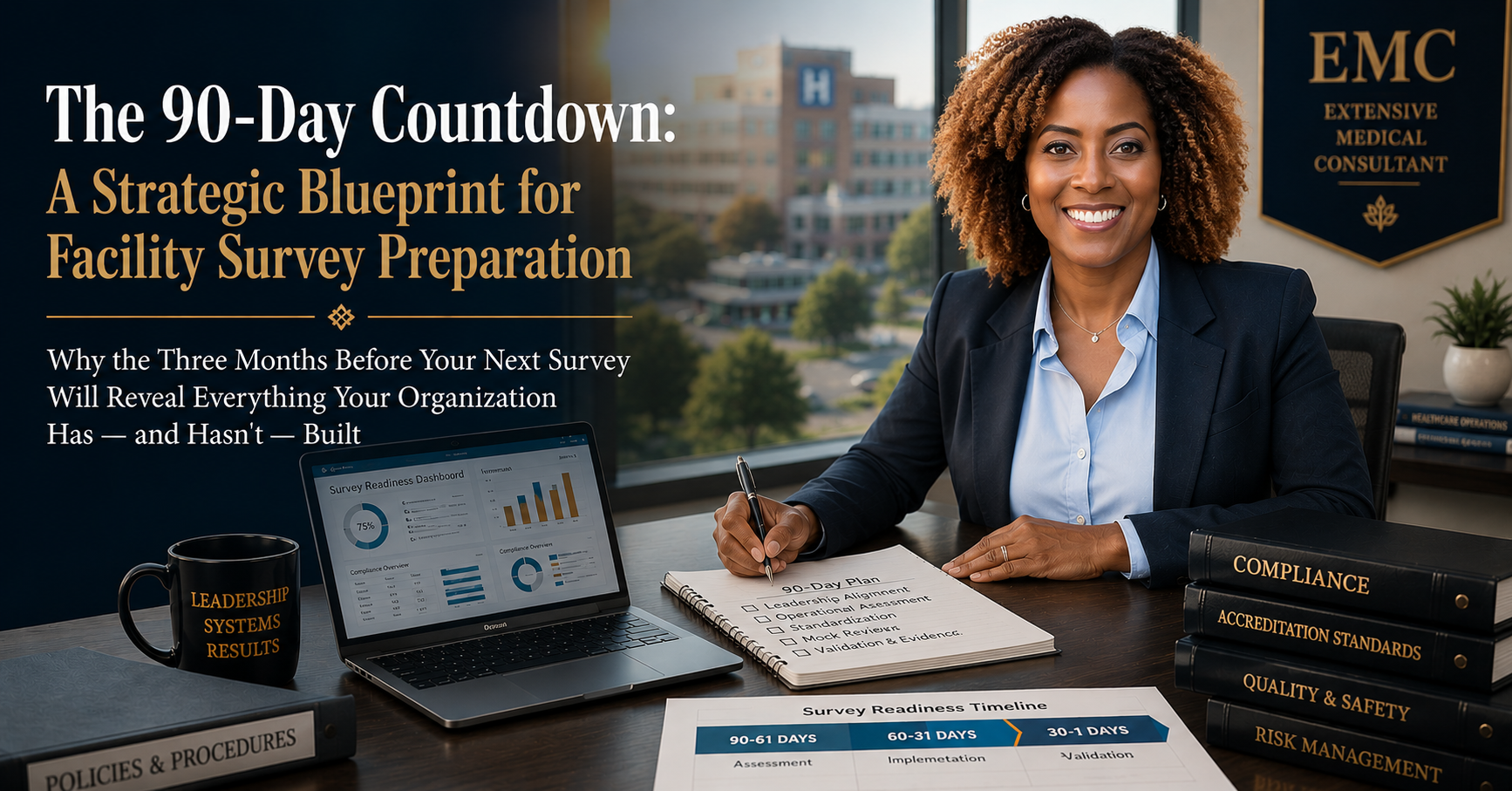
A 90-day executive blueprint for accreditation survey readiness. Learn how healthcare leaders build sustainable systems, not last-minute checklists.

Dr. Scarlett Lusk shares 6 leadership lessons from 27 years in the U.S. Public Health Service — and how military-grade discipline transforms civilian healthcare operations.
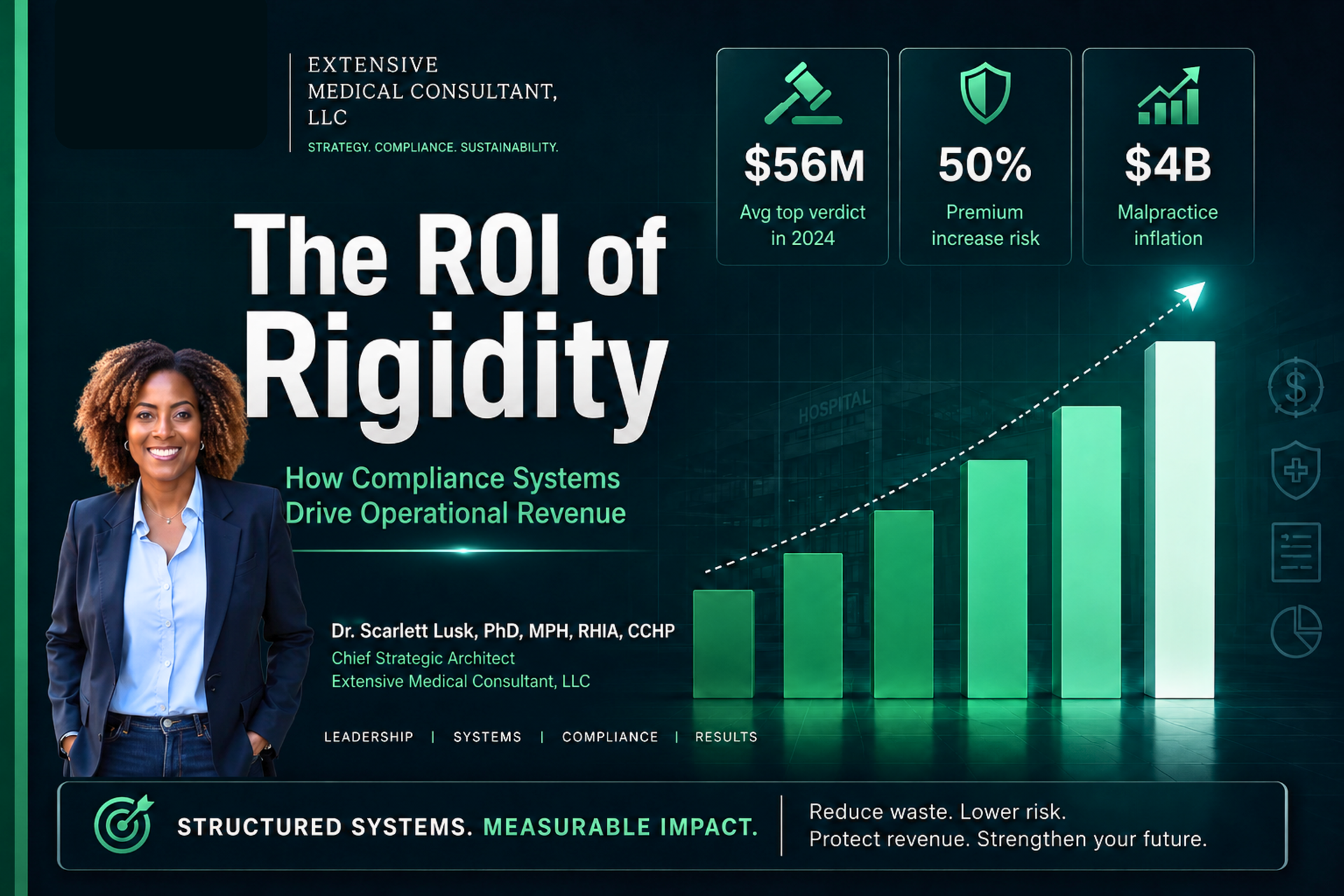
Learn how structured healthcare compliance systems reduce waste, lower litigation risk, and compress insurance premiums — generating measurable financial returns for CFOs and CEOs. Expert insight from Dr. Scarlett Lusk, Extensive Medical Consultant, LLC.

Discover how healthcare organizations can move beyond reactive accreditation preparation and build sustainable compliance systems for NCCHC, ACA, and AAAHC readiness with EMC and Dr. Scarlett Lusk.
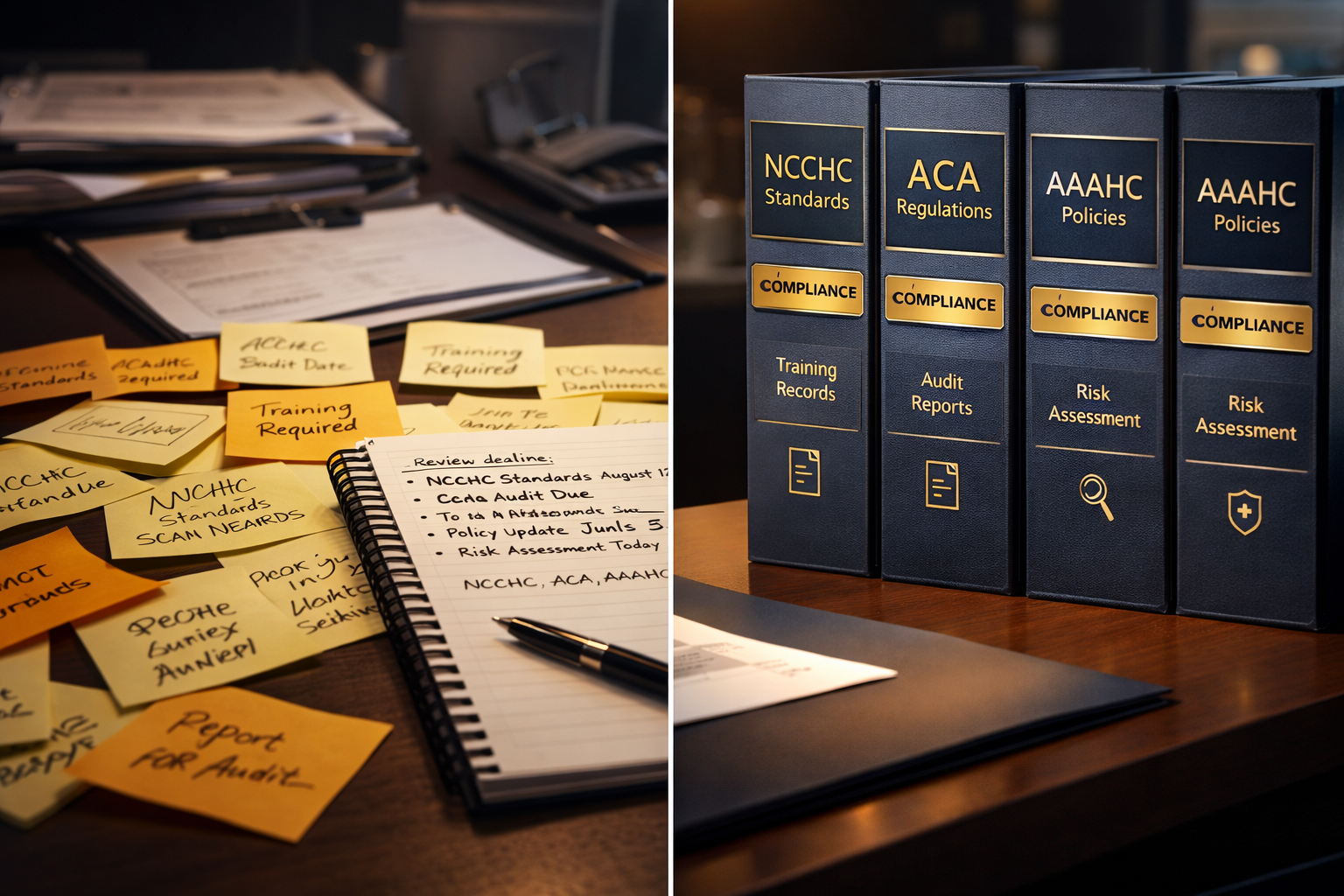
Tribal knowledge in healthcare is your most dangerous compliance vulnerability. Discover how person-dependent systems create accreditation risk and how EMC builds the documentation frameworks that eliminate it.

Healthcare leadership burnout is a systems problem, not a personal one. Discover how EMC helps healthcare executives reduce operational pressure through compliance systems, workflow optimization, and leadership frameworks.

Failing accreditation costs more than a citation. Discover the true financial, reputational, and operational consequences — and how EMC helps you prevent them.

Modern healthcare organizations operate in an increasingly complex environment. Regulatory requirements evolve, accreditation standards tighten, and operational demands continue to grow. While internal teams work tirelessly to maintain quality care and efficient operations, many clinics eventually encounter challenges that require a fresh perspective. This is where external consulting expertise becomes valuable. Healthcare consultants are not replacements for internal leadership; they are strategic partners who help organizations strengthen systems, identify risks, and navigate complex compliance landscapes. Through structured guidance and objective analysis, consulting support can help clinics move from reactive problem-solving to proactive operational stability. Under the leadership of Dr. Scarlett Lusk, Extensive Medical Consultant works with healthcare organizations to provide that clarity, structure, and expertise. Why Internal Teams Often Miss Critical Blind Spots Healthcare professionals and administrators are deeply committed to their organizations. However, being closely involved in daily operations can sometimes make it difficult to recognize systemic issues. Internal teams often focus on immediate operational demands: Patient care coordination Staffing challenges Documentation management Regulatory compliance requirements Over time, these responsibilities can create operational “blind spots.” Processes that once worked well may become outdated, inefficient, or misaligned with current compliance expectations. Because internal teams are immersed in daily workflows, they may not always see the structural gaps forming beneath the surface. External consultants provide something essential: objective distance. They can analyze operations without the constraints of internal routines, allowing them to identify hidden inefficiencies, compliance vulnerabilities, and workflow breakdowns that might otherwise go unnoticed. The Value of Objective Leadership Support Healthcare leadership carries significant responsibility. Administrators and clinical leaders must balance patient care, regulatory compliance, operational efficiency, and staff wellbeing—all at the same time. In such high-pressure environments, objective leadership support becomes extremely valuable. External consultants serve as strategic advisors who help leaders: Evaluate operational structures Strengthen compliance frameworks Prepare for accreditation reviews Implement sustainable workflow improvements This type of guidance allows healthcare leaders to make informed decisions based on data, regulatory insight, and industry best practices. Rather than reacting to problems after they occur, organizations can build systems designed to prevent them. When Clinics Should Consider Bringing in Consultants Many clinics assume consulting support is only necessary during a crisis. In reality, the most effective consulting relationships begin before problems escalate. Healthcare organizations often benefit from external expertise during key moments of growth or transition, including: 1. Preparing for Accreditation or Regulatory Surveys Accreditation readiness requires careful preparation. Consultants help ensure policies, documentation, and operational workflows meet regulatory expectations before surveyors arrive. 2. Rapid Organizational Growth As clinics expand, operational structures must evolve. Growth often exposes inefficiencies or compliance gaps that were not visible at smaller scales. 3. Operational Workflow Challenges When teams experience recurring inefficiencies, communication breakdowns, or documentation issues, consulting support can help redesign workflows for greater clarity and efficiency. 4. Leadership Transitions New leadership often benefits from an external operational assessment to understand existing systems and identify areas for improvement. By bringing in consultants at these moments, clinics can proactively address structural issues rather than waiting for them to surface during audits or inspections. EMC’s Tailored Consulting Approach At Extensive Medical Consultant, consulting is not based on one-size-fits-all solutions. Every healthcare organization has unique operational structures, leadership styles, and regulatory challenges. That is why EMC focuses on tailored consulting strategies designed around each client’s specific needs. Guided by the extensive leadership experience of Dr. Scarlett Lusk, EMC provides consulting services that help healthcare organizations strengthen operational foundations while maintaining focus on patient care. The consulting approach emphasizes four key areas: Accreditation Preparation Healthcare organizations receive structured guidance to prepare for accreditation surveys with confidence. Compliance System Development EMC helps clinics design compliance systems that align with regulatory standards and support long-term operational stability. Workflow Optimization Operational workflows are evaluated and redesigned to improve efficiency, communication, and documentation processes. Leadership Support Healthcare executives receive strategic guidance to help them make informed decisions about organizational growth, risk management, and operational improvement. Through this structured and collaborative approach, EMC helps healthcare organizations move beyond temporary fixes and build sustainable systems that support long-term success. Building Stronger Healthcare Systems The healthcare environment will continue to evolve. Regulatory expectations will change, patient demands will grow, and operational complexity will increase. Organizations that thrive in this environment are those that prioritize strong systems, clear structures, and proactive leadership strategies. External consulting support plays an important role in helping healthcare leaders achieve these goals. By identifying blind spots, strengthening compliance frameworks, and optimizing workflows, consultants provide the strategic insight organizations need to operate confidently. With experienced leadership and a commitment to operational excellence, Extensive Medical Consultant continues to support healthcare organizations in building the systems that make sustainable success possible. Need guidance navigating accreditation, compliance, or operational challenges? Connect with Extensive Medical Consultant today to learn how expert consulting support can help strengthen your healthcare organization’s future.
Discover the hidden operational gaps — "silent zones" — that drive compliance failures in ambulatory and correctional healthcare. Expert insight from Dr. Scarlett Lusk, EMC.
Poor clinical documentation creates legal vulnerability even when care was correct. Learn how EMC builds systemic documentation frameworks that protect your organization.
A 90-day executive blueprint for accreditation survey readiness. Learn how healthcare leaders build sustainable systems, not last-minute checklists.
Dr. Scarlett Lusk shares 6 leadership lessons from 27 years in the U.S. Public Health Service — and how military-grade discipline transforms civilian healthcare operations.
Learn how structured healthcare compliance systems reduce waste, lower litigation risk, and compress insurance premiums — generating measurable financial returns for CFOs and CEOs. Expert insight from Dr. Scarlett Lusk, Extensive Medical Consultant, LLC.
Discover how healthcare organizations can move beyond reactive accreditation preparation and build sustainable compliance systems for NCCHC, ACA, and AAAHC readiness with EMC and Dr. Scarlett Lusk.
Tribal knowledge in healthcare is your most dangerous compliance vulnerability. Discover how person-dependent systems create accreditation risk and how EMC builds the documentation frameworks that eliminate it.
Healthcare leadership burnout is a systems problem, not a personal one. Discover how EMC helps healthcare executives reduce operational pressure through compliance systems, workflow optimization, and leadership frameworks.
Failing accreditation costs more than a citation. Discover the true financial, reputational, and operational consequences — and how EMC helps you prevent them.
Modern healthcare organizations operate in an increasingly complex environment. Regulatory requirements evolve, accreditation standards tighten, and operational demands continue to grow. While internal teams work tirelessly to maintain quality care and efficient operations, many clinics eventually encounter challenges that require a fresh perspective. This is where external consulting expertise becomes valuable. Healthcare consultants are not replacements for internal leadership; they are strategic partners who help organizations strengthen systems, identify risks, and navigate complex compliance landscapes. Through structured guidance and objective analysis, consulting support can help clinics move from reactive problem-solving to proactive operational stability. Under the leadership of Dr. Scarlett Lusk, Extensive Medical Consultant works with healthcare organizations to provide that clarity, structure, and expertise. Why Internal Teams Often Miss Critical Blind Spots Healthcare professionals and administrators are deeply committed to their organizations. However, being closely involved in daily operations can sometimes make it difficult to recognize systemic issues. Internal teams often focus on immediate operational demands: Patient care coordination Staffing challenges Documentation management Regulatory compliance requirements Over time, these responsibilities can create operational “blind spots.” Processes that once worked well may become outdated, inefficient, or misaligned with current compliance expectations. Because internal teams are immersed in daily workflows, they may not always see the structural gaps forming beneath the surface. External consultants provide something essential: objective distance. They can analyze operations without the constraints of internal routines, allowing them to identify hidden inefficiencies, compliance vulnerabilities, and workflow breakdowns that might otherwise go unnoticed. The Value of Objective Leadership Support Healthcare leadership carries significant responsibility. Administrators and clinical leaders must balance patient care, regulatory compliance, operational efficiency, and staff wellbeing—all at the same time. In such high-pressure environments, objective leadership support becomes extremely valuable. External consultants serve as strategic advisors who help leaders: Evaluate operational structures Strengthen compliance frameworks Prepare for accreditation reviews Implement sustainable workflow improvements This type of guidance allows healthcare leaders to make informed decisions based on data, regulatory insight, and industry best practices. Rather than reacting to problems after they occur, organizations can build systems designed to prevent them. When Clinics Should Consider Bringing in Consultants Many clinics assume consulting support is only necessary during a crisis. In reality, the most effective consulting relationships begin before problems escalate. Healthcare organizations often benefit from external expertise during key moments of growth or transition, including: 1. Preparing for Accreditation or Regulatory Surveys Accreditation readiness requires careful preparation. Consultants help ensure policies, documentation, and operational workflows meet regulatory expectations before surveyors arrive. 2. Rapid Organizational Growth As clinics expand, operational structures must evolve. Growth often exposes inefficiencies or compliance gaps that were not visible at smaller scales. 3. Operational Workflow Challenges When teams experience recurring inefficiencies, communication breakdowns, or documentation issues, consulting support can help redesign workflows for greater clarity and efficiency. 4. Leadership Transitions New leadership often benefits from an external operational assessment to understand existing systems and identify areas for improvement. By bringing in consultants at these moments, clinics can proactively address structural issues rather than waiting for them to surface during audits or inspections. EMC’s Tailored Consulting Approach At Extensive Medical Consultant, consulting is not based on one-size-fits-all solutions. Every healthcare organization has unique operational structures, leadership styles, and regulatory challenges. That is why EMC focuses on tailored consulting strategies designed around each client’s specific needs. Guided by the extensive leadership experience of Dr. Scarlett Lusk, EMC provides consulting services that help healthcare organizations strengthen operational foundations while maintaining focus on patient care. The consulting approach emphasizes four key areas: Accreditation Preparation Healthcare organizations receive structured guidance to prepare for accreditation surveys with confidence. Compliance System Development EMC helps clinics design compliance systems that align with regulatory standards and support long-term operational stability. Workflow Optimization Operational workflows are evaluated and redesigned to improve efficiency, communication, and documentation processes. Leadership Support Healthcare executives receive strategic guidance to help them make informed decisions about organizational growth, risk management, and operational improvement. Through this structured and collaborative approach, EMC helps healthcare organizations move beyond temporary fixes and build sustainable systems that support long-term success. Building Stronger Healthcare Systems The healthcare environment will continue to evolve. Regulatory expectations will change, patient demands will grow, and operational complexity will increase. Organizations that thrive in this environment are those that prioritize strong systems, clear structures, and proactive leadership strategies. External consulting support plays an important role in helping healthcare leaders achieve these goals. By identifying blind spots, strengthening compliance frameworks, and optimizing workflows, consultants provide the strategic insight organizations need to operate confidently. With experienced leadership and a commitment to operational excellence, Extensive Medical Consultant continues to support healthcare organizations in building the systems that make sustainable success possible. Need guidance navigating accreditation, compliance, or operational challenges? Connect with Extensive Medical Consultant today to learn how expert consulting support can help strengthen your healthcare organization’s future.
