
Why Strong Healthcare Leadership Starts With Strong Systems
Introduction: Leadership Alone Is Not Enough
Healthcare leadership has never been more demanding. Regulatory pressure, workforce shortages, compliance complexity, patient safety expectations, and financial constraints create a constant state of operational tension.
Many organizations respond by asking leaders to “do more.”
More oversight.
More engagement.
More availability.
But here is the strategic truth:
Leadership effort without a leadership structure leads to exhaustion, not excellence.
Strong healthcare leadership does not begin with personality, resilience, or even experience. It begins with systems.
Dr. Scarlett Lusk, healthcare leadership strategist and founder of Extensive Medical Consultant, LLC, has consistently emphasized that sustainable executive performance is built on infrastructure, not intensity. Her work focuses on transforming overwhelmed leadership environments into structured, high-performing healthcare systems.
Because in modern healthcare, effort may sustain you temporarily, but structure sustains you long-term.
Leadership Effort vs. Leadership Structure
One of the most misunderstood dynamics in healthcare organizations is the difference between leadership effort and leadership structure. Dr. Scarlett Lusk frequently identifies this distinction as the turning point between reactive management and strategic leadership.
Leadership Effort
Leadership effort is personal. It includes:
- Long hours
- Constant decision-making
- Hands-on crisis resolution
- Emotional labor
- Direct involvement in operational issues
Effort can temporarily compensate for weak systems. However, it is not scalable, and it does not protect leaders from burnout or compliance risk.
When organizations rely heavily on leadership effort, executives become the safety net for every gap in the system.
That model is unsustainable.
Leadership Structure
Leadership structure is organizational. It includes:
- Defined workflows
- Clear accountability channels
- Compliance monitoring systems
- Communication frameworks
- Standard operating procedures
Structure distributes responsibility.
Structure creates predictability.
Structure reduces dependency on individual heroics.
Dr. Scarlett Lusk’s leadership framework focuses on strengthening these structural pillars so healthcare executives can shift from constant firefighting to strategic oversight.
When healthcare systems rely primarily on structure, leaders regain clarity, authority, and sustainability.
This distinction is critical in modern healthcare management.
How Strong Systems Protect Healthcare Leaders
Healthcare systems are not merely operational tools. They are protective architecture.
Dr. Scarlett Lusk teaches that well-designed systems serve as executive safeguards, reducing exposure, stabilizing performance, and preventing overload.
1. Systems Reduce Decision Fatigue
Without standardized processes, leaders make repetitive operational decisions every day. Over time, this constant cognitive load weakens clarity and slows strategic thinking.
Defined systems streamline routine processes, allowing leaders to focus on growth, compliance, integrity, and long-term strategy.
Protection begins with predictability.
2. Systems Strengthen Compliance and Risk Management
Compliance failures are rarely caused by ignorance. They are often caused by inconsistency.
Structured compliance systems:
- Track documentation
- Standardize reporting
- Clarify responsibility
- Reduce regulatory exposure
Dr. Scarlett Lusk integrates compliance architecture directly into operational design, ensuring that protection is built into the system, not added after problems arise.
This approach safeguards both the organization and its leadership.
3. Systems Improve Organizational Stability
In healthcare, unpredictability increases stress at every level. Strong systems create operational rhythm.
- When workflows are clearly defined:
- Teams perform with confidence
- Communication improves
- Escalations decrease
- Leaders regain oversight clarity
This stability impacts patient safety, financial performance, and staff retention.
According to Dr. Scarlett Lusk, stability is not accidental; it is engineered.
Preventing Crisis-Driven Healthcare Management
Crisis-driven management is one of the most damaging leadership patterns in healthcare organizations.
It often looks like:
- Constant urgency
- Reactive compliance responses
- Emergency staffing solutions
- Leadership burnout
- Short-term decision cycles
While crisis management may feel productive, over time, it erodes culture, morale, and executive sustainability.
Strong healthcare systems prevent crises before they escalate.
By implementing:
- Early-warning compliance monitoring
- Operational dashboards
- Defined accountability layers
- Escalation protocols
Organizations shift from reaction to prevention.
This is where true strategic leadership emerges, and this is the transformation model Dr. Scarlett Lusk applies when working with healthcare organizations seeking long-term operational strength.
Why This Approach Works in Healthcare Organizations
Healthcare operates at the intersection of:
- Clinical care
- Regulatory governance
- Financial stewardship
- Human service delivery
Because of this complexity:
Informal management fails.
Reactive leadership collapses under pressure.
Effort-only leadership burns out.
Structured healthcare systems align people, policies, and performance into a coordinated framework.
Dr. Scarlett Lusk’s leadership model prioritizes:
✔ Organizational clarity
✔ Executive protection
✔ Operational predictability
✔ Sustainable compliance
✔ Long-term growth strategy
This positions her not merely as a consultant, but as a healthcare leadership authority focused on systemic transformation.
The Strategic Shift: From Overload to Oversight
When healthcare leaders transition from effort-based leadership to structure-based leadership, the results are measurable.
Before Systems:
- High stress
- Frequent compliance risk
- Reactive culture
- Leadership exhaustion
After Systems:
- Strategic clarity
- Defined accountability
- Reduced operational volatility
- Sustainable executive performance
This shift does not reduce leadership responsibility. It strengthens it.
Under structured systems, leaders move from operational overload to strategic oversight, the position true leadership requires.
Conclusion: Systems Are the Foundation of Strong Healthcare Leadership
Healthcare leadership is not tested during calm seasons; it is tested during complexity.
And complexity cannot be managed through effort alone.
Strong healthcare leadership starts with strong systems because:
- Systems protect leaders from overload
- Systems reduce compliance exposure
- Systems prevent crisis-driven management
- Systems allow strategic vision to replace operational chaos
In modern healthcare organizations, structure is not optional. It is foundational.
Leaders deserve systems that support their responsibility, not systems that rely on their sacrifice.
If your leadership team feels overwhelmed, reactive, or stretched beyond capacity, the issue may not be effort; it may be infrastructure.
Dr. Scarlett Lusk works directly with healthcare organizations to design operational systems that protect leadership, strengthen compliance, and build sustainable performance.
Do not wait for the next crisis to expose structural gaps.
Schedule your strategic consultation today and begin building the systems that support strong healthcare leadership.
Real leadership strength is not about carrying more.
It is about designing better.

The 2026 NCCHC Mental Health Standards are now in effect. Discover what changed, what your facility must implement, and how EMC supports correctional healthcare leaders through the transition.

Discover the hidden operational gaps — "silent zones" — that drive compliance failures in ambulatory and correctional healthcare. Expert insight from Dr. Scarlett Lusk, EMC.

Poor clinical documentation creates legal vulnerability even when care was correct. Learn how EMC builds systemic documentation frameworks that protect your organization.
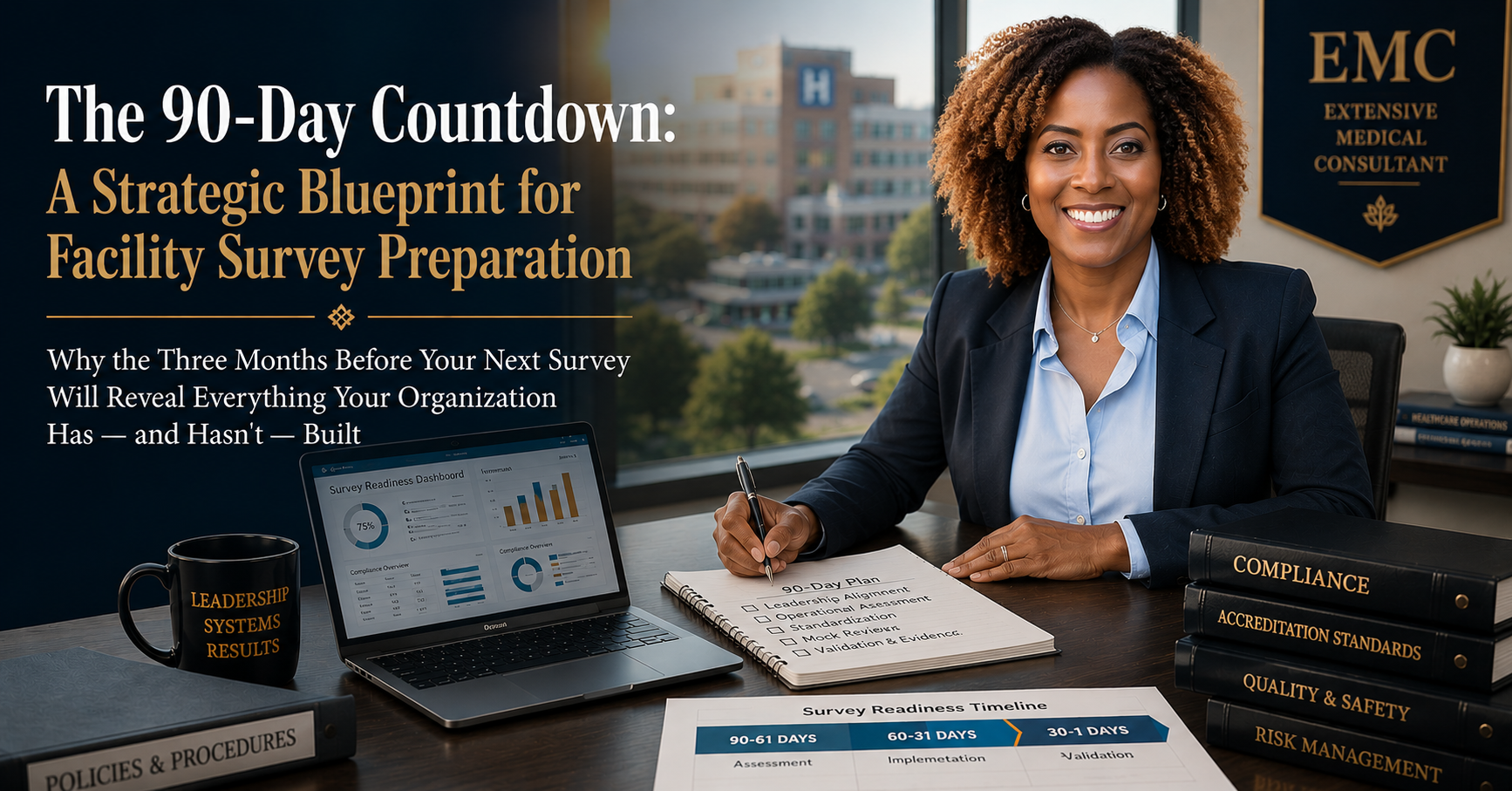
A 90-day executive blueprint for accreditation survey readiness. Learn how healthcare leaders build sustainable systems, not last-minute checklists.

Dr. Scarlett Lusk shares 6 leadership lessons from 27 years in the U.S. Public Health Service — and how military-grade discipline transforms civilian healthcare operations.
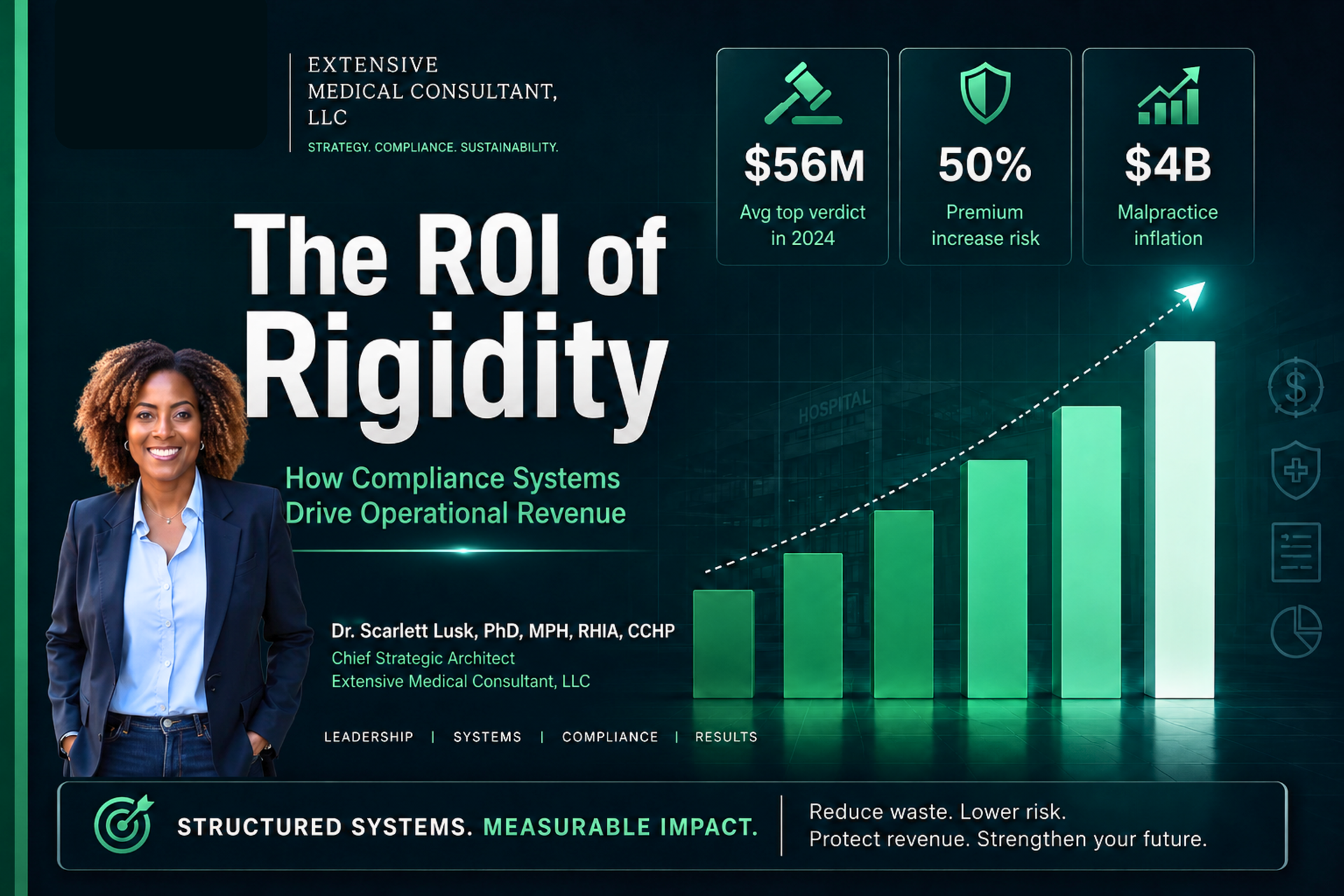
Learn how structured healthcare compliance systems reduce waste, lower litigation risk, and compress insurance premiums — generating measurable financial returns for CFOs and CEOs. Expert insight from Dr. Scarlett Lusk, Extensive Medical Consultant, LLC.

Discover how healthcare organizations can move beyond reactive accreditation preparation and build sustainable compliance systems for NCCHC, ACA, and AAAHC readiness with EMC and Dr. Scarlett Lusk.

Tribal knowledge in healthcare is your most dangerous compliance vulnerability. Discover how person-dependent systems create accreditation risk and how EMC builds the documentation frameworks that eliminate it.

Healthcare leadership burnout is a systems problem, not a personal one. Discover how EMC helps healthcare executives reduce operational pressure through compliance systems, workflow optimization, and leadership frameworks.

Failing accreditation costs more than a citation. Discover the true financial, reputational, and operational consequences — and how EMC helps you prevent them.
The 2026 NCCHC Mental Health Standards are now in effect. Discover what changed, what your facility must implement, and how EMC supports correctional healthcare leaders through the transition.
Discover the hidden operational gaps — "silent zones" — that drive compliance failures in ambulatory and correctional healthcare. Expert insight from Dr. Scarlett Lusk, EMC.
Poor clinical documentation creates legal vulnerability even when care was correct. Learn how EMC builds systemic documentation frameworks that protect your organization.
A 90-day executive blueprint for accreditation survey readiness. Learn how healthcare leaders build sustainable systems, not last-minute checklists.
Dr. Scarlett Lusk shares 6 leadership lessons from 27 years in the U.S. Public Health Service — and how military-grade discipline transforms civilian healthcare operations.
Learn how structured healthcare compliance systems reduce waste, lower litigation risk, and compress insurance premiums — generating measurable financial returns for CFOs and CEOs. Expert insight from Dr. Scarlett Lusk, Extensive Medical Consultant, LLC.
Discover how healthcare organizations can move beyond reactive accreditation preparation and build sustainable compliance systems for NCCHC, ACA, and AAAHC readiness with EMC and Dr. Scarlett Lusk.
Tribal knowledge in healthcare is your most dangerous compliance vulnerability. Discover how person-dependent systems create accreditation risk and how EMC builds the documentation frameworks that eliminate it.
Healthcare leadership burnout is a systems problem, not a personal one. Discover how EMC helps healthcare executives reduce operational pressure through compliance systems, workflow optimization, and leadership frameworks.
Failing accreditation costs more than a citation. Discover the true financial, reputational, and operational consequences — and how EMC helps you prevent them.
