Accreditation Is Not a One-Time Event: Why Continuous Readiness Matters
Healthcare accreditation is often treated as a finish line. It is seen as a milestone to cross, celebrate, and then move on from until the next survey cycle appears. For healthcare leaders, administrators, and compliance professionals operating under standards set by the Joint Commission, NCCHC, ACA, ODO, and AAAHC,
this mindset is not only outdated but also risky.
Accreditation was never intended to function as a periodic checklist. It reflects how an organization operates every single day. In today’s regulatory environment, where expectations are higher and scrutiny is constant, continuous readiness is no longer optional. It is the foundation of sustainable, high-quality healthcare delivery.
At Extensive Medical Consultant (EMC), led by Dr. Scarlett Lusk, PhD, MPH, RHIA, CCHP,
accreditation is treated as an operational discipline. This approach strengthens governance, protects patients, and supports long-term organizational resilience.
Accreditation Is More Than a Milestone
Accreditation bodies do not exist to pass or fail organizations. Their role is to ensure that healthcare systems consistently meet standards that protect patient safety, ethical practice, and quality outcomes. When accreditation is treated as a once-every-few-years hurdle, organizations unintentionally weaken its true purpose.
The reality is straightforward. When systems function effectively every day, accreditation becomes confirmation rather than a crisis.
Section 1: Common Accreditation Misconceptions and Their Risks
Despite years of regulatory advancement, several misconceptions continue to undermine healthcare organizations.
Misconception 1: Accreditation Is a One-Time Checklist
Many organizations rush to update policies, conduct last-minute training, and organize documentation just weeks before a survey. While this may create the appearance of readiness, it rarely reflects real practice.
The risk includes:
- Inconsistent staff behavior
- Policies that exist on paper but are not followed
- Higher likelihood of findings during unannounced surveys
Misconception 2: Passing the Last Survey Means You Are Compliant
Accreditation standards evolve continuously. Regulatory interpretations change. What passed during the previous survey may no longer meet current expectations.
The risk includes:
- Continued use of outdated policies
- Failure to address regulatory updates
- Exposure to citations, corrective action plans, or loss of accreditation
Misconception 3: Accreditation Is the Compliance Department’s Responsibility
Accreditation is often isolated within compliance teams while leadership and frontline staff remain disengaged.
The risk includes:
- Staff confusion during surveys
- Leadership is unable to clearly explain compliance strategies
- A culture driven by reaction instead of accountability
Misconception 4: Surveyors Only Review Documents
Documentation is important, but it is not the primary focus of surveys.
The risk includes:
- Excessive focus on paperwork
- Insufficient investment in operational systems and staff competency
Section 2: What Surveyors Actually Look For
Understanding surveyor expectations is essential for continuous readiness. Across accrediting bodies, surveyors assess whether policy, practice, and outcomes are aligned.
1. Consistency Between Policy and Practice
Surveyors observe operations, interview staff, and review documentation to confirm that policies are actively followed.
They evaluate whether:
- Staff understand policies related to their roles
- Procedures are applied consistently across shifts and departments
- Leadership can explain how compliance is monitored
2. Leadership Engagement
Surveyors expect leadership to be informed, visible, and accountable.
They assess:
- How leaders oversee compliance
- Whether governance structures support quality and safety
- If leadership addresses risk proactively
3. Staff Competency and Training
Training records alone are insufficient. Surveyors validate training through staff interaction.
They look for:
- Staff confidence in explaining procedures
- Evidence of ongoing education
- Clear understanding of emergency, safety, and ethical protocols
4. Continuous Monitoring and Improvement
Accreditation bodies emphasize improvement rather than perfection.
- Surveyors expect to see:
- Internal audits and self-assessments
- Corrective actions driven by data
- Proof that issues are identified internally before external review
Section 3: Year-Round Continuous Readiness Strategies
Organizations that maintain readiness do not scramble before surveys. Accreditation is embedded in daily operations.
1. Living Policies Instead of Static Manuals
Effective policies are:
- Reviewed on a scheduled basis
- Updated when regulations change
- Integrated into daily workflows
- Best practice: Assign ownership for each policy area and systematically track revisions.
2. Ongoing Staff Education
Training should be continuous, role-specific, and practical.
Effective methods include:
- Short, recurring competency refreshers
- Scenario-based learning
- Leadership-led discussions that reinforce expectations
3. Internal Audits and Mock Surveys
Routine self-assessments reveal gaps early.
Key components include:
- Internal audits aligned with accreditation standards
- Leadership participation in mock surveys
- Clear tracking of corrective actions
4. Data-Driven Monitoring
Continuous readiness relies on measurable insight.
Organizations should monitor:
- Incident trends
- Compliance metrics
- Quality indicators linked to accreditation standards
- Data transforms compliance from a reactive task into a strategic advantage.
5. Leadership Accountability
When leadership owns accreditation, readiness becomes part of organizational culture.
This includes:
- Regular compliance briefings
- Clear reporting structures
- Visible leadership involvement in preparedness efforts
Section 4: EMC’s Proactive Accreditation Model
At Extensive Medical Consultant, accreditation is treated as an integrated operational system rather than a seasonal project.
Under the leadership of Dr. Scarlett Lusk, EMC has developed a proactive model that supports continuous readiness across correctional healthcare, public health systems, ambulatory care, and private clinics.
Key Elements of EMC’s Model
1. Systems-Based Assessment
EMC evaluates how governance, operations, staffing, and policies function together.
2. Regulatory Alignment Across Standards
EMC helps organizations meet overlapping requirements from multiple accrediting bodies through unified systems.
3. Leadership-Centered Readiness
Executive teams are equipped to engage confidently with surveyors and sustain compliance.
4. Continuous Support
EMC partners with organizations year-round instead of appearing only before surveys.
5. Education and Empowerment
Staff and leadership learn not only how to meet standards, but why those standards exist and how they improve care.
This approach transforms accreditation from a source of stress into a strategic asset.
Conclusion: Readiness Is a Leadership Decision
Accreditation is not a single moment in time. It reflects leadership commitment, organizational discipline, and system integrity.
Healthcare organizations that embrace continuous readiness:
- Reduce regulatory risk
- Improve patient outcomes
- Strengthen staff confidence
- Build sustainable operational excellence
Organizations that rely on last-minute preparation expose themselves to disruption and reputational harm.
The question is no longer when your next survey will occur. The question is whether your systems are ready today.
At Extensive Medical Consultant, Dr. Scarlett Lusk and her team help organizations move beyond checklist compliance toward lasting readiness and resilience. If your organization is ready to transition from reactive accreditation to continuous confidence, now is the time to act.

The 2026 NCCHC Mental Health Standards are now in effect. Discover what changed, what your facility must implement, and how EMC supports correctional healthcare leaders through the transition.

Discover the hidden operational gaps — "silent zones" — that drive compliance failures in ambulatory and correctional healthcare. Expert insight from Dr. Scarlett Lusk, EMC.

Poor clinical documentation creates legal vulnerability even when care was correct. Learn how EMC builds systemic documentation frameworks that protect your organization.
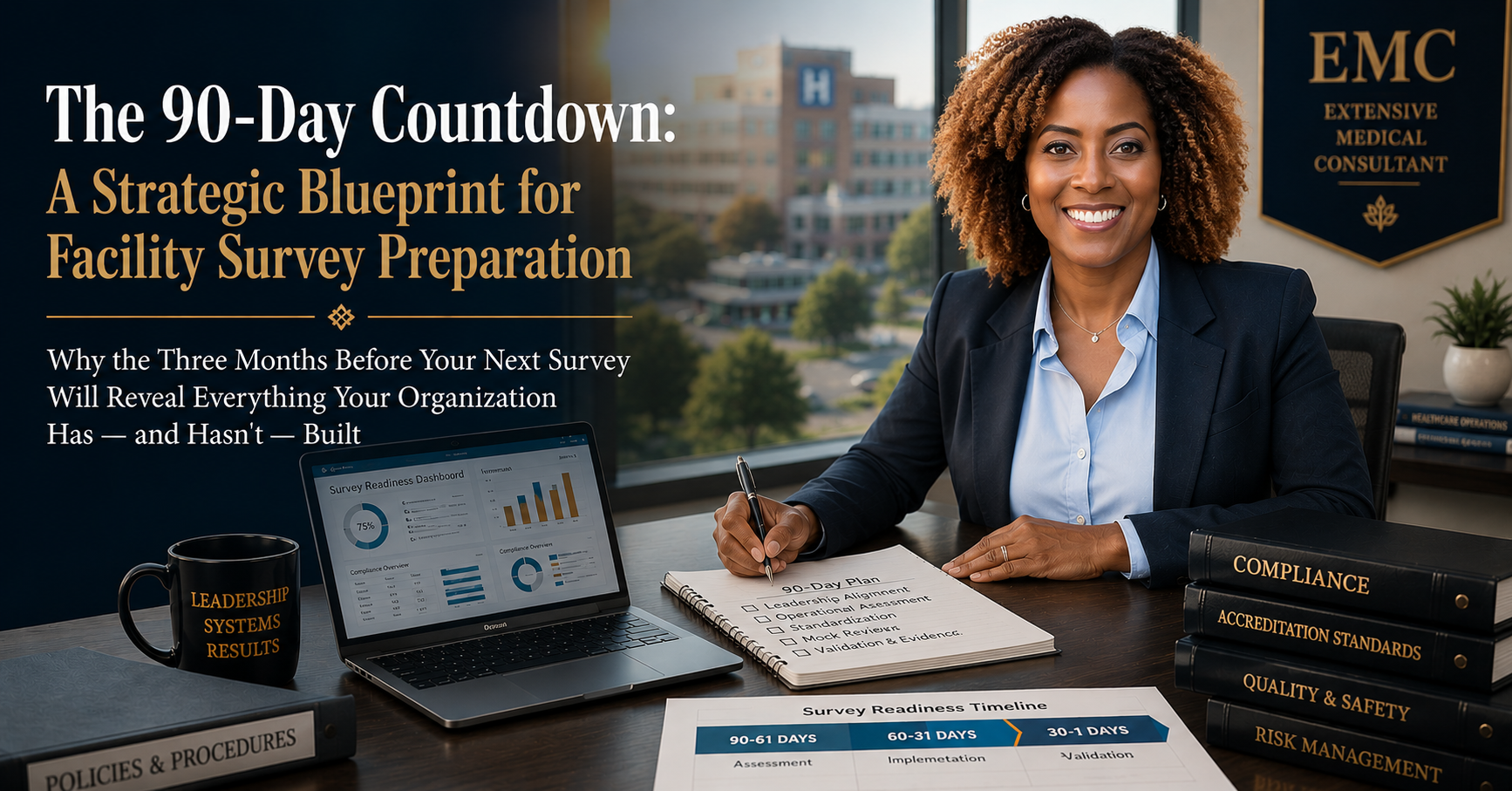
A 90-day executive blueprint for accreditation survey readiness. Learn how healthcare leaders build sustainable systems, not last-minute checklists.

Dr. Scarlett Lusk shares 6 leadership lessons from 27 years in the U.S. Public Health Service — and how military-grade discipline transforms civilian healthcare operations.
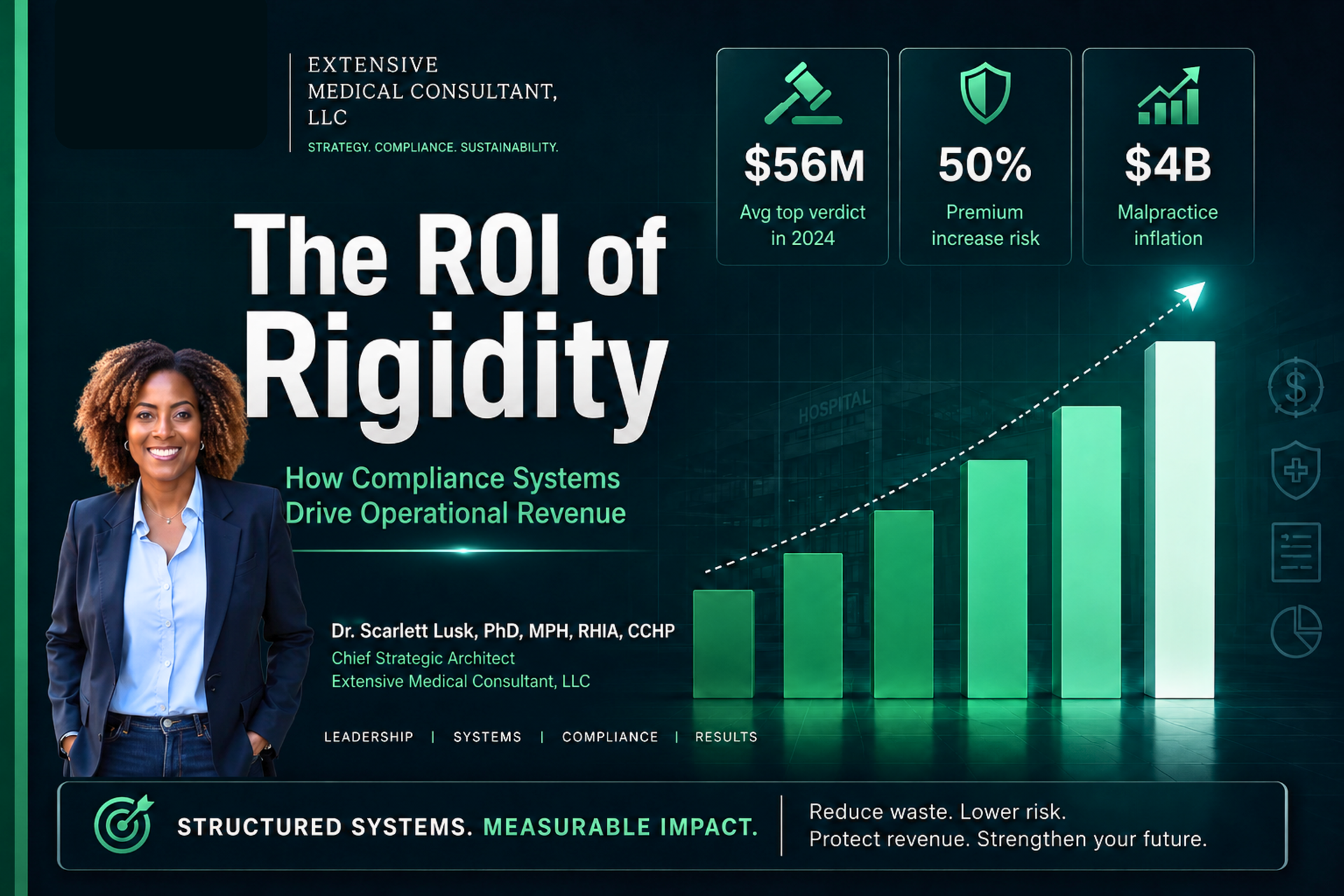
Learn how structured healthcare compliance systems reduce waste, lower litigation risk, and compress insurance premiums — generating measurable financial returns for CFOs and CEOs. Expert insight from Dr. Scarlett Lusk, Extensive Medical Consultant, LLC.

Discover how healthcare organizations can move beyond reactive accreditation preparation and build sustainable compliance systems for NCCHC, ACA, and AAAHC readiness with EMC and Dr. Scarlett Lusk.
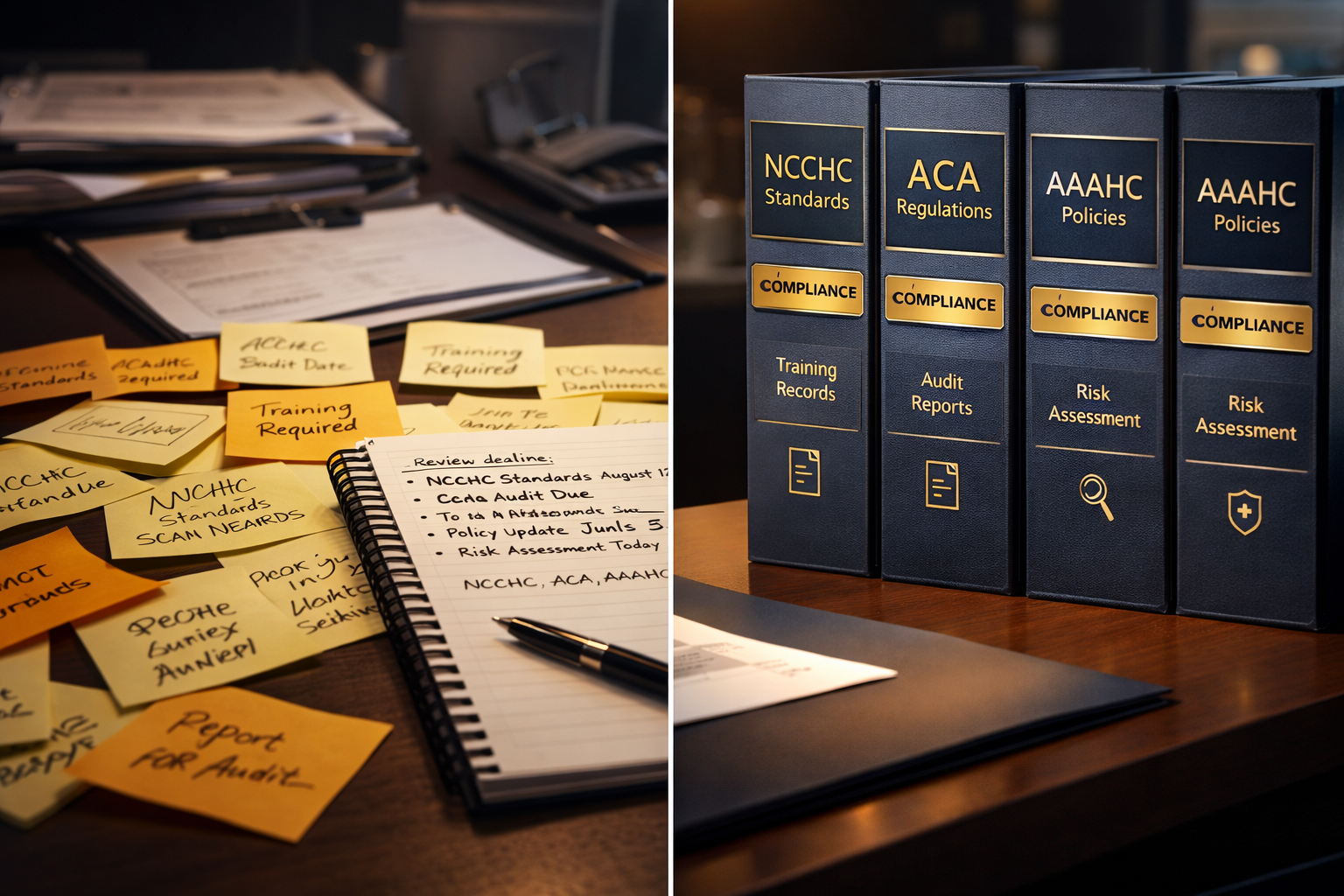
Tribal knowledge in healthcare is your most dangerous compliance vulnerability. Discover how person-dependent systems create accreditation risk and how EMC builds the documentation frameworks that eliminate it.

Healthcare leadership burnout is a systems problem, not a personal one. Discover how EMC helps healthcare executives reduce operational pressure through compliance systems, workflow optimization, and leadership frameworks.

Failing accreditation costs more than a citation. Discover the true financial, reputational, and operational consequences — and how EMC helps you prevent them.
The 2026 NCCHC Mental Health Standards are now in effect. Discover what changed, what your facility must implement, and how EMC supports correctional healthcare leaders through the transition.
Discover the hidden operational gaps — "silent zones" — that drive compliance failures in ambulatory and correctional healthcare. Expert insight from Dr. Scarlett Lusk, EMC.
Poor clinical documentation creates legal vulnerability even when care was correct. Learn how EMC builds systemic documentation frameworks that protect your organization.
A 90-day executive blueprint for accreditation survey readiness. Learn how healthcare leaders build sustainable systems, not last-minute checklists.
Dr. Scarlett Lusk shares 6 leadership lessons from 27 years in the U.S. Public Health Service — and how military-grade discipline transforms civilian healthcare operations.
Learn how structured healthcare compliance systems reduce waste, lower litigation risk, and compress insurance premiums — generating measurable financial returns for CFOs and CEOs. Expert insight from Dr. Scarlett Lusk, Extensive Medical Consultant, LLC.
Discover how healthcare organizations can move beyond reactive accreditation preparation and build sustainable compliance systems for NCCHC, ACA, and AAAHC readiness with EMC and Dr. Scarlett Lusk.
Tribal knowledge in healthcare is your most dangerous compliance vulnerability. Discover how person-dependent systems create accreditation risk and how EMC builds the documentation frameworks that eliminate it.
Healthcare leadership burnout is a systems problem, not a personal one. Discover how EMC helps healthcare executives reduce operational pressure through compliance systems, workflow optimization, and leadership frameworks.
Failing accreditation costs more than a citation. Discover the true financial, reputational, and operational consequences — and how EMC helps you prevent them.
