New Year, New Standards: How Healthcare Leaders Should Prepare for 2026
Introduction: 2026 Will Reward Prepared Leaders, Not Reactive Ones
A new year in healthcare is never just a calendar change; it’s a regulatory reset.
As 2026 begins, healthcare leaders across the United States face a growing reality: the systems that worked last year are no longer enough.
Regulatory expectations are higher, audits are more detailed, and accrediting bodies are placing increased emphasis on implementation, leadership accountability, and continuous readiness.
The question is no longer “Are we compliant?”
The real question is “Are our systems built to stay compliant?”
At Extensive Medical Consultant (EMC),
we work with hospitals, clinics, and healthcare organizations to ensure they don’t simply respond to standards—they lead with them.
Under the guidance of Dr. Scarlett Lusk,
EMC helps healthcare leaders prepare for 2026 with confidence, structure, and clarity.
Regulatory Shifts Heading Into 2026: What Leaders Must Understand
Healthcare regulations do not pause, and they certainly do not simplify.
As we move into 2026, clinics and hospitals are seeing:
- Increased scrutiny from accrediting bodies such as The Joint Commission, NCCHC, ACA, AAAHC, and ODO
- Greater emphasis on leadership involvement and governance
- Stronger expectations around policy implementation, staff training, and documentation accuracy
- Less tolerance for last-minute accreditation preparation
- A shift from checklist compliance to system-wide performance evaluation
Surveyors and auditors are no longer satisfied with policies that exist only on paper.
They are evaluating:
- How systems function day-to-day
- Whether leadership understands and supports compliance
- How organizations manage risk proactively
Compliance in 2026 is about systems, not survival.
Why Last Year’s Systems No Longer Work
Many healthcare organizations enter the new year carrying outdated operational frameworks. These systems were often built:
- To pass a specific audit
- To respond to a past issue
- To meet minimum standards rather than future expectations
The problem?
Healthcare does not reward static systems.
Outdated systems lead to:
- Compliance gaps
- Staff confusion and burnout
- Leadership overload
- Increased audit risk
- Financial penalties and reputational damage
What worked in 2024 or 2025 may now expose your organization to risk in 2026.
At EMC, we frequently find that clinics believe they are compliant—until a system review reveals misalignment with current standards. This is why annual system reviews and proactive consulting
are no longer optional for serious healthcare leaders.
The Leadership Mindset Shift: From Reactive to Proactive Compliance
Strong healthcare leadership in 2026 requires a fundamental mindset shift.
Reactive leadership asks:
- “What do we fix before the audit?”
Proactive leadership asks:
- “How do we design systems that never fail an audit?”
True leadership is not about managing crises; it’s about preventing them.
Proactive compliance leadership means:
- Reviewing systems before problems arise
- Aligning policies with real-world operations
- Training staff consistently, not seasonally
- Using data to guide operational decisions
- Seeking expert insight before risk becomes reality
This mindset protects not only accreditation status but also patient safety, staff morale, and organizational credibility.
Dr. Scarlett Lusk’s Perspective: Leadership Through Structure
With over 26 years of leadership experience
across healthcare administration, public health, epidemiology, and regulatory compliance, Dr. Scarlett Lusk, PhD, MPH, CCHP,
understands what separates struggling organizations from high-performing ones.
“Healthcare leaders don’t fail because they don’t care. They struggle because systems were never designed to support long-term excellence.”
Dr. Lusk’s approach is grounded in:
- Evidence-based system design
- Leadership accountability
- Continuous quality improvement
- Patient-centered compliance
- Sustainable operational structure
At EMC, consulting is not about temporary fixes; it’s about building systems leaders can trust.
What Preparing for 2026 Actually Looks Like
Healthcare organizations ready for 2026 are already:
1. Conducting comprehensive system reviews
2. Identifying operational inefficiencies
3. Aligning policies with current regulatory expectations
4. Strengthening leadership oversight
5. Preparing year-round for audits and accreditation
6. Investing in expert consulting support
Preparation is not reactive; it is intentional, strategic, and structured.
Why Healthcare Leaders Choose Extensive Medical Consultant
Healthcare leaders partner with EMC because we offer:
- Tailored consulting, not generic solutions
- Deep regulatory expertise
- Leadership-level insight
- Accreditation and audit readiness support
- Operational and compliance system design
- A proactive, prevention-focused approach
EMC is not an external advisor; we become a strategic partner
in your organization’s success.
2026 Is the Year to Lead Differently
The clinics and hospitals that thrive in 2026 will not be the busiest; they will be the best prepared.
If your organization is ready to:
- Reduce compliance risk
- Strengthen leadership systems
- Improve operational efficiency
- Enter 2026 with confidence and clarity
Then now is the time to act.
Book Your 2026 Readiness Consultation
Don’t wait for an audit, survey, or crisis to reveal system gaps.

The 2026 NCCHC Mental Health Standards are now in effect. Discover what changed, what your facility must implement, and how EMC supports correctional healthcare leaders through the transition.

Discover the hidden operational gaps — "silent zones" — that drive compliance failures in ambulatory and correctional healthcare. Expert insight from Dr. Scarlett Lusk, EMC.

Poor clinical documentation creates legal vulnerability even when care was correct. Learn how EMC builds systemic documentation frameworks that protect your organization.
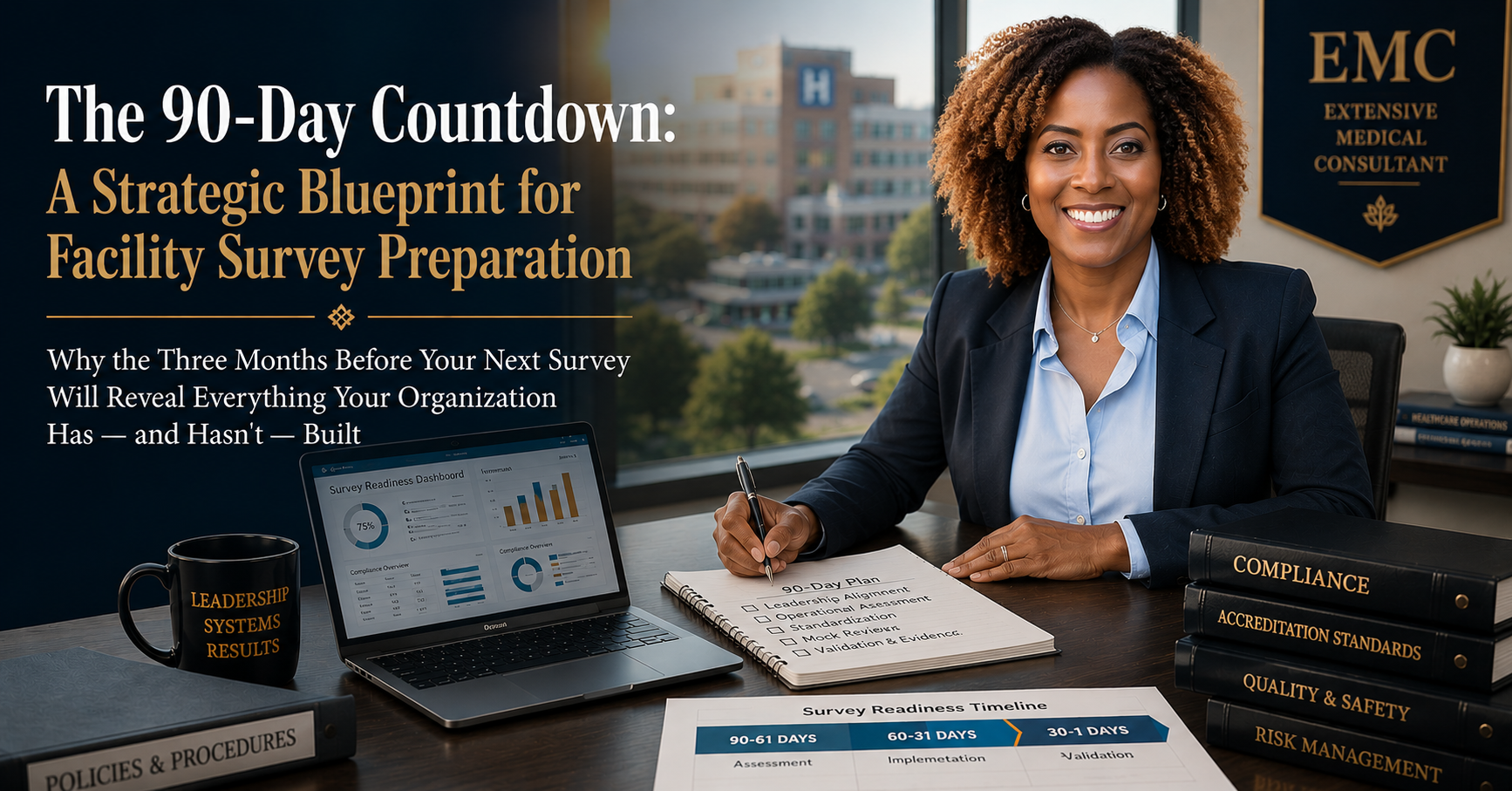
A 90-day executive blueprint for accreditation survey readiness. Learn how healthcare leaders build sustainable systems, not last-minute checklists.

Dr. Scarlett Lusk shares 6 leadership lessons from 27 years in the U.S. Public Health Service — and how military-grade discipline transforms civilian healthcare operations.
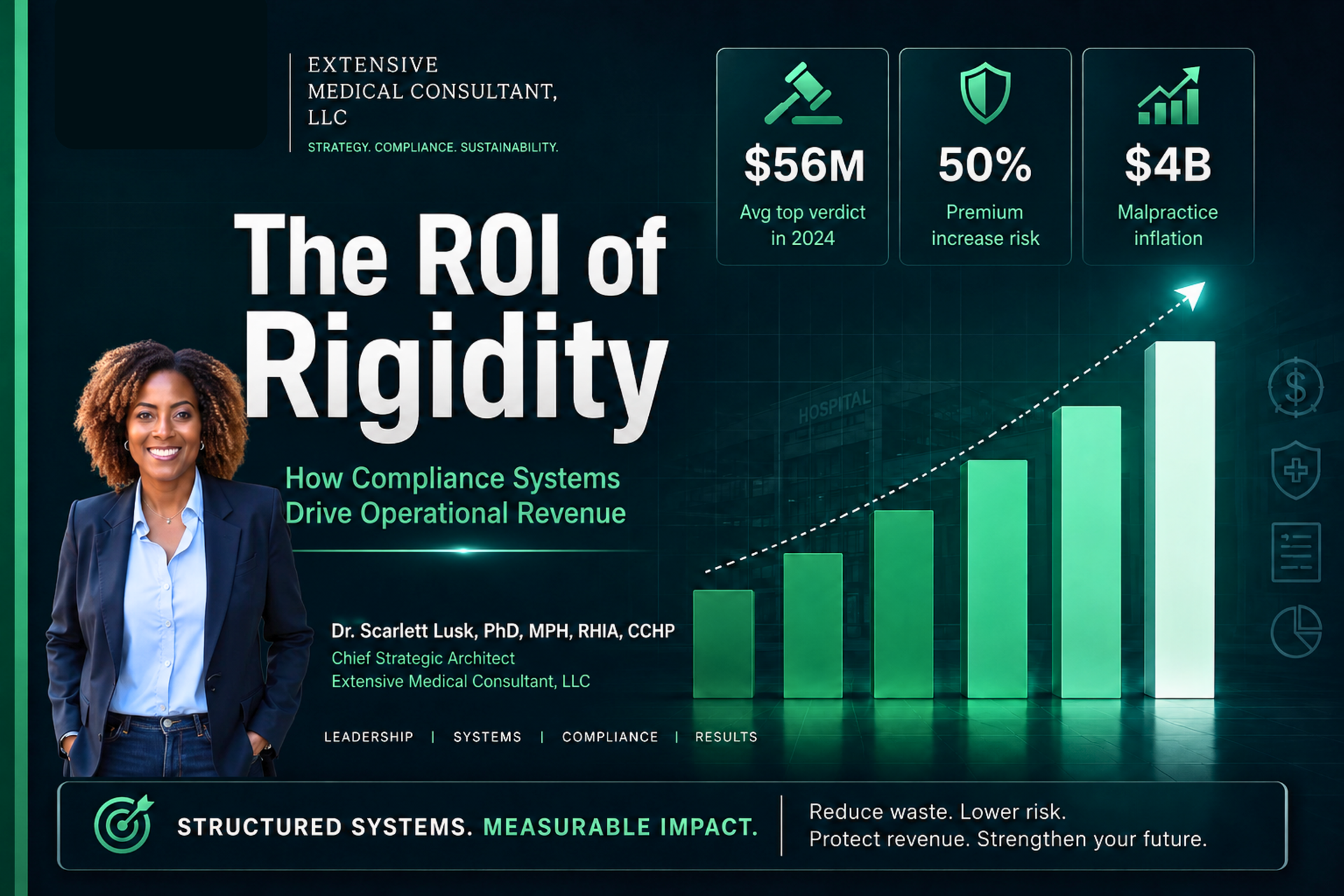
Learn how structured healthcare compliance systems reduce waste, lower litigation risk, and compress insurance premiums — generating measurable financial returns for CFOs and CEOs. Expert insight from Dr. Scarlett Lusk, Extensive Medical Consultant, LLC.

Discover how healthcare organizations can move beyond reactive accreditation preparation and build sustainable compliance systems for NCCHC, ACA, and AAAHC readiness with EMC and Dr. Scarlett Lusk.

Tribal knowledge in healthcare is your most dangerous compliance vulnerability. Discover how person-dependent systems create accreditation risk and how EMC builds the documentation frameworks that eliminate it.

Healthcare leadership burnout is a systems problem, not a personal one. Discover how EMC helps healthcare executives reduce operational pressure through compliance systems, workflow optimization, and leadership frameworks.

Failing accreditation costs more than a citation. Discover the true financial, reputational, and operational consequences — and how EMC helps you prevent them.
The 2026 NCCHC Mental Health Standards are now in effect. Discover what changed, what your facility must implement, and how EMC supports correctional healthcare leaders through the transition.
Discover the hidden operational gaps — "silent zones" — that drive compliance failures in ambulatory and correctional healthcare. Expert insight from Dr. Scarlett Lusk, EMC.
Poor clinical documentation creates legal vulnerability even when care was correct. Learn how EMC builds systemic documentation frameworks that protect your organization.
A 90-day executive blueprint for accreditation survey readiness. Learn how healthcare leaders build sustainable systems, not last-minute checklists.
Dr. Scarlett Lusk shares 6 leadership lessons from 27 years in the U.S. Public Health Service — and how military-grade discipline transforms civilian healthcare operations.
Learn how structured healthcare compliance systems reduce waste, lower litigation risk, and compress insurance premiums — generating measurable financial returns for CFOs and CEOs. Expert insight from Dr. Scarlett Lusk, Extensive Medical Consultant, LLC.
Discover how healthcare organizations can move beyond reactive accreditation preparation and build sustainable compliance systems for NCCHC, ACA, and AAAHC readiness with EMC and Dr. Scarlett Lusk.
Tribal knowledge in healthcare is your most dangerous compliance vulnerability. Discover how person-dependent systems create accreditation risk and how EMC builds the documentation frameworks that eliminate it.
Healthcare leadership burnout is a systems problem, not a personal one. Discover how EMC helps healthcare executives reduce operational pressure through compliance systems, workflow optimization, and leadership frameworks.
Failing accreditation costs more than a citation. Discover the true financial, reputational, and operational consequences — and how EMC helps you prevent them.
