Adaptive Leadership in Healthcare: Lessons from Pandemic to Present

The COVID-19 pandemic reshaped healthcare in ways no one could have anticipated. Beyond the immediate challenges of patient care, healthcare leaders were confronted with the urgent need to rethink systems, inspire resilience, and guide their teams through uncertainty. The concept of adaptive leadership emerged not just as a management theory, but as a lifeline for clinics, hospitals, and providers striving to survive and evolve.


At Extensive Medical Consultant (EMC), Dr. Scarlett Lusk has witnessed firsthand how adaptive leadership can transform healthcare organizations from within. With her extensive experience mentoring clinic leaders, Dr. Lusk has become a trusted voice on how to build teams that thrive under pressure, embrace change, and put patients first.


What is Adaptive Leadership in Healthcare?


Adaptive leadership is the ability to pivot with purpose, guiding teams and systems through unpredictable challenges. Unlike traditional leadership models that rely on rigid structures, adaptive leadership focuses on:

  • Recognizing and responding to change in real time

  • Building resilience in both leaders and teams

  • Empowering individuals to innovate within their roles

  • Aligning daily operations with long-term vision

In healthcare, where compliance requirements, patient safety, and community trust are non-negotiable, adaptive leadership is not optional; it is essential.


Lessons Learned: From Pandemic to Present


The healthcare industry faced a profound test during the pandemic. As clinics and hospitals struggled with supply shortages, overwhelmed staff, and rapidly changing regulations, leaders had to adapt quickly. Dr. Lusk emphasizes three critical lessons from this period that remain vital today:


1. Communication is Leadership


During the height of the pandemic, clear, transparent communication became the difference between chaos and coordination. Leaders who could articulate evolving guidelines, while also providing emotional reassurance, earned the trust of both staff and patients. Today, that standard must remain. Strong leaders prioritize communication not as a task, but as the cornerstone of organizational culture.


2. Resilience Must Be Cultivated


Healthcare teams were pushed to their limits, and burnout became a crisis in itself. Dr. Lusk notes that resilience is not an innate trait; it is cultivated through leadership that balances accountability with compassion. Leaders who normalize rest, provide emotional support, and encourage adaptability build stronger, longer-lasting teams.


3. Innovation is a Necessity, Not a Luxury


From telemedicine adoption to new infection control protocols, innovation moved at record speed during the pandemic. Adaptive leaders embraced change rather than resisted it. Today, the challenge is to maintain that spirit of innovation. Whether in patient engagement, compliance readiness, or care delivery, innovation keeps clinics relevant and sustainable.


The Role of Extensive Medical Consultant and Dr. Scarlett Lusk


At Extensive Medical Consultant, Dr. Scarlett Lusk mentors healthcare leaders in applying adaptive leadership principles to real-world challenges. Her approach combines decades of clinical expertise, compliance knowledge, and hands-on consulting to guide organizations through:


  • Accreditation readiness and compliance strategy

  • Staff training and culture-building

  • Patient-centered leadership practices

  • Long-term resilience planning

What sets Dr. Lusk apart is her belief that healthcare leadership is not about titles; it is about trust, adaptability, and compassion. By walking alongside clinic leaders, she helps them design systems that meet regulatory demands while fostering environments where both patients and staff feel supported.


Why Adaptive Leadership Matters Now


As the healthcare landscape continues to shift, whether through new accreditation standards, technological disruptions, or workforce shortages, leaders must remain agile. Clinics that cling to outdated management styles risk falling behind in compliance, patient trust, and staff retention.


Adaptive leadership ensures that healthcare organizations are not just reacting to change, but shaping their own future. By blending strategic foresight with day-to-day empathy, leaders can turn challenges into opportunities for growth.


Building a Culture of Trust and Transformation


Dr. Lusk emphasizes that adaptive leadership is about more than survival; it is about building cultures of trust, accountability, and innovation. When leaders model adaptability, their teams follow. When clinics invest in resilience, patients benefit. And when leadership aligns compliance with compassion, healthcare transforms from a system of rules into a community of healing.


Conclusion: The Future of Healthcare Leadership


The pandemic was a test that revealed both the vulnerabilities and the strengths of healthcare systems worldwide. The lessons learned must not fade. Adaptive leadership is the pathway forward, one that equips healthcare leaders to meet tomorrow’s challenges with confidence.


Dr. Scarlett Lusk and the team at Extensive Medical Consultant are dedicated to helping clinics not only prepare for accreditation but also build leadership cultures that endure. From pandemic lessons to present realities, EMC continues to stand as a partner in resilience, compliance, and compassionate leadership.


Is your clinic ready to lead through change, not just survive it? Partner with
Dr. Scarlett Lusk and Extensive Medical Consultant to strengthen leadership, build resilience, and future-proof your healthcare organization.



Black shapes with a white diagonal stripe on a white background.

Have a question?

We’re here to help. Send us a message or give us a call today

346-564-1335
hidden compliance risks ambulatory correctional healthcare
By Scarlett Lusk August 19, 2026
Discover the hidden operational gaps — "silent zones" — that drive compliance failures in ambulatory and correctional healthcare. Expert insight from Dr. Scarlett Lusk, EMC.
By Scarlett Lusk August 9, 2026
Poor clinical documentation creates legal vulnerability even when care was correct. Learn how EMC builds systemic documentation frameworks that protect your organization.
By Scarlett Lusk June 30, 2026
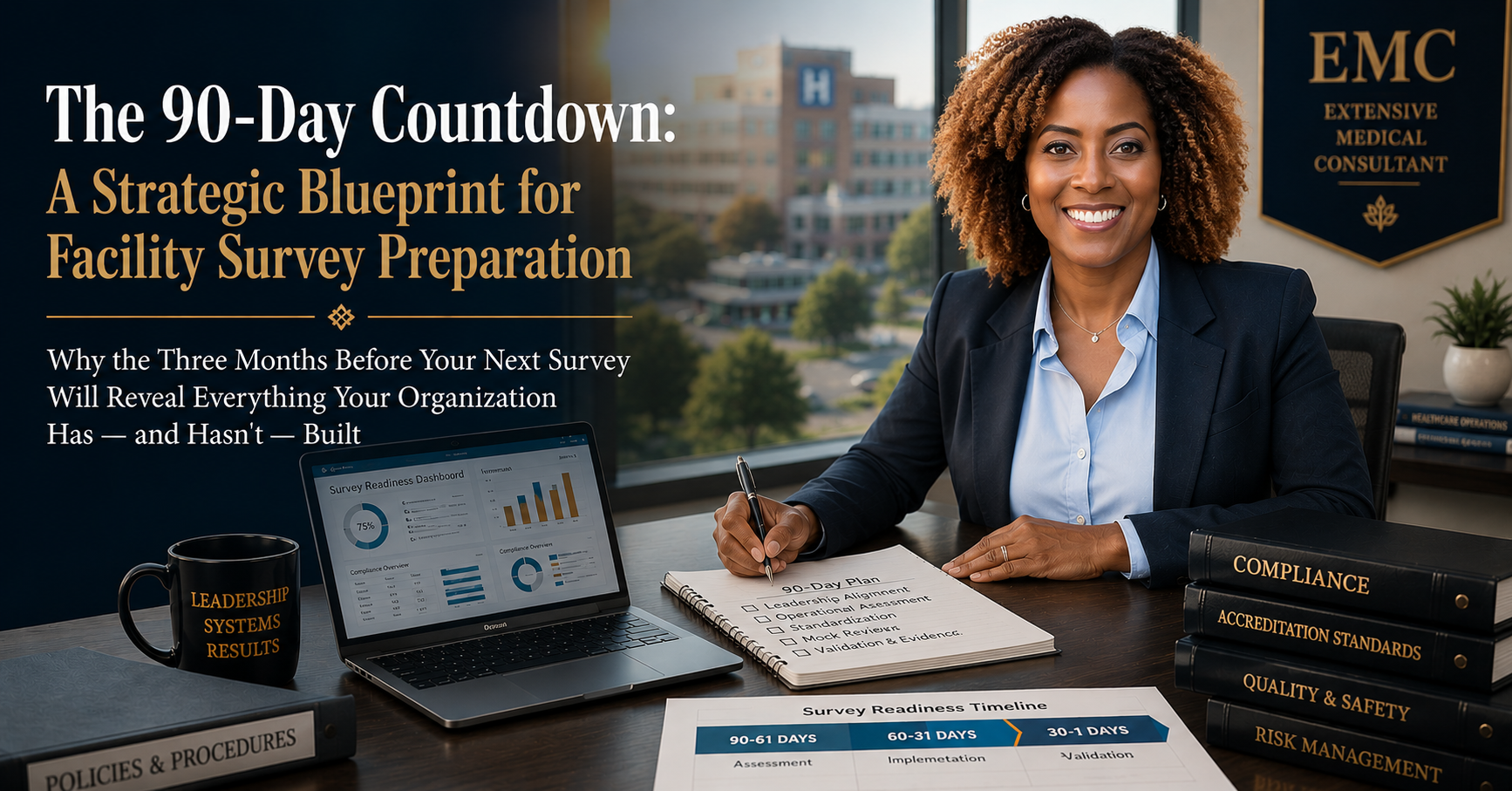
A 90-day executive blueprint for accreditation survey readiness. Learn how healthcare leaders build sustainable systems, not last-minute checklists.
Leadership Under Pressure: Lessons from 27 Years in the U.S. Public Health Service
By Scarlett Lusk May 29, 2026
Dr. Scarlett Lusk shares 6 leadership lessons from 27 years in the U.S. Public Health Service — and how military-grade discipline transforms civilian healthcare operations.
Healthcare compliance consultant reviewing financial performance dashboard — EMC, Houston TX
By Scarlett Lusk May 18, 2026
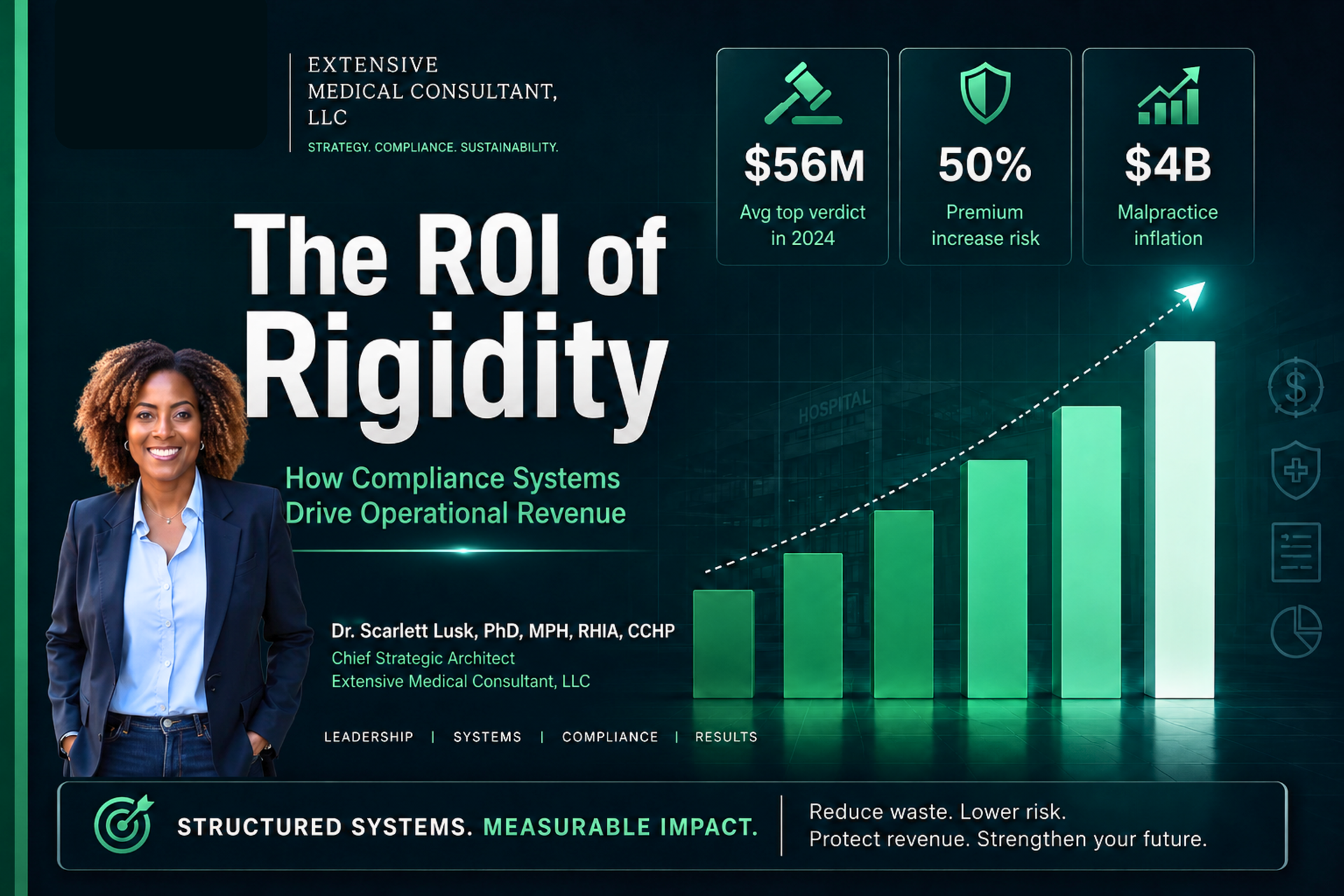
Learn how structured healthcare compliance systems reduce waste, lower litigation risk, and compress insurance premiums — generating measurable financial returns for CFOs and CEOs. Expert insight from Dr. Scarlett Lusk, Extensive Medical Consultant, LLC.
Beyond the Checklist: Continuous Accreditation Readiness for NCCHC, ACA & AAAHC | EMC
By Scarlett Lusk May 13, 2026
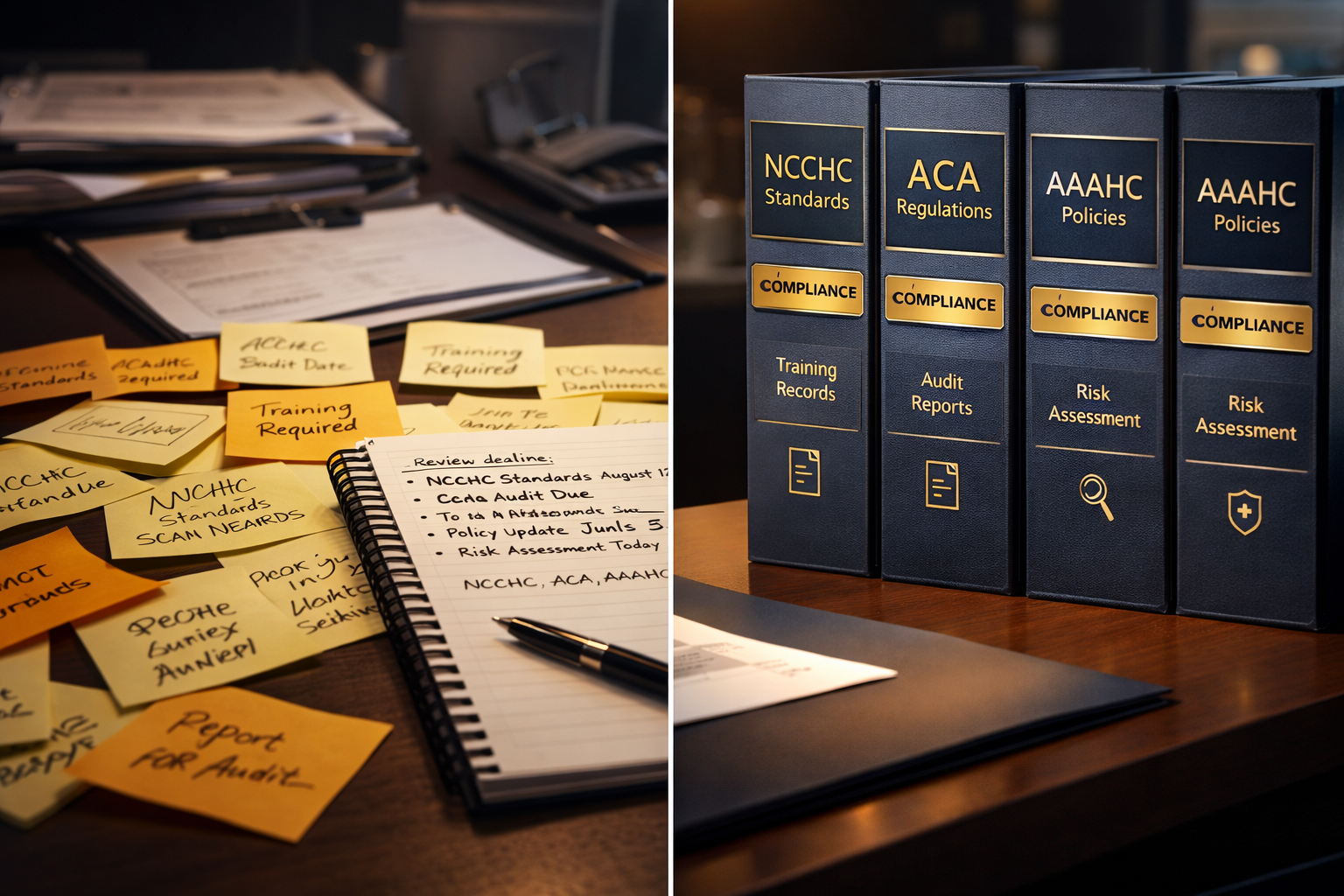
Discover how healthcare organizations can move beyond reactive accreditation preparation and build sustainable compliance systems for NCCHC, ACA, and AAAHC readiness with EMC and Dr. Scarlett Lusk.
The
By Scarlett Lusk April 21, 2026
Tribal knowledge in healthcare is your most dangerous compliance vulnerability. Discover how person-dependent systems create accreditation risk and how EMC builds the documentation frameworks that eliminate it.
By Scarlett Lusk April 11, 2026
Healthcare leadership burnout is a systems problem, not a personal one. Discover how EMC helps healthcare executives reduce operational pressure through compliance systems, workflow optimization, and leadership frameworks.
Healthcare accreditation consulting by Dr. Scarlett Lusk — compliance and audit readiness expert.
March 23, 2026
Failing accreditation costs more than a citation. Discover the true financial, reputational, and operational consequences — and how EMC helps you prevent them.
By Scarlett Lusk March 13, 2026
Modern healthcare organizations operate in an increasingly complex environment. Regulatory requirements evolve, accreditation standards tighten, and operational demands continue to grow. While internal teams work tirelessly to maintain quality care and efficient operations, many clinics eventually encounter challenges that require a fresh perspective. This is where external consulting expertise becomes valuable. Healthcare consultants are not replacements for internal leadership; they are strategic partners who help organizations strengthen systems, identify risks, and navigate complex compliance landscapes. Through structured guidance and objective analysis, consulting support can help clinics move from reactive problem-solving to proactive operational stability. Under the leadership of Dr. Scarlett Lusk, Extensive Medical Consultant works with healthcare organizations to provide that clarity, structure, and expertise. Why Internal Teams Often Miss Critical Blind Spots Healthcare professionals and administrators are deeply committed to their organizations. However, being closely involved in daily operations can sometimes make it difficult to recognize systemic issues. Internal teams often focus on immediate operational demands: Patient care coordination Staffing challenges Documentation management Regulatory compliance requirements Over time, these responsibilities can create operational “blind spots.” Processes that once worked well may become outdated, inefficient, or misaligned with current compliance expectations. Because internal teams are immersed in daily workflows, they may not always see the structural gaps forming beneath the surface. External consultants provide something essential: objective distance. They can analyze operations without the constraints of internal routines, allowing them to identify hidden inefficiencies, compliance vulnerabilities, and workflow breakdowns that might otherwise go unnoticed. The Value of Objective Leadership Support Healthcare leadership carries significant responsibility. Administrators and clinical leaders must balance patient care, regulatory compliance, operational efficiency, and staff wellbeing—all at the same time. In such high-pressure environments, objective leadership support becomes extremely valuable. External consultants serve as strategic advisors who help leaders: Evaluate operational structures Strengthen compliance frameworks Prepare for accreditation reviews Implement sustainable workflow improvements This type of guidance allows healthcare leaders to make informed decisions based on data, regulatory insight, and industry best practices. Rather than reacting to problems after they occur, organizations can build systems designed to prevent them. When Clinics Should Consider Bringing in Consultants Many clinics assume consulting support is only necessary during a crisis. In reality, the most effective consulting relationships begin before problems escalate. Healthcare organizations often benefit from external expertise during key moments of growth or transition, including: 1. Preparing for Accreditation or Regulatory Surveys Accreditation readiness requires careful preparation. Consultants help ensure policies, documentation, and operational workflows meet regulatory expectations before surveyors arrive. 2. Rapid Organizational Growth As clinics expand, operational structures must evolve. Growth often exposes inefficiencies or compliance gaps that were not visible at smaller scales. 3. Operational Workflow Challenges When teams experience recurring inefficiencies, communication breakdowns, or documentation issues, consulting support can help redesign workflows for greater clarity and efficiency. 4. Leadership Transitions New leadership often benefits from an external operational assessment to understand existing systems and identify areas for improvement. By bringing in consultants at these moments, clinics can proactively address structural issues rather than waiting for them to surface during audits or inspections. EMC’s Tailored Consulting Approach At Extensive Medical Consultant, consulting is not based on one-size-fits-all solutions. Every healthcare organization has unique operational structures, leadership styles, and regulatory challenges. That is why EMC focuses on tailored consulting strategies designed around each client’s specific needs. Guided by the extensive leadership experience of Dr. Scarlett Lusk, EMC provides consulting services that help healthcare organizations strengthen operational foundations while maintaining focus on patient care. The consulting approach emphasizes four key areas: Accreditation Preparation Healthcare organizations receive structured guidance to prepare for accreditation surveys with confidence. Compliance System Development EMC helps clinics design compliance systems that align with regulatory standards and support long-term operational stability. Workflow Optimization Operational workflows are evaluated and redesigned to improve efficiency, communication, and documentation processes. Leadership Support Healthcare executives receive strategic guidance to help them make informed decisions about organizational growth, risk management, and operational improvement. Through this structured and collaborative approach, EMC helps healthcare organizations move beyond temporary fixes and build sustainable systems that support long-term success. Building Stronger Healthcare Systems The healthcare environment will continue to evolve. Regulatory expectations will change, patient demands will grow, and operational complexity will increase. Organizations that thrive in this environment are those that prioritize strong systems, clear structures, and proactive leadership strategies. External consulting support plays an important role in helping healthcare leaders achieve these goals. By identifying blind spots, strengthening compliance frameworks, and optimizing workflows, consultants provide the strategic insight organizations need to operate confidently. With experienced leadership and a commitment to operational excellence, Extensive Medical Consultant continues to support healthcare organizations in building the systems that make sustainable success possible. Need guidance navigating accreditation, compliance, or operational challenges? Connect with Extensive Medical Consultant today to learn how expert consulting support can help strengthen your healthcare organization’s future.
More Posts
hidden compliance risks ambulatory correctional healthcare
By Scarlett Lusk August 19, 2026
Discover the hidden operational gaps — "silent zones" — that drive compliance failures in ambulatory and correctional healthcare. Expert insight from Dr. Scarlett Lusk, EMC.
By Scarlett Lusk August 9, 2026
Poor clinical documentation creates legal vulnerability even when care was correct. Learn how EMC builds systemic documentation frameworks that protect your organization.
By Scarlett Lusk June 30, 2026
A 90-day executive blueprint for accreditation survey readiness. Learn how healthcare leaders build sustainable systems, not last-minute checklists.
Leadership Under Pressure: Lessons from 27 Years in the U.S. Public Health Service
By Scarlett Lusk May 29, 2026
Dr. Scarlett Lusk shares 6 leadership lessons from 27 years in the U.S. Public Health Service — and how military-grade discipline transforms civilian healthcare operations.
Healthcare compliance consultant reviewing financial performance dashboard — EMC, Houston TX
By Scarlett Lusk May 18, 2026
Learn how structured healthcare compliance systems reduce waste, lower litigation risk, and compress insurance premiums — generating measurable financial returns for CFOs and CEOs. Expert insight from Dr. Scarlett Lusk, Extensive Medical Consultant, LLC.
Beyond the Checklist: Continuous Accreditation Readiness for NCCHC, ACA & AAAHC | EMC
By Scarlett Lusk May 13, 2026
Discover how healthcare organizations can move beyond reactive accreditation preparation and build sustainable compliance systems for NCCHC, ACA, and AAAHC readiness with EMC and Dr. Scarlett Lusk.
The
By Scarlett Lusk April 21, 2026
Tribal knowledge in healthcare is your most dangerous compliance vulnerability. Discover how person-dependent systems create accreditation risk and how EMC builds the documentation frameworks that eliminate it.
By Scarlett Lusk April 11, 2026
Healthcare leadership burnout is a systems problem, not a personal one. Discover how EMC helps healthcare executives reduce operational pressure through compliance systems, workflow optimization, and leadership frameworks.
Healthcare accreditation consulting by Dr. Scarlett Lusk — compliance and audit readiness expert.
March 23, 2026
Failing accreditation costs more than a citation. Discover the true financial, reputational, and operational consequences — and how EMC helps you prevent them.
By Scarlett Lusk March 13, 2026
Modern healthcare organizations operate in an increasingly complex environment. Regulatory requirements evolve, accreditation standards tighten, and operational demands continue to grow. While internal teams work tirelessly to maintain quality care and efficient operations, many clinics eventually encounter challenges that require a fresh perspective. This is where external consulting expertise becomes valuable. Healthcare consultants are not replacements for internal leadership; they are strategic partners who help organizations strengthen systems, identify risks, and navigate complex compliance landscapes. Through structured guidance and objective analysis, consulting support can help clinics move from reactive problem-solving to proactive operational stability. Under the leadership of Dr. Scarlett Lusk, Extensive Medical Consultant works with healthcare organizations to provide that clarity, structure, and expertise. Why Internal Teams Often Miss Critical Blind Spots Healthcare professionals and administrators are deeply committed to their organizations. However, being closely involved in daily operations can sometimes make it difficult to recognize systemic issues. Internal teams often focus on immediate operational demands: Patient care coordination Staffing challenges Documentation management Regulatory compliance requirements Over time, these responsibilities can create operational “blind spots.” Processes that once worked well may become outdated, inefficient, or misaligned with current compliance expectations. Because internal teams are immersed in daily workflows, they may not always see the structural gaps forming beneath the surface. External consultants provide something essential: objective distance. They can analyze operations without the constraints of internal routines, allowing them to identify hidden inefficiencies, compliance vulnerabilities, and workflow breakdowns that might otherwise go unnoticed. The Value of Objective Leadership Support Healthcare leadership carries significant responsibility. Administrators and clinical leaders must balance patient care, regulatory compliance, operational efficiency, and staff wellbeing—all at the same time. In such high-pressure environments, objective leadership support becomes extremely valuable. External consultants serve as strategic advisors who help leaders: Evaluate operational structures Strengthen compliance frameworks Prepare for accreditation reviews Implement sustainable workflow improvements This type of guidance allows healthcare leaders to make informed decisions based on data, regulatory insight, and industry best practices. Rather than reacting to problems after they occur, organizations can build systems designed to prevent them. When Clinics Should Consider Bringing in Consultants Many clinics assume consulting support is only necessary during a crisis. In reality, the most effective consulting relationships begin before problems escalate. Healthcare organizations often benefit from external expertise during key moments of growth or transition, including: 1. Preparing for Accreditation or Regulatory Surveys Accreditation readiness requires careful preparation. Consultants help ensure policies, documentation, and operational workflows meet regulatory expectations before surveyors arrive. 2. Rapid Organizational Growth As clinics expand, operational structures must evolve. Growth often exposes inefficiencies or compliance gaps that were not visible at smaller scales. 3. Operational Workflow Challenges When teams experience recurring inefficiencies, communication breakdowns, or documentation issues, consulting support can help redesign workflows for greater clarity and efficiency. 4. Leadership Transitions New leadership often benefits from an external operational assessment to understand existing systems and identify areas for improvement. By bringing in consultants at these moments, clinics can proactively address structural issues rather than waiting for them to surface during audits or inspections. EMC’s Tailored Consulting Approach At Extensive Medical Consultant, consulting is not based on one-size-fits-all solutions. Every healthcare organization has unique operational structures, leadership styles, and regulatory challenges. That is why EMC focuses on tailored consulting strategies designed around each client’s specific needs. Guided by the extensive leadership experience of Dr. Scarlett Lusk, EMC provides consulting services that help healthcare organizations strengthen operational foundations while maintaining focus on patient care. The consulting approach emphasizes four key areas: Accreditation Preparation Healthcare organizations receive structured guidance to prepare for accreditation surveys with confidence. Compliance System Development EMC helps clinics design compliance systems that align with regulatory standards and support long-term operational stability. Workflow Optimization Operational workflows are evaluated and redesigned to improve efficiency, communication, and documentation processes. Leadership Support Healthcare executives receive strategic guidance to help them make informed decisions about organizational growth, risk management, and operational improvement. Through this structured and collaborative approach, EMC helps healthcare organizations move beyond temporary fixes and build sustainable systems that support long-term success. Building Stronger Healthcare Systems The healthcare environment will continue to evolve. Regulatory expectations will change, patient demands will grow, and operational complexity will increase. Organizations that thrive in this environment are those that prioritize strong systems, clear structures, and proactive leadership strategies. External consulting support plays an important role in helping healthcare leaders achieve these goals. By identifying blind spots, strengthening compliance frameworks, and optimizing workflows, consultants provide the strategic insight organizations need to operate confidently. With experienced leadership and a commitment to operational excellence, Extensive Medical Consultant continues to support healthcare organizations in building the systems that make sustainable success possible. Need guidance navigating accreditation, compliance, or operational challenges? Connect with Extensive Medical Consultant today to learn how expert consulting support can help strengthen your healthcare organization’s future.